Friday, December 31, 9999
Saturday, May 03, 2008
It's Journal Time!
Out here on the island, there is a long standing tradition of recording all of our daily activities in the Farallon Island Journal. After our scrumptious dinner, we sit down to write in the journals and shout out whatever we have to add. PRBO biologists and interns have done this every day since June 7, 1967. At the end of the year the Journal is bound and becomes part of the island archives. This gives us the opportunity to look back at any given day and see who was here, what was happening on the island, or what birds were present.
Seabird Biologist and two interns complete the daily activity of journal entry.
There are a total of three journals which comprise the official Farallon Island Journal:The first journal contains everything of relevance that happened that day, including weather, rare animal sightings, and common activities. This journal is very helpful if you are wondering about some event that occurred on one particular day. For instance, on April 7, 1999, there was a very interesting boat landing, and by interesting, I mean horrible. Here is a taste of that fateful day, “Near the entrance to the cove, Kelly gave the motor some gas and it flew off the back of the boat. The motor had been tightened down in the morning and there was a rope tying the motor to the boat. So we focused on rowing away from the cove thinking the motor was attached to the boat. But alas, the rope had broken and the motor had fallen into the abyss.” Everything that occurred in one given day is recorded and kept for future use. We also use this journal to keep track of who was on the island or who visited the island.
The second journal includes many different topics, from breeding birds to maintenance, butterflies to boats, or unusual events to dinner, not saying that the two are at all related. It has also become a tradition to record the dreams of island inhabitants if their dreams are related to the island, take place on the island, or if they involve some sort of dream bird. This tradition has been going on for seven or eight years, and that is a lot of time for a lot of people to have some pretty interesting dreams. Some dreams seem to be stress related, “Annie dreamt that the island vegetation was at least waist high and growing fast. She was worried that we would not be able to find our way around the island or locate study plots”. While others are just absurd, “Russ had a dream that wherever he went, jungle, city, Movie Theater, there were Murres milling about in large numbers being counted. Not just Russ was doing the counting either. Little old ladies were leaning out their apartment windows with clickers along with the rest of the populace”.
The last journal pertains to rare, non-breeding, live birds seen on the island. This journal contains a list (including # of individuals) of birds that have been seen on the Farallones this year. We get a variety of migratory birds, such as grebes, tubenoses, geese, falcons, shorebirds, kingfishers, kinglets, warblers, and sparrows. Sometimes we get large waves of land birds, such as Ruby Crowned Kinglets or Audubon Warblers, after strong winds. Occasionally, other uncommon species are seen in small numbers, such as Belted Kingfishers, a Eurasian Collared Dove, a Saw-whet Owl and Brown Boobies. In the beginning of the seabird season, daily shorebird walks provide the opportunity to survey particular areas of the island where non-breeding species often migrate to later in the season. Though breeding birds currently prevent us from doing the shorebird walk, we keep our eyes open and identify any other species we encounter during the day.
A Saw-whet Owl perched in the Monterey Cypress next to the PRBO house.
Thursday, April 10, 2008
The Importance of Individuals
Common Murres with
their individual color bands.
For Cassin’s Auklet, observations are more complex. This species breeds in burrows, as opposed to nests above ground. In order to collect data on the breeding success of these birds, we have specially constructed nest boxes which can be opened at the top, allowing the researcher to see the bird with minimal disturbance to itself or its ‘burrow’. Due to efforts in previous years, the age of some of these auklets (identified by a numbered metal band) are known. Age specific data is rare and difficult to come by in many sea-going bird species which makes the information collected on these individuals unique and valuable.
Thursday, March 13, 2008
Jewel Cave Revealed
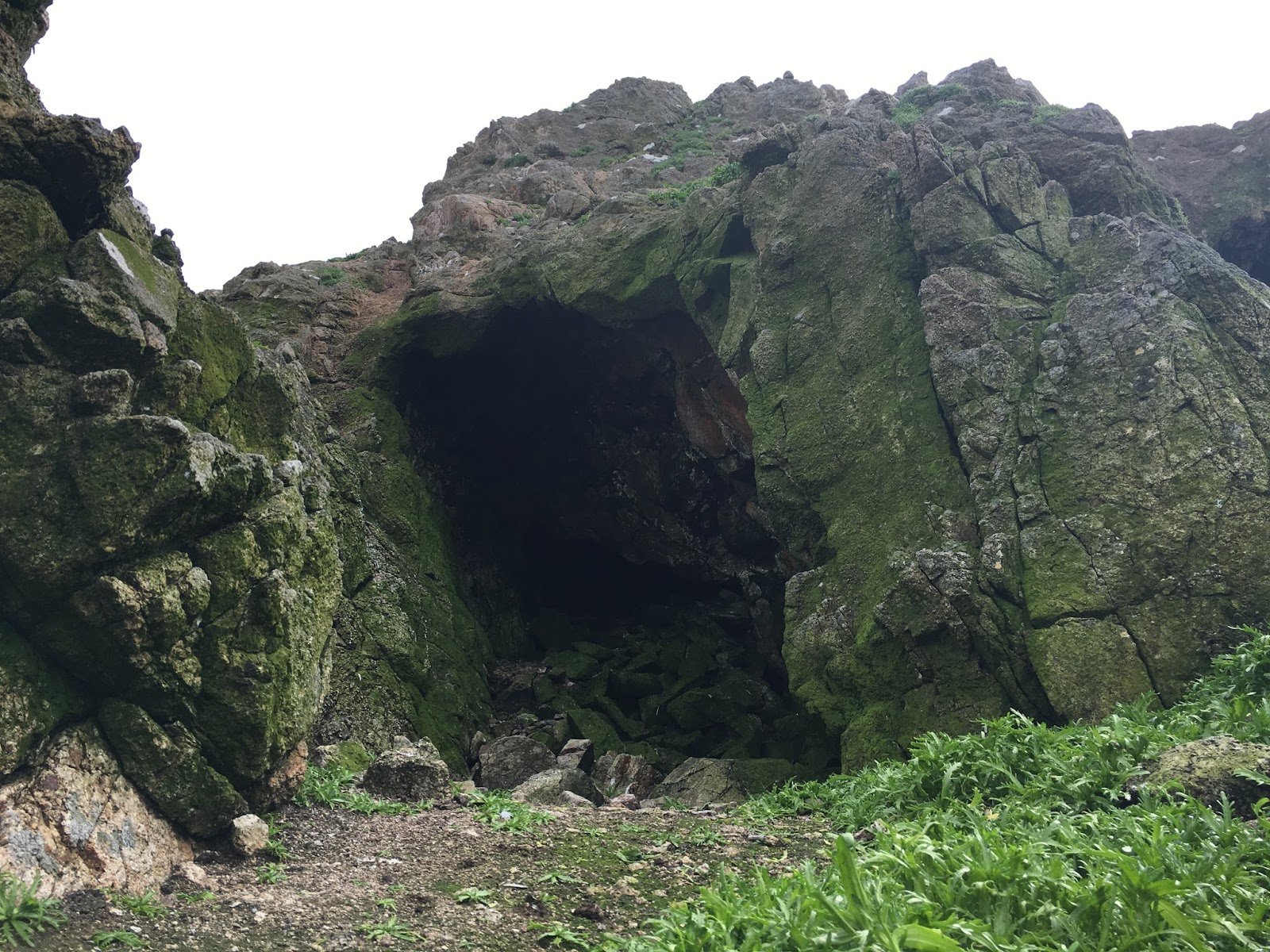
With ocean swells constantly pounding the island day and night, all year long, the intertidal zone on the Farallones is a harsh environment indeed. Nonetheless, a variety of tenacious plants and animals survive in this zone, and they are revealed during low tides. Only then can we observe the temporary pools left behind by the receeding waters on calm days. The stunning beauty of the tidepools is captured in names like "Jewel Cave" and "Pastel Cave."
Neon orange sponges, fuschia algaes, electric green anemones, and vivid purple sea urchins are part of the mindbogglingly colorful palette typically hidden deeper underwater. Pisasters patrol the pools feeding on mussels, and delicate hydroids filter plankton.
Monday, March 10, 2008
Spring wildflowers on SEFI
Early spring is perhaps the most beautiful time of the year on Southeast Farallon Island as wildflowers burst into bloom, carpeting the island with lovely colors and sweet smells. The most abundant wildflower species here is the maritime goldfields (also known as Farallon weed) which covers a majority of the island. From the marine terrace to the top of Lighthouse Hill, the maritime goldfields form a thick carpet of vivid green and yellow. Purple and white sticky sand spurry blooms on rocky outcrops.Friday, March 07, 2008
Superweaner!
Once an elephant seal cow is done nursing her pup, she mates with one or more of the dominant males and heads back out to sea, leaving her pup behind. The weaned pups live off their blubber, sleeping and playing with each other for a few months before venturing into the water for the first time to find food.
Some pups are able to suckle successfully from two females. Sometimes a cow will share her pup with another cow, or a weaned pup is adopted by a foster mother after the real mom has departed. Usually the foster mother has lost her own pup. These shared pups are called "superweaners" or "double mother suckers," and they typically grow much fatter than other pups. We had three superweaners in our Mirounga Beach colony this year, all males.


Tuesday, February 19, 2008
Weaner Patrol
During the winter, pregnant female northern elephant seals travel upwards of a thousand miles from their deep-ocean foraging waters to breeding beaches at SEFI and other colonies along the coast of California and Mexico. Here, the cows will give birth and nurse their pups, fasting the entire time they are on land.


After the cows have nursed their pups for 3 to 4 weeks, their energy resources and stored fat are depleted, transferred to their pups who will usually triple their birth weight. Elephant seal milk is extremely rich, with some of the highest fat content of any mammal's milk.
When a cow has transferred her fat reserves to her pup, she is ready to leave. Before she departs, each cow mates with one or more of the big adult males, who have been awaiting this moment for weeks. To us, the males seem to form an obstacle course through which a cow must navigate on her way back out to sea. Some sneaky guys will even lurk in the water waiting for a final chance to mate with cows before they reach the deep water. We've seen cows copulating with 3 different males, but they have little choice, since the males are 2 to 3 times larger than the cows. Below, the bull Gimli mates with a cow while her pup looks on. You can see the battle wounds from a recent fight, when Bedlam Boy took a large bite out of Gimli's nose (see previous blog posting).
When the cow departs, she leaves behind her weaned pup, called a "weaner." On SEFI, the number of weaners surpassed the number of pups on February 16. Now, PRBO biologists are on weaner patrol, heading to the beaches each morning to see which cows have departed and to record the sex and size of their weaners. We also give each weaner a small plastic flipper tag so we can permanently identify the individual. Some day, if the animal survives, it may return to SEFI to breed as an adult, and the flipper tag will allow us to know its age, birthplace, and mother. 

Friday, February 01, 2008
Bedlam Boy defeats Gimli

Another big battle today, as Bedlam Boy defeated Gimli by driving him off the Marine Terrace harem. These fights are how the elephant seals determine whose genes are the best, and who earns the right to copulate with the harem of females. Harem-based mating is called polygyny and often results in the most bizarre male appearance and behaviors in the animal world through a process called sexual selection.


Click here to see a video of this contest.
Sunday, January 20, 2008
Today in Farallon History
Today is 'Elephant Seal Day' on the Farallones. We celebrate this day to remember January 20, 1972: the birthday of the first elephant seal pup born on the Farallones after over 100 years of absence.
PRBO biologists have been observing the Farallon Islands from our field station on Farallon National Wildlife Refuge since June 7, 1967. Every evening, the biologists write a journal of all the noteworthy happenings on the islands, including the birds, marine mammals, and facilities. Here are a few gleanings from this day in Farallon Journal History.
2008
PRBO folks on the Island: Lee, Bond, Bogle, Chinn.
Southeast Farallon Island Elephant seal scorecard:
Sand Flat = 65 cows, 38 pups, 2 weaners, Salvatore is alpha bull.
Mirounga Beach = 19 cows, 13 pups, Rusty is alpha bull.
Marine Terrace Sand Flat = 14 cows and 12 pups, Bedlam Boy alpha.
Marine Terrace Mirounga Beach = 2 cows, 2 pups, Don Quixote alpha.
Huge fight between the two highest ranking bulls, Salvatore and Rusty, left Upper Mirounga Beach bloodstained, both bulls battered, and no change in dominance or harem control.
On this day in 1972
- PRBO staff on the island was: Lewis.
- First elephant seal pup born on SEFI since the species was extirpated and presumed extinct in late 1800s. Female pup was tagged Pink 1.
- Total number of elephant seals on Farallones = 2.
Also noteworthy events from 1972
- Nixon president of the US, Salvador Allende president of Chile.
- “Streets of San Francisco” TV show premieres.
- Transamerica pyramid building completed in downtown San Francisco.
30 years ago today- 1978
- PRBO staff on the island was: Huber, Morrell, Nisbet, Peaslee, Peterson, Potash, and Rovetta.
- A 20’ white shark killed and ate a cow-sized elephant seal off Sea Pigeon Gulch.
- Stormy weather created a waterspout in Mirounga Bay, and large swells washed across Sand Flat taking 1 pup out to sea.
- Sand Flat e-seal numbers = 71 cows, 43 pups, 1 weaner, Dimple is alpha bull.
Other noteworthy local events from 1978
- Dianne Feinstein, president of the San Francisco Board of Supervisors, announces that former Board of Supervisors member Dan White had murdered Mayor George Moscone and Supervisor Harvey Milk at City Hall in San Francisco. "Twinkie defense" gets White's conviction down to manslaughter.
- Johnnie Rotton quits Sex Pistols after final show of US tour at Winterland Ballroom, San Francisco.
20 years ago today- 1988
- PRBO staff on the island was: Calder, Emslie, Ferone, Lerdau, Montgomery, and Sydeman.
- Storm winds tore hundreds of shingles off the roof and blew out a window of the Salamander house. Fresh water supply tested, found to be turbid and E. coli contaminated. Boom won’t raise/lower at east landing.
- SEFI e-seal numbers = 93 cows, 43 pups. Pilgrim alpha bull at Sand Flat and Sherlock alpha at Mirounga Beach.
Other noteworthy local events from 1988
- Mandatory rationing of water for 2.1 million residents of the San Francisco area after two consecutive dry winters and a failure of voluntary efforts.
10 years ago today- 1998
- PRBO staff on the island was: Nusbaum, Pitkin, and Windsor.
- Pod of ~1000 common dolphins swam past East Landing (a sign of El Niño).
- Electrical power generator died during dinner.
- Sand Flat e-seal numbers = 50 cows, 37 pups. Meaty Boy alpha bull at Sand Flat, Sashimi alpha at Mirounga Beach.
- one of the strongest El Nino events in history brought the wettest San Francisco winter since 1862.
Sunday, January 06, 2008
Big swells flood Sand Flat


Tuesday, January 01, 2008
End of an Era
Joelle Buffa, Farallons Refuge Manager for US Fish and Wildlife Service for the past 13 years, is moving on to a new job.
Joelle took the ragtag, limping island facilities where electricity was rare, North Landing a crushing hazard, and water tasted strongly of gull, and she improved every aspect of island life and operations. To list her extensive improvements would take many pages, but a short list of the major projects includes:
Replacing cranky and breakdown plagued generators with 3 new gensets and installing a huge solar power system. Demolishing the ancient, defunct north landing crane and installing a new crane, stairs and landing decks including a new Zodiac. When the Coast Guard suddenly stopped delivering water, she revitalized the 100-year-old rainwater collection system and installed multiple filters, ozone and UV treatment. Replacing the tiny Boston whaler we used for east landing with a burly SAFE boat that vastly enlarged the landing possibilities. Remodeling the Murre house interior and replacing windows and exterior siding for both houses. Rebuilding the dry-stacked masonry lighthouse trail. And more.
Joelle has always worked overtime to protect these unique islands and their precious natural resources. The wildlife has always been her first priority, but a close second was always our safety and comfort. The biologists and interns of the Farallon Program at PRBO Conservation Science have all benefited from Joelle's tireless energy and passion for these islands, and she accomplished all of this without a boat.
Thank you Joelle, we'll miss you, but will continue to enjoy your legacy for many years.
One last token of Joelle's affection (and her desire to give everything a nickname) was the rechristening of the two houses on the island as 'Murre' and 'Salamander' after two of her favorite island denizens. Accompanying the new names were beautiful original artwork that now adorn the front doors.
Friday, December 28, 2007
Battle Royale 2007


Here is a link to the raw footage of the video, for those who don't want to miss a single shove or bite.
Thursday, December 27, 2007
Weanerschnitzel!
You may remember the cow Schnitzel and her two difficult years of failed reproduction. Schnitzel's pup died in 2004 and in 2005 she abandoned her pup. However, last year her pup survived to weaning. Weaning is when a mother goes back to sea, leaving a milk-fattened offspring on the beach to fend for itself. From that day forward, these pups (now weaners), who have never known anything but the island and their mother's care, must instinctively learn to swim in the ocean, avoid predators, and feed themselves.
We tag all of our pups every year, but so few return to the Farallones in subsequent years – either because they failed to survive the sharks or because they emigrated to another colony – that we only name animals older than 1 year, and typically just breeding adults.
This month, a tagged immature was spotted on
Saturday, December 22, 2007
See Who's Back
With today’s arrival of the first elephant seal pup of the 2008 breeding season, to First Cow, we are finally starting to see some action on the main breeding beaches of the
The big males are starting to sort out their hierarchy. Last year the three largest harems on
Aubrey, although relatively small in size, appears to be an aggressive fighter. Aubrey easily has everyone else – including Salvatore – running scared, and is currently the master of Sand Flat (and its two cows).
Salvatore hung out on the periphery of Sand Flat last year, constantly sneaking up on females under Don Francisco’s (very large) nose but then high-tailing it when Don bellowed his anger. Salvatore is back in the same spot this year, and has been in at least one big fight because we found him one morning on
Bedlam Boy is another larger-sized male with a big nose who has been coming to the Farallones for several years. He has many fighting scars which make him easy to spot from afar. So far he has fled from both Aubrey and Salvatore, but he is certainly in the running for at least one of the smaller harems.
Rusty is an old favorite of ours, and was the first big male to show up this year. He has been hanging out on the Marine Terrace, perhaps saving up his energy to take over one of the harems once the cows show up in full force.
Don Quixote is a new male tagged and named this year. He first arrived on Sand Flat, but promptly was kicked off by Salvatore. Don Quixote had some bloody wounds on his back, so he’s been taking it easy at Sea Lion Cove for the past few days.
DMX is smaller but a very insistent male who aggressively pursues the females. He still flees from the bigger males but always has his eyes on the cows. Today he just took
Let us know who you think is going to be the King of the Farallones this year!
Wednesday, December 05, 2007
Winter Season is Here
December 1 marked the seasonal changing of the guard for PRBO Conservation Science biologists at the Farallon Islands National Wildlife Refuge. We set right to work monitoring survival, reproduction, and population growth of one of the most intensively studied northern elephant seal breeding colonies in the world.
On our first check of Sand Flat,
we discovered an immature female elephant seal with a plastic strap (the kind used to bind stacks of newspapers) stuck tightly around her neck. The ring was cutting into her flesh, making a very nasty wound, choking her slowly and painfully, and ultimately would have resulted in her death. PRBO biologist Derek Lee fashioned a hook with a sharpened inner edge on a long pole, and was able to cut off the plastic strap. After four days she is still on the beach and her wound is healing nicely.
Although people think that plastic trash is going to the landfill, very often it washes out to sea and kills wildlife. About 80% of the plastic in the ocean has been transported from non-point source pollution from storm drains, creeks, rivers, streams and beaches into the ocean, where it becomes a threat to marine life. Clear plastic bags that look like jellyfish are eaten by endangered leatherback sea turtles. Albatrosses in the North Pacific (and other seabirds) feed small plastic items to their chicks, and they eventually die. Animals are entangled in plastic straps, rings, and nets, and either drown or slowly choke to death – we typically see at least a dozen ringnecked sea lions on the Farallones every year.
An enormous area twice the size of Texas that is covered with plastic debris swirls around the central Pacific Ocean, known as the Eastern Garbage Patch. There is also a smaller area off the coast of Japan known as the Western Garbage Patch. Areas in the oceans that concentrate plastic items and fragments can threaten thousands of seabirds, sea turtles, pinnipeds, and other marine animals. In fact, according to ecologist David Laist of the Marine Mammal Commission, plastics may kill as many marine mammals as oil spills, heavy metals, or other toxic materials.
Our incident on the Farallones serves as a reminder that vast amounts of plastic, which can persist up to 1,000 years, finds its way into our ocean and ends up having severe unintended consequences. This female elephant seal was lucky, but how many other marine animals are not? One way you can help is to reduce your own consumption of plastics, and to lobby your elected officials for local measures to control storm drain runoff.
Wednesday, October 17, 2007
Fall songbird banding
Southeast Farallon Island is the largest island in the Farallon National Wildlife Refuge and is an ideal location to study bird migration. Located 18 miles south of Point Reyes and 27 miles west of San Francisco, the island is a mere 120 acres of decomposing granite. The island rises steeply out of the ocean to 350 feet where the Coast Guard operates a lighthouse. On the leeward, southeast side of the island is a flat area called the Marine Terrace where there are two houses, two maintenance buildings, and four trees (three Monterey cypresses and one Monterey pine).
During the fall, most of the ground cover turns brown and shrivels due to the dry Mediterranean-type summer. This severe shortage of suitable songbird habitat means that when fall migrant birds arrive on the island, the majority of them congregate around the houses or in the four trees where they are easy to study and relocate. Birds on other parts of the island are also relatively easy to spot as they flit about on the granite or hop amongst dry plantain on the terrace.
Migration is not a steady phenomenon, but occurs in pulses. Local weather is the primary factor that dictates whether birds stopover on the Farallon Islands during the fall. According to Pyle et al. (Condor, 1993), most fall nocturnal migrants that arrive on the Farallones are first blown out over the Pacific Ocean by easterly winds. The top of the coastal marine layer is relatively low, which allows these migrants to fly above the cloud deck in order to navigate by the stars. By flying above it, though, many don’t realize that they have inadvertently flown over the ocean. In the morning when they fly down through the clouds to find food, they discover that they are over a vast, inhospitable ocean. For birds that descend near the island, cloud ceiling height determines whether a big fallout occurs or just a few new birds arrive. If the bottom of the marine layer is too high, the birds will see the mainland and fly directly to it where suitable habitats can provide more food and shelter. If the cloud ceiling is too low, we experience a thick fog that prohibits the birds from seeing the island and us from seeing the birds, sharks, whales, or just about anything else. When weather conditions are just right, the island acts as a vacuum, sucking in all the birds that cannot find anywhere else to land.
The Farallon Islands are well known for the spectacular number of wayward birds that show up seemingly every year that are unusual to California and occasionally unusual to North America. However, the majority of fall migrants that arrive here are common West Coast birds that have been blown slightly off course and these are the focus of our studies. Since 1967, PRBO Conservation Science, formerly known as the Point Reyes Bird Observatory, has conducted annual surveys of fall migrants in an attempt to understand their stopover ecology, migratory behavior, and population trends. Because the island is small enough that a few people can cover the entire area, we are able to produce an approximate census of each species that we call a “daily estimated total.” Recently, Farallon survey protocols were improved to increase accuracy and precision of estimates, resulting in better comparisons of year to year variability and population trends. For instance, PRBO biologists conduct two daily landbird area searches (one in the morning and one in the afternoon) of all accessible areas on the island.
This ensures that all parts of the island are visited by at least one person everyday so that few birds are missed. Based mostly on topography and habitat, we divided the island into five survey areas so that we know the location of the birds and can better estimate their abundance. The areas are: 1) the PRBO and Coast Guard houses, and the three cypress trees in the lee of these houses, 2) Heligoland Hill and its shrubby pine, the derelict water tanks, Shubrick, and Twitville, 3) the Marine Terrace, 4) Corm Blind Hill to North Landing, and 5) Lighthouse Hill. On a slow day, the entire area search takes approximately two hours, but on a busy wave day, it can take twice that long. For this reason, we split the area search into two halves (East Side and West Side) during the last two weeks of September and all of October so that one person only does half of the area search.
In order to understand seasonal abundance of species and migratory behavior, we need to know how many days birds are stopping over on the island. To help us keep track of individuals, we capture as many birds as we can in mist-nets and attach a single aluminum band with a unique number to a bird’s leg for individual identification. 
To aid our ability to track these individuals in the field, we band birds on the right leg during even-numbered days and the left leg during odd-numbered days. When only a few individuals are present for a given species, it is usually possible to differentiate a few left or right-banded individuals by differences in their plumage. However, when a species arrives on the island in large numbers for a few days in a row, it can be extremely difficult to remember individual plumages of up to ten right-banded and ten left-banded birds.
To improve our ability to monitor individual stopover duration and our daily estimated totals, we recently began color banding the six most frequently-caught species with unique color-band combinations. These species are Yellow Warbler, Townsend’s Warbler, Yellow-rumped Warbler, White-crowned Sparrow, Golden-crowned Sparrow, and Dark-eyed Junco. This has greatly improved our ability to estimate the total numbers of individuals present on a given day. Several times we compared our daily estimated totals for color-banded species with and without color-band data and found that our totals were consistently low (by as much as 20%) when we did not incorporate the color-band data. This color-banded Yellow Warbler would be recorded in the field as GS/YO, or green over silver on the left leg AND yellow over orange on the right.
Banding birds also allows us to determine a bird’s age, sex, and energetic condition. Aging birds is important for determining species demographics, reproductive rates, and population trends. One way we determine a bird’s age is by examining whether the skull has completed ossification.
A juvenile songbird’s skull is composed of a single layer of bone. Over the course of a few months, a second layer of bone is grown below the first and small bone pillars grow in between to connect the layers. By looking through the skin on the bird’s head, it is possible to determine the extent of ossification. Ossified areas appear speckled with white dots, while unossified areas appear pink. Most birds do not complete ossifying their skulls until October or November. After that, we need to rely on plumage features to differentiate adult and juvenile birds. In general, because nestlings grow all of their feathers simultaneously and as quickly as possible to avoid predators, the quality of these juvenal feathers is not as strong as that of feathers produced in later molts, which can be grown in smaller groups. Many birds in their first year only molt some of these weaker, juvenal feathers making it possible to distinguish these birds from adults by their mixed generations of feathers.
Determining the sex of migrant birds also helps us determine population demographics and trends. During the breeding season, most songbirds can be easily sexed by whether the bird has a brood patch for incubating eggs (female), or an enlarged cloacal protuberance used for storing sperm (male). In the fall, prior to migration, adult females grow new belly feathers and the male’s cloacal protuberance regresses so the bird is not encumbered by it. Thus, we must rely on morphological traits to identify a bird’s sex. In some species, this is possible by simply measuring the wing since males are typically larger. However, in most species there is so much overlap that we need to rely instead on plumage differences which is, again, easy in some species and impossible in others. This Rusty Blackbird was aged as an adult based on its uniform wing coverts and sexed as a female by plumage and wing length.
Fat is the primary fuel used by birds to provide them the energy to migrate. After a night of migrating, birds may exhaust this fuel supply and they need to replenish it by eating food during the day. After we capture a bird, we determine its energetic condition by examining its subcutaneous fat deposits. A lean bird will have a deep, concave furcular hollow, while a fat bird’s furcular hollow is filled with a yellow substance that looks like chicken fat.
In addition, the weight of a bird divided by its body size (determined by wing length) provides another estimate of energetic condition. Every time we recapture birds, we reassess their fat and weight to determine the rate at which they are gaining energy for their next flight. This information can provide important clues to the migratory strategies of songbirds, which may ultimately help scientists and conservationists protect or improve critical stopover habitats. This Orchard Oriole had no fat in its furcular hollow.
Although songbird migration is the focus of our research during the fall period at the Farallon National Wildlife Refuge, we also study several other taxa such as seabirds, shorebirds, owls, sharks, fur seals, and bats. Future blogs will introduce these other taxa and provide updates on bird migration and rare bird sightings.
Thursday, August 02, 2007
The Importance of Sea Surface Temperature
As you may know, one of our primary goals out here on Southeast Farallon Island is to monitor the reproductive success of seabirds and to use this information to indicate changes in the quality of the marine ecosystem. Often overlooked, however, is the fact that we also collect data on another very important indicator of change in the marine environment—Sea Surface Temperature.
Water temperature is one of the most important physical properties of the marine ecosystem. Not only does it strongly influence the metabolism and growth rate of marine organisms, but it affects their distribution throughout the marine environment as well. Here on the Farallones, we have recorded daily sea surface temperatures since 1920. This data is then analyzed by the Scripps Institute of Oceanography in San Diego, CA. Having such a long term and reliable data set for sea surface temperature is important because it enables us to see how both natural processes and potential anthropogenic effects have changed the local marine environment over the years. Seeing as how sea surface temperature has such profound effects on the marine environment, it makes sense that sea surface temperature would strongly influence the seabird species out here on the Farallones, who are dependent on the ocean for their food and subsequent survival.
One species in which sea surface temperature plays an especially important role is the Cassin’s Auklet. Long term research here on the island has shown that the timing of egg-laying for Cassin’s Auklets is strongly correlated with sea surface temperature.
This relationship suggests that local sea surface temperature affects when Cassin's Auklets breed on the Farallones. The temperature of the surface water often indicates whether cold water, rich in krill (Cassin’s Auklets primary prey) from the North has made its way down to the Farallones via the California Current System (CCS). Local winds also mix the water, bringing cooler nutrient rich water up to the surface in a process called upwelling. The breeding season is the most energetically costly time of the year for these birds, because not only do they have to eat but their chicks do too. Sea surface temperature is a good general indicator of food availability for seabirds at the onset of their breeding season.
Friday, July 13, 2007
Fledging Murre Chicks take the Big Leap!
For Murres, when the chick is ready to go, it is the father that takes the
chick out to the sea and teaches them how to find and catch their own fish. Fledging, however, can be a difficult process. Chick and dad have to make their way through the entire colony of Murres (see diagram below) - which can be especially difficult seeing as how Common Murres have some of the most densely packed colonies of any bird in the world! Even after the father and the chick get through the colony (trying to avoid getting pecked by other territorial Murre adults), the chick still has to conquer the toughest part of its journey—the cliff jump. It is at this point, where the father flies down to the water below and calls to his chick to jump in. At some places on the island the chick has to jump off a ledge that is up to 150 feet high! That would be the equivalent of a human jumping off a building that was 1.5 times the height of the Eiffel Tower! Meanwhile they have to make sure they clear the rocks below and be cautious of the Western Gulls that are in the area and are always looking at them as an easy meal. This may seem like an unimaginable task for a chick that is only 20 days old, but they still manage to do it.
Route a typical murre chick takes to the ocean
Late evening (an hour or two before dusk) tends to be the time when most chicks begin their seaward journey and fledging continues throughout the night. It is to the chick’s advantage to fledge under low light conditions because it is more difficult for their predators to spot them at the cliff’s edge or in the water. As you can imagine watching this series of events take place can be quite exciting and is often one of the highlights of the seabird season for the biologists. On those nights that look good for chick "jumping"we often try to make dinner early so we can catch watch as many chicks fledge as possible.
Once the chicks make it into the water they meet up with their dads and swim away from the island in search of food. Once on the water they are relatively safe from predators and will begin receiving their first fishing lesson. Murre dads continue to stay with and care for the chicks for about 2 months, but the chicks learn to feed themselves after only about a week on the water. With any luck these chicks will grow up fat and happy and return to the island in 5 to 6 years to find a mate and a territory of their own to call home.
Wednesday, June 06, 2007
Eggs and Chicks!!
By this time in the breeding season, most of the 12 species of seabirds nesting here on the Farallones have eggs or chicks. Below are some photos of adults, eggs and chicks taken on the Farallones. (There is plenty of debate over which species has the cutest chick. You can cast your vote by leaving a comment)
.
Rhinoceros Auklet:
Common Murre:
Black Oystercatcher:
Brandt's Cormorant: 

Cassin's Auklet:
What exactly is a Rhino-Cam?

Every five days we push the camera head of this expensive piece of field equipment through long, windy dirt tunnels made by nesting Rhinoceros Auklets. With the camera, we are able to collect data on egg laying, chick hatching, and chick growth. Because we do not handle or touch the birds in any way, the camera method of monitoring nesting behavior is less obtrusive. It also provides valuable information on the timing differences between birds that lay eggs and hatch chicks in natural sites versus birds that use man made "nest boxes.".While operating the camera can be frustrating, it is extremely rewarding to locate a breeding auklet at the end of a tunnel. Sometimes the birds just glare at you, but other times they bite the camera. Arboreal Salamanders, Cave Crickets, Burrowing Owl and very young Western Gull chicks also frequent the burrows. When you turn the camera on, you can never be sure exactly what you will come face to face with.