 We had a record day for gray whale sightings today. At least 75 gray whales swam past the island on their way to the calving and breeding lagoons in Baja California, Mexico. A few were observed feeding around the island, but most were making their way steadily south. Orcas have also been sighted near the island twice this winter.
Monday, January 22, 2007
75 Gray Whales Today
We had a record day for gray whale sightings today. At least 75 gray whales swam past the island on their way to the calving and breeding lagoons in Baja California, Mexico. A few were observed feeding around the island, but most were making their way steadily south. Orcas have also been sighted near the island twice this winter.

Saturday, January 20, 2007
A Day in the Life of a Farallones Biologist
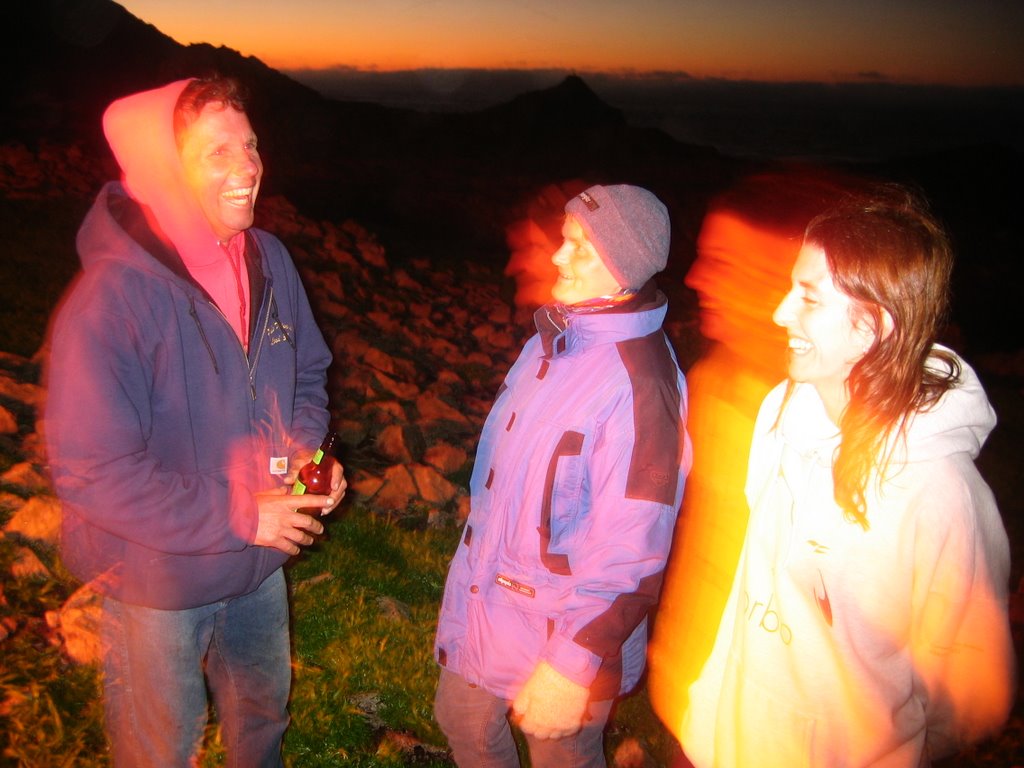
 The winter crew watches the sun set on another beautiful day on the Farallones.
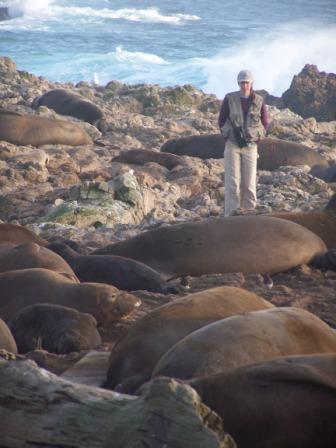 During the winter season we primarily study the demography (reproduction, survival, and population change) of the Farallones northern elephant seal population. These parameters can be determined by individually marking the elephant seals to see where they move, how long they live, how often they reproduce and whether their pups survive. We put permanent colored plastic tags with a unique number and letter combination in their hind flipper that we can re-read year after year – and we give each tagged animal a name.
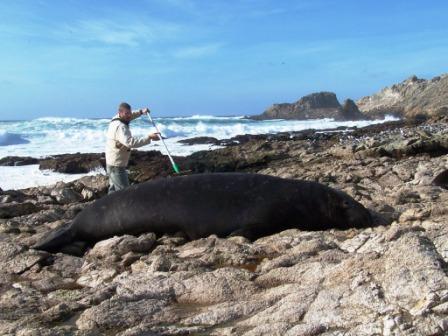 For short-term tracking within the breeding season, we stamp a unique number on each adult elephant seal with blonde hair bleach and black hair dye generously donated by Clairol. The bleach and dye numbers disappear when the animal molts in a few months. But during the breeding season (December through March), these big, clearly stamped numbers allow us to efficiently keep a daily count of seals arriving, defending harems, giving birth, nursing, and departing. We check all the breeding beaches in the morning and again in the afternoon to get the count.
Every pup gets the same stamp number as its mother so we can monitor each female’s reproductive success and pup fate. Also, the number helps us to identify the pup so we can tag it once it is weaned and we’ll know the exact age and who its mother was when we see the animal again in future years. See the picture below of the cow Drip and her pup – they are both stamped “-25,” and Drip's tags are also visible.

At about 110-180 pounds, your average Homo sapiens biologist poses no threat to a 5,000-pound bull male northern elephant seal. These large males are remarkably tolerant of human presence and do not seem to mind if we get close enough to read their tags or stamp a number. But, of course, we still tread very carefully around these animals, as one misstep could yield some painful results!
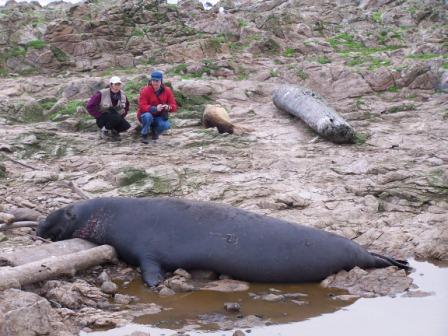
In addition to intensively studying the elephant seals, we monitor the abundance of
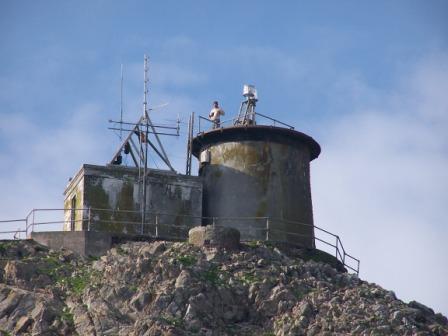
Finally, we post a lookout at the lighthouse to observe and record whales, sharks, dolphins, and any other interesting and notable wildlife that come to the island’s waters to feed or just pass by on their annual migration. For example, the other day we saw a pod of 8 Orca in the waters just off West End Island, and another day 500 Risso's Dolphins swam by. Our one-day high count of grey whales migrating south to calve and breed in Baja California, Mexico is 58.
Saturday, January 13, 2007
Nero Goes from Hero to Zero
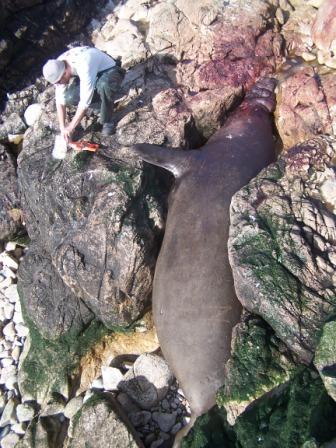
Early this morning, biologist Shawn Farry went to check the beach and discovered a phenomenal sight. Nero, the Sand Flat bull, was dead in Log Channel from severe head wounds. From the evidence we found, it appears that Nero and Don Francisco fought an epic battle that ended when Nero’s head was crushed in Don's jaws. We are all still reeling from the shock. Now that we were able to get a very close look at Nero, we were overwhelmed by his size and bulk. He was nearly 5 meters long, and 5 meters around the chest (sadly we didn’t have the equipment to weigh such a massive creature, but he likely weighed thousands of pounds). In the picture below, biologist Derek Lee prepares to take measurements.
 The loss of Nero left a power vacuum on the Sand Flat. First, Aubrey (a tough fighter but not quite a bull) rushed onto Sand Flat and promptly and excitedly attempted to mate with numerous females – most of them with young pups and not yet sexually receptive. Not surprisingly, the females snarled their protest. Salvatore, a bull who had been hanging on the periphery of the Sand Flat and previously fled whenever Nero displayed his nose and bellowed, heard the ruckus and looked up from his nap. Realizing that Nero was gone, Salvatore fought Aubrey for 20 minutes across Sand Flat and
With hormones still raging, Salvatore then attempted to challenge Don at  Don beat Salvatore and Salvatore retreated within about a minute. Apparently Don Francisco is the current alpha bull of SEFI, but he hasn’t yet taken over Sand Flat, the island’s largest harem. Time will tell where all the remaining males will end up, but this shake-up was certainly one of the most exciting days of the season.
We also had our first weaner today. Cow -27 was nowhere to be seen, and her pup was looking round and healthy after more than 3 weeks of nursing the richest, fattiest milk in the animal kingdom. It is likely that the weaner is the offspring of Nero from last year. While Nero’s life ended brutally after only one full year as alpha bull, he probably sired more than 90 pups.
Thursday, January 11, 2007
Seal update
 The elephant seal beaches are filling up now. We have 33 cows on Sand Flat, 10 cows on Mirounga Beach, and 6 on the Marine Terrace with 27 pups altogether. Nero is still alpha bull on Sand Flat, with Salvatore loitering nearby, but never challenging the big-nose. Rusty and Aubrey had a big 20 minute fight, but neither has a harem now, so the outcome is questionable. Don Francisco is with the Mirounga Beach harem, and Bedlam Boy is with the Terrace harem.
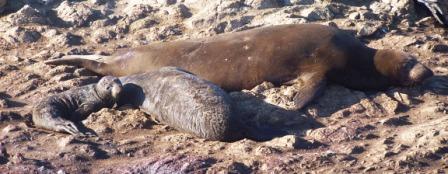 The first cow-pup drama of the season was started by the abandonment of pup -46 by its mother. She then caused some mayhem by trying to steal the newly born pups of cows -51 and -57. In the melee, the pup of -57 was killed. Cows -51 and -57 shared the remaining pup for a couple days before -51 claimed sole rights. -57 has been wandering around trying to adopt a pup, but without success. -46 is also roaming about, trying to steal pups, continuing to cause disturbance. Meanwhile, the abandoned pup of -46 has been severely bitten in the head, but was adopted by Schnitzel. Schnitzel hasn't nursed the adoptee much, but it is still alive and alert. Two of the three pups born on Mirounga Beach have died after being crushed or bitten by other seals. The crowded and high traffic area is very tough on the new pups there.
For those readers keeping a score card, the newly-arrived cows that haven't yet been mentioned in this blog include: Grasshopper, Daphna, Arwen, Lynne R., and Galadriel.
Wednesday, January 10, 2007
The Nose Knows
 Adult male elephant seals are the largest of the pinnipeds, which include seals, sea lions, and walruses. These colossal mammals can grow up to 15 feet long and weigh up to 5,000 pounds! As males get older, they develop a chest shield of wrinkled skin that is bright pink, rough, and deeply fissured like the bark on a tree.
 But the inflatable proboscis is without doubt the most exceptional feature of the male elephant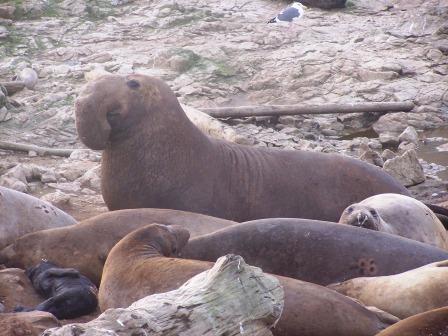 seal. Its full size is reached when the male is about eight years old. This peculiar proboscis is an enlargement of the nasal cavity that hangs down about a foot over the mouth when the animal is relaxed (much like the trunk of an elephant, thus the name).
But when that nose inflates…watch out!

A combination of muscle action and blood pressure causes it to form a large cushion on top of the snout, with the tip hanging down so that the nostrils open immediately in front of the mouth. The seal then forces air from his lungs into the nostrils at about 3 to 5 pulses per second. The inflated proboscis acts like as a resonating chamber, projecting the rhythmic, metallic-sounding snorts for nearly a quarter of a mile.
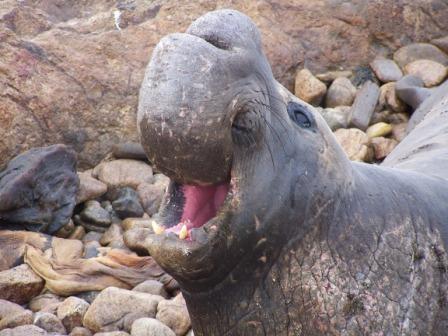
The male elephant seal’s proboscis is a classic example of sexual selection, in which females select males with a certain characteristic that communicates the male’s fitness such that it evolves to extreme proportions. The nose does not appear to perform any particular function for the male other than to attract females and repel males with its enormous size and resulting deep bellow, and is known as a “secondary sexual characteristic.” This is similar to the large showy tail on a peacock or the massive antlers on an elk.
Friday, January 05, 2007
Crowds of Cows (and pups)

The number of cows and pups on SEFI’s main elephant seal beach, Sand Flat, is growing by the day. Once again, First Cow, Giovanna, Schnitzel, and Drip had the first pups of the breeding season – they like to arrive early so they can take advantage of the uncrowded beach to nurse their babies without too much wrangling for precious space. Later in the season Sand Flat will have scores of cows and pups and mayhem often ensues. In fact, it is starting to get a bit crowded already. There are 21 cows and 12 pups, with three or four new cows and pups arriving each day! The beach resonates with the cries of the little seals and the gentle responding “pup sound” that the mother makes to reassure her pup that she is nearby.
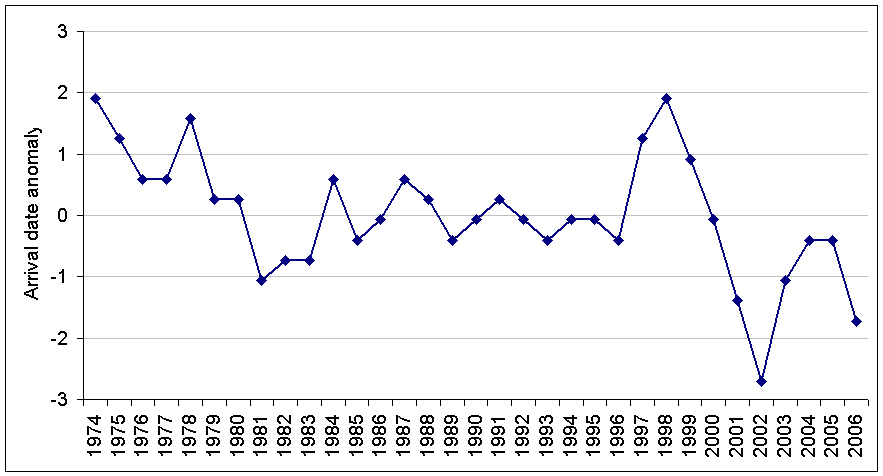 The timing of cow arrival at the Farallones each year (known as phenology) has changed over the decades. This could possibly be due to changes in the average age of the cows breeding here. The islands were first colonized in the 1960s by young animals dispersing from colonies at Año Nuevo and the Channel Islands of Southern California. The graph here shows the median arrival date of females to SEFI from 1974 until 2006. The shifting phenology could also be due to changes in the ocean climate causing periods when food was more or less abundant and cows returned to SEFI earlier or later as a result. Our research has found that during the last 15 years, earlier phenology means higher reproductive success.
Below, we profile a few of the cows we’ve been tracking since their birth.
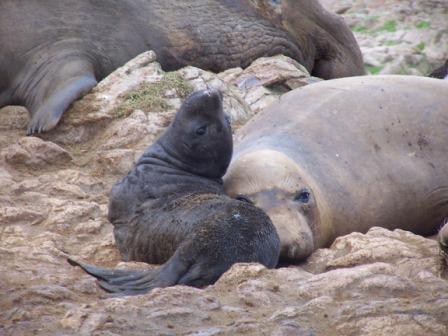 Mercury was born on Sand Flat in 1990, making her a whopping 17 years old this year! She’s given birth 10 times on the very beach where she was born, producing seven healthy weaners. Furthermore, Mercury’s pup from 1999, Princess Superstar, returned to SEFI this year as a pregnant cow. Both of them just gave birth in the past couple of days, resulting in three generations together on the beach. Mercury and Princess Superstar spend a lot of time near each other – perhaps the bonds of kinship reduce antagonistic behavior that decreases nursing time and hinders pup development.
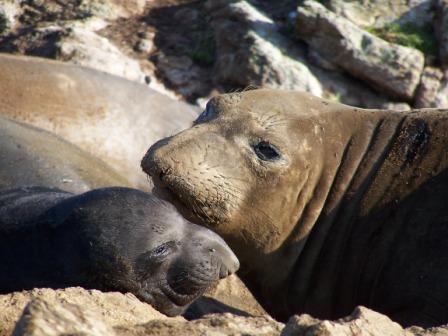 Another relatively old female on Sand Flat is Drip. Drip was born in 1992 at
 Queen Latifah was born on Sand Flat in 1999. This is her first year returning to SEFI and she’s now nursing her pup that was born on New Year’s Eve. She is a relatively calm cow who really seems to enjoy her sleep – unlike some of the others who spend lots of time snarling at neighboring cows. Since this is her first year back at SEFI, we’re not sure where and with whom she mated last year, but we’re happy to see her back home.
Maddy also was born on Sand Flat in 1999, first returned in 2003, first pupped in 2004, and has given birth here every year since. Unfortunately, she is only “one for three” so far, with only one successful weaner, but she is young yet. She hasn’t pupped yet this year but we’re checking the beach every day.
 Schnitzel is a relatively young cow, born on Sand Flat in 2000. This is Schnitzel’s third year returning to SEFI to pup. Hopefully the third time’s the charm. In 2005, she did not nurse her newborn pup and it died, but we chalked it up to the terrible wounds Schnitzel had on her head and back from an attack by an over-enthusiastic male elephant seal. Last year Schnitzel abandoned her pup as soon as it was born, which often happens with younger, inexperienced cows. Happily that year, First Cow adopted Schnitzel’s abandoned pup and nursed it for several weeks. This year Schnitzel hit her stride and her pup is looking nice and fat. This year, in an interesting karmic twist, Schnitzel herself appears to have adopted an abandoned pup.
Christine is another relatively young cow from the class of 2000. She pupped successfully on Sand Flat in 2004 but she didn’t breed here for the past two years. We’re glad that she is back. She hasn’t given birth yet but it will probably happen any day now.
Thursday, December 28, 2006
Christmas presents
We're picking up the pieces, like many in the Bay Area, in the wake of the after-Christmas storm that blew across the islands with 50+ knot winds. Here, the gusts buffeted the house so heavily that it shook. We woke up thinking it was an earthquake. The gale-force winds peeled siding from the houses and sent flying everything that wasn't tied down, including the large, heavy covers to our water catchment tanks. Happily, enough rain fell during the storm to add another few inches of fresh water to our cistern storage.
 All of us here on the Farallones wish the best holiday cheer to the many folks who have supported us during the past year. The rich marine life here in the Gulf of the Farallones has attracted a human community that appreciates the Farallon Islands and the wealth of natural resources that exists here, and many help us with our research on this lonely rock perched at the edge of the continental shelf.
We made a great feast for the solstice with the groceries our Farallon Patrol coordinating angel, Brandy Johnson, arranged to be delivered on the 'Chelsea Lee' out of Sausalito. After big seas and high winds scrubbed our scheduled weekend Farallon Patrol run, skipper Harry Andrews and his crew Brett and Chris graciously rearranged their schedules, making a weekday dash to the islands during the one day of decent weather in the week of the 17th. We depend on these volunteer skippers of the Farallon Patrol who use their own boats to keep the island biologists fed, and delivering parts so we can keep our self-sufficient power and water systems running. Thanks Brandy and Farallon Patrol skippers and crew.
We received an early present the week before, when Brandy and Albertha arranged for Jared on the crab boat 'Bright Future' to deliver a cell phone to the island during a period when our radio communications were down and we were cut off from the mainland. Thanks Brandy, Albertha and Jared.
 Many of the working boats of the charter boat fleet support our research on the Farallones by transporting critical equipment or personnel to/from the islands during their fishing/crabbing/shark- and whale-watching trips. Special holiday greetings to Mick and company on 'Superfish,' as well as the folks on 'Butchie B.,' 'California Dawn,' ' Wacky Jacky,' and the boats of the Oceanic Society and SF Bay Whalewatching. Thanks to everyone in the charter fleet. Thanks also to and Ron on 'GW' for checking our buoys.
 A big year-end thanks also goes out to Rick, Steve, Ernie and the rest of North Coast Divers for being the most enthusiastic crane installers and maintainers we've ever had the pleasure of having on the island. You guys obviously appreciate the Farallones, and that makes all the difference.
We on the island are especially grateful this winter for the kind gifts from two special Santas, Joan Lee and Margaret Lewis.
Francine at Clairol also sent us our annual gift of product to mark the elephant seals with. Thanks Francine and Mary.
Of course, we must also thank Joelle and Jesse at the Refuge, and the Sanctuary folks as well for all that they have done this past year to make our research on the Farallones a success.
 All of us here on the Farallones wish the best holiday cheer to the many folks who have supported us during the past year. The rich marine life here in the Gulf of the Farallones has attracted a human community that appreciates the Farallon Islands and the wealth of natural resources that exists here, and many help us with our research on this lonely rock perched at the edge of the continental shelf.
We made a great feast for the solstice with the groceries our Farallon Patrol coordinating angel, Brandy Johnson, arranged to be delivered on the 'Chelsea Lee' out of Sausalito. After big seas and high winds scrubbed our scheduled weekend Farallon Patrol run, skipper Harry Andrews and his crew Brett and Chris graciously rearranged their schedules, making a weekday dash to the islands during the one day of decent weather in the week of the 17th. We depend on these volunteer skippers of the Farallon Patrol who use their own boats to keep the island biologists fed, and delivering parts so we can keep our self-sufficient power and water systems running. Thanks Brandy and Farallon Patrol skippers and crew.
We received an early present the week before, when Brandy and Albertha arranged for Jared on the crab boat 'Bright Future' to deliver a cell phone to the island during a period when our radio communications were down and we were cut off from the mainland. Thanks Brandy, Albertha and Jared.
 Many of the working boats of the charter boat fleet support our research on the Farallones by transporting critical equipment or personnel to/from the islands during their fishing/crabbing/shark- and whale-watching trips. Special holiday greetings to Mick and company on 'Superfish,' as well as the folks on 'Butchie B.,' 'California Dawn,' ' Wacky Jacky,' and the boats of the Oceanic Society and SF Bay Whalewatching. Thanks to everyone in the charter fleet. Thanks also to and Ron on 'GW' for checking our buoys.
 A big year-end thanks also goes out to Rick, Steve, Ernie and the rest of North Coast Divers for being the most enthusiastic crane installers and maintainers we've ever had the pleasure of having on the island. You guys obviously appreciate the Farallones, and that makes all the difference.
We on the island are especially grateful this winter for the kind gifts from two special Santas, Joan Lee and Margaret Lewis.
Francine at Clairol also sent us our annual gift of product to mark the elephant seals with. Thanks Francine and Mary.
Of course, we must also thank Joelle and Jesse at the Refuge, and the Sanctuary folks as well for all that they have done this past year to make our research on the Farallones a success.
Wednesday, December 20, 2006
Bulls on the Beach
Elephant seal males that are sexually mature are called bulls. At the beginning of each breeding season, bulls arrive at the Farallones and establish their dominance hierarchy through displays of their mass and nose size, bellowing, and occasional fights. The highest-ranked bull is called the alpha, and he defends the largest harem (group of females). The rankings are fluid, and challenges occur daily. The payoff for the males comes at the end of the breeding season, when the cows they have been defending for a month wean their pups and become sexually receptive. The bull mates with each cow just before she returns to sea, leaving her pup on the beach as a weanling. Let's take a look at the main contenders for alpha bull status on the Farallones this year.
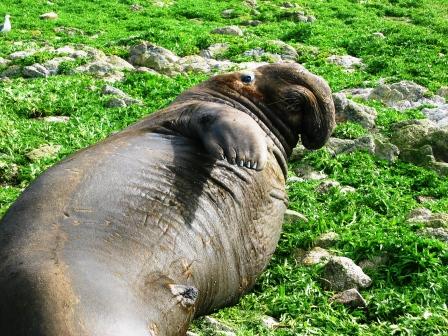 Nero became the alpha bull early last season by deposing JD, the previous alpha bull. Nero is the bull of Sand Flat, the largest harem on the Farallones with 97 cows last year. He's not the most massive male around, but his nose is enormous. Harem-organized species usually have a sexually-selected body part that acts as a signalling device to other members of that species to transmit information about sexual maturity and dominance. For elephant seals, the proboscis (nose) says it all. When Nero inflates his nose and bellows, the other males quickly move away.
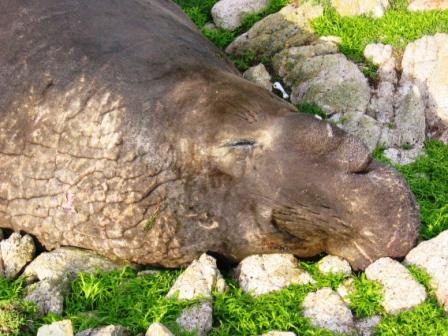 Don Francisco is a veteran male who held a small harem last year on the Marine Terrace. He successfully defended this group from the constant incursions by satellite males. Last year he stayed away from Nero and contented himself with his 16 cows. We'll see if this year Don is still happy on the Terrace, or if he will challenge Nero.
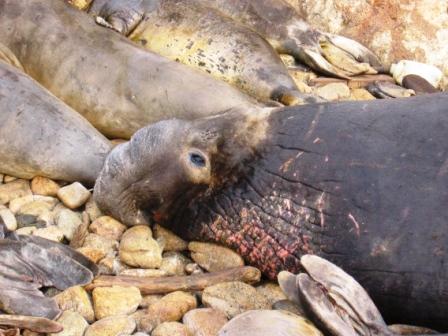 Puffy is a newcomer to the Farallones, he was first seen this year, already an adult, and has established himself on Mirounga Beach. There are usually about 35 cows in this harem, but it is not a great location for the pups, over half die each year due to crowding and high swells washing out the small beach. Not a great investment in future gene survival, but about the same payoff as the Marine Terrace. Puffy is pretty large, he may make a move on the Sand Flat harem, but his nose just isn't up to Nero's caliber.
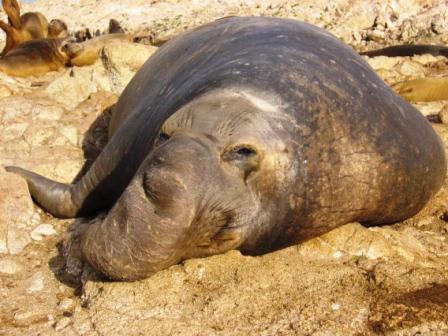 Bedlam Boy is a big satellite male who orbits the periphery of Sand Flat. Nero can't control the entire harem at all times, so satellite bulls like Bedlam Boy keep lesser males cleared away from certain portions of the harem's edge, never engaging the alpha directly, always ready for an opportune moment to mate with a cow while Nero is preoccupied on the other side of the beach. Bedlam may challenge Nero later, but thus far he has retreated every time Nero trumpets.
 Brendan is still too young to claim a harem of his own, but he has been hanging around, sparring and harassing bulls for the last few years. He's earning his fighting chops and learning the terrain for future years when he will have the mass and the nose to defend a harem.
Still missing from last year's class of males are
Monday, December 18, 2006
Back to the Elephant Seals
 December 2 marked the annual turnover of biologists from fall to winter crew at Southeast Farallon Island (SEFI). From mid-August until early December, PRBO researchers spent their time watching for white shark attacks from Lighthouse Hill and monitoring the hundreds of species of birds that stop over at the
 December is the beginning of the breeding season for northern elephant seals, one of five species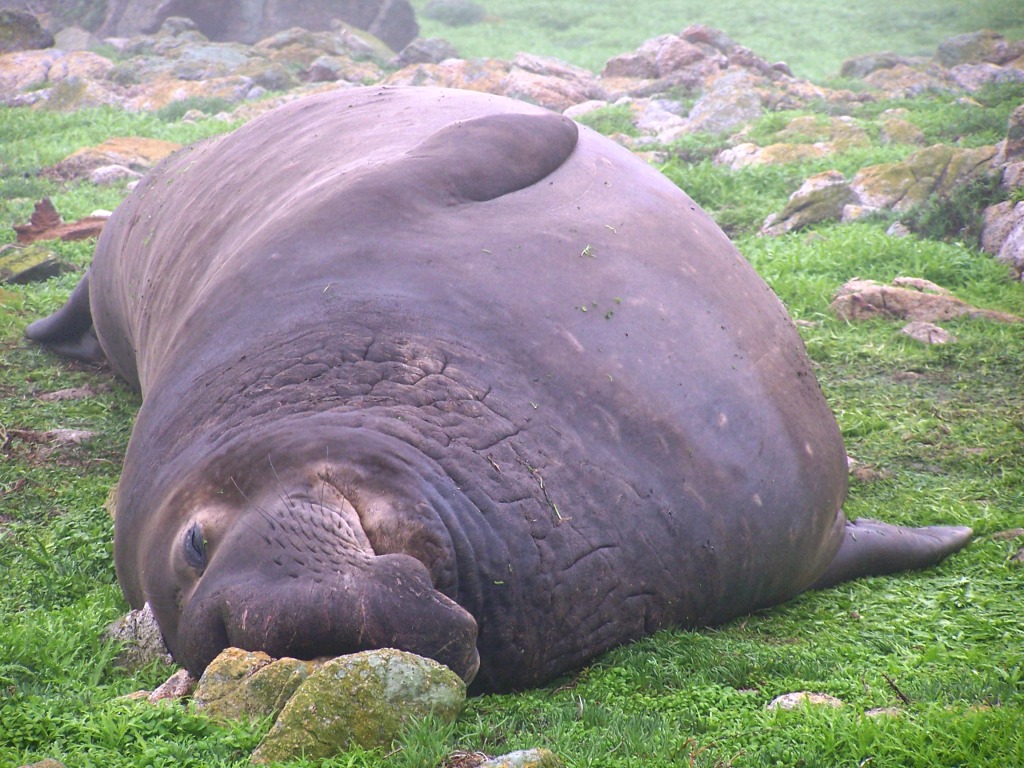 of pinnipeds (a group of animals that includes seals and sea lions) at SEFI. Northern elephant seals breed on western North American islands from Guadaloupe Island of Mexico to the Farallones and some coasts (such as
Before the adult elephant seals arrive for the winter breeding season at the Farallons, they’ve been out at sea for several months, foraging mostly for squid off the coasts of
While at sea, elephant seals spend a surprising amount of time deep underwater. Scientists have discovered that these wonders of evolution spend 90 percent of their time diving, typically for about 20 minutes each dive, and coming up for air for only 2 or 3 minutes before heading back down again. The seals have a number of adaptations that enable their bodies to withstand the high pressures deep underwater. In fact, depth helps them to store fat more efficiently because their metabolism slows down due to the cold and water pressure at depth – they even sleep deep underwater.
By some estimates, females gain a kilogram a day while out at sea. They are trying to fatten up for the two month-long fasts they will make, especially for the winter breeding season where they will lose up to half their body weight nursing their hungry pups.
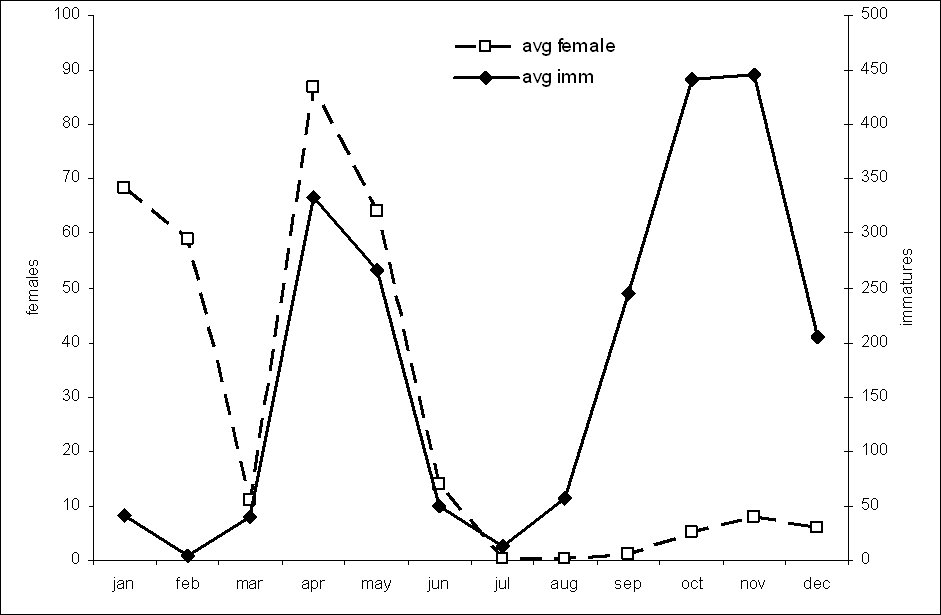
During the fall most of the elephant seals on SEFI are immatures, which are generally less than about 4 years old. The picture below shows two immature elephant seals hanging out together. The graph shows the average annual numbers of adult female (dashed line) and immature (solid line) elephant seals on the island – you can see how many immatures are here in the fall, which is why it is also the time of most shark attacks.

To date, we’ve had 6 pregnant cows arrive at SEFI, but no pups yet.
 This is in contrast to last year, where we already had a pup born on December 8 (the earliest ever recorded here). A "harem" is beginning to form at Sand Flat, with Nero – last year’s reigning bull there – fighting off the other smaller males for his right to mate with these females once their pups are weaned. But that is a long way off and new big males are arriving every day. Will there be a bull that dares to challenge Nero? Here, Nero announces his presence to the others with a loud, resonant snort through his massive nose.
 Sunday, October 15, 2006
Fall Season
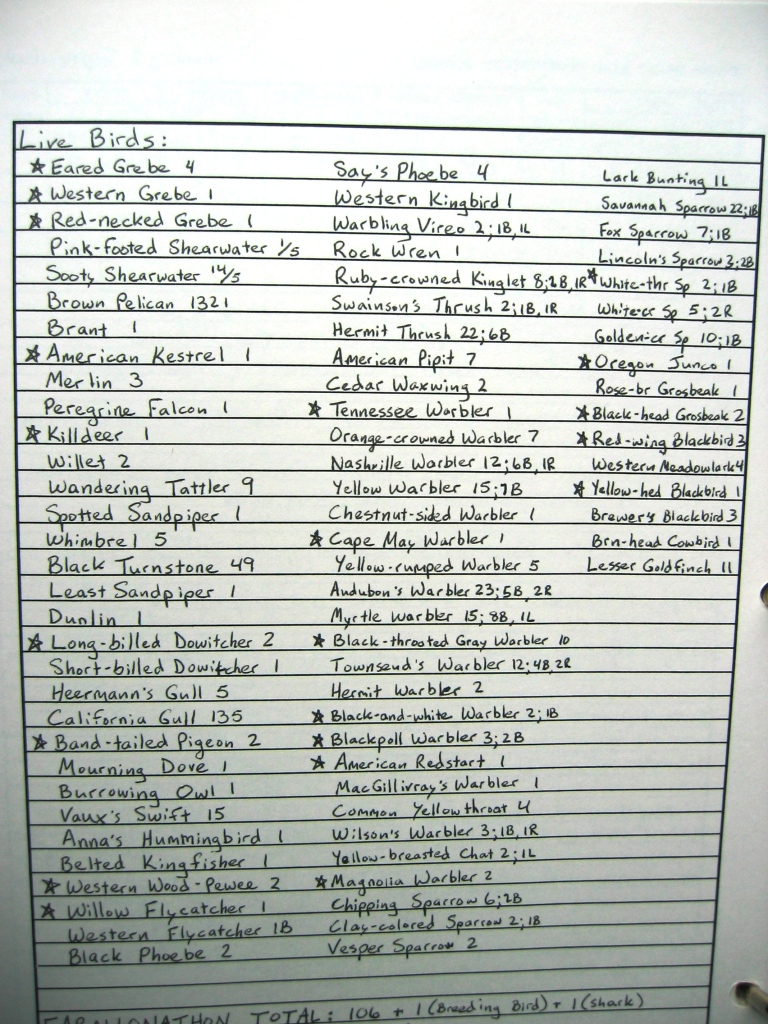 The fall season on the Farallones (from September through November) is mainly concerned with studies of migrant landbirds. Every year, migrating birds travel with the seasons; south in the fall to winter in temperate and tropical latitudes and north in the spring to breed in northern latitudes. These birds often follow natural landscape features such as mountain ridges and coastlines to navigate. Since 1965, PRBO biologists have captured and banded thousand of migrating birds as they stop over on the Farallon Islands as well as at Palomarin field station on the mainland near Bolinas.
Here is a typical list of birds that were identified on the Farallones during one day in October.
Sunday, May 21, 2006
Following Nesting Brandt's Cormorants

Like many of the seabird species, Brandt's Cormorants are well into their nesting season. These large foot propelled diving birds feed on a variety of fishes and nest in dense colonies in some of the island's flat areas. Breeding populations are up this year in many areas, and most birds are currently incubating eggs. Male cormorants gather nesting material from native vegetation and then display for females, showing off their bright blue gular pouches.
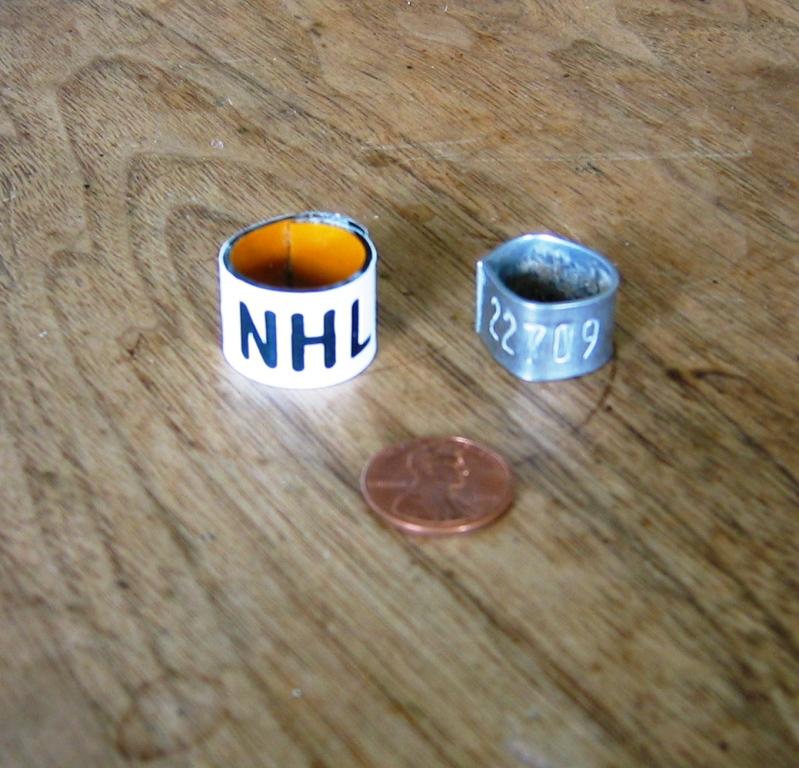
Our Brandt's Cormorant studies, like much of our seabird research, involve following how individuals survive and reproduce throughout their lives. We do this by banding birds as chicks with metal and color bands like the ones shown here. The numbers and letters provide a "name tag" we can use to follow the same cormorants every year throughout their lives, which can last over 20 years. To do this we resight bands and birds at their nest sites through a telescope from an observation blind above our main study colony. This can be challenging, imagine reading the numbers on the metal band above on a bird 200 feet away through a telescope. It is a task that requires a lot of patience!
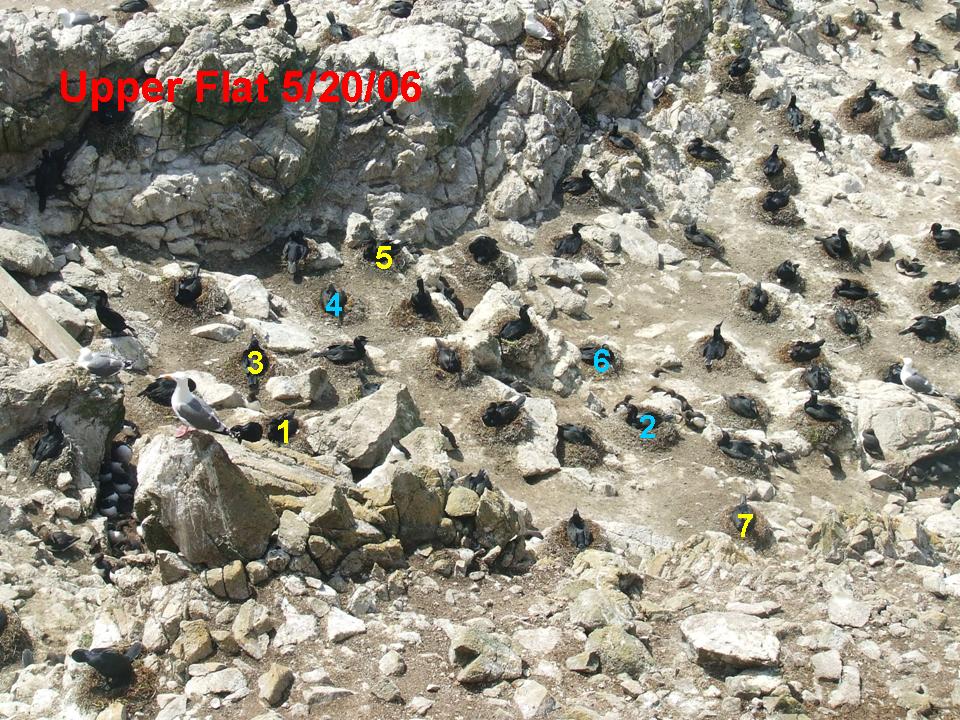
Currently, we are following over 100 nests of breeding banded birds in our main study colony. Here is a map of one of the areas. The numbers mark nest sites of followed birds. While we will obtain breeding success information on all nests, the blue numbers mark nests we are sure to check at least every 5 days, to gain valuable information on the timing of egg laying and chick hatching. This is long tedious work, that requires many hours spent watching cormorants on their nests, often waiting long periods to see into their nests and confirm their bands. However, the rewards are great, as the information gathered from individual birds allows us to assess the variation in survival and reproduction between birds of known age and experience. This additional layer of data helps to improve our ability to examine how the breeding activities of seabirds can reflect changes in the ocean environment. Its definitely something to think about as you're sitting in a cold blind on a hilltop, waiting for your cormorants to stand up....
Tuesday, April 25, 2006
Tristram's Storm-petrel visits the Farallones!
*Update: Note that this original report refers to this bird as a Black Storm-Petrel, it was eventually confirmed as a Tristram's Storm-Petrel, a Hawaii/central pacific species which was the 1st North American Record!*
Storm-petrels are diminutive little seabirds usually only glimpsed for a moment as they flutter over the surface of the ocean. They are part of an order of birds know as Procellarids, more commonly called the "tubenoses" for the presence of a specialized structure that encases the nasal openings on the top of the bill. They are long lived, with records of individuals in excess of 35 years old, lay a single egg each season which they will rear over the course of several months, and are the most pelagic of all seabirds which breed on the Farallones. Storm-petrels travel great distances from their breeding colonies in search of food, sometimes up to 250 km in a single foraging trip, and spend most of their lives in the open ocean. They are primarily nocturnal at the colony, returning only after full dark in order to take their turn incubating the egg or to feed waiting chicks. Approximately half of the world's population of Ashy Storm-petrel breeds at the Farallones along with a small population of Leach's Storm-petrel.
Twice a month, we go out in the middle of the night to mist net these incredible birds as they return to the colony. This work is part of a long-term mark/recapture study to assess population status and trends and to estimate survival. But on April 22, we had an unexpected visitor to our colony, the Black Storm-petrel.
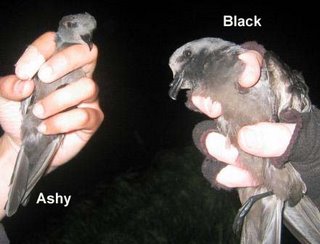
 Black Storm-petrels are the largest of the storm-petrel species commonly seen along the west coast of North America, and are considerably larger than both Ashy and Leach's, as can be seen in the photo below. The bird on the left is an Ashy while the bird on the right is the Black. It also has a much stockier build, longer wings, larger bill, and stronger bite than the Ashy (as the person in this photo discovered just prior to releasing the bird).
  Black Storm-petrels breed on offshore islands from Baja California, Mexico north to the Channel Islands and in the Gulf of California, but the majority of the world's population breeds on San Benito Island in southern Mexico. They are typically seen off the coast of southern California, but may also be seen in Monterey Bay and the Gulf of the Farallones during the winter. However, it is rare for this species to be observed this far north during the breeding season and is the first spring record for the Farallones as well as the only one ever caught on the island. The occurrence of this Black Storm-petrel on the Farallones, in addition to being exciting for those of us living here, illustrates the impressive foraging range of these birds and the unpredictable nature of life on this island.
Storm-petrels are diminutive little seabirds usually only glimpsed for a moment as they flutter
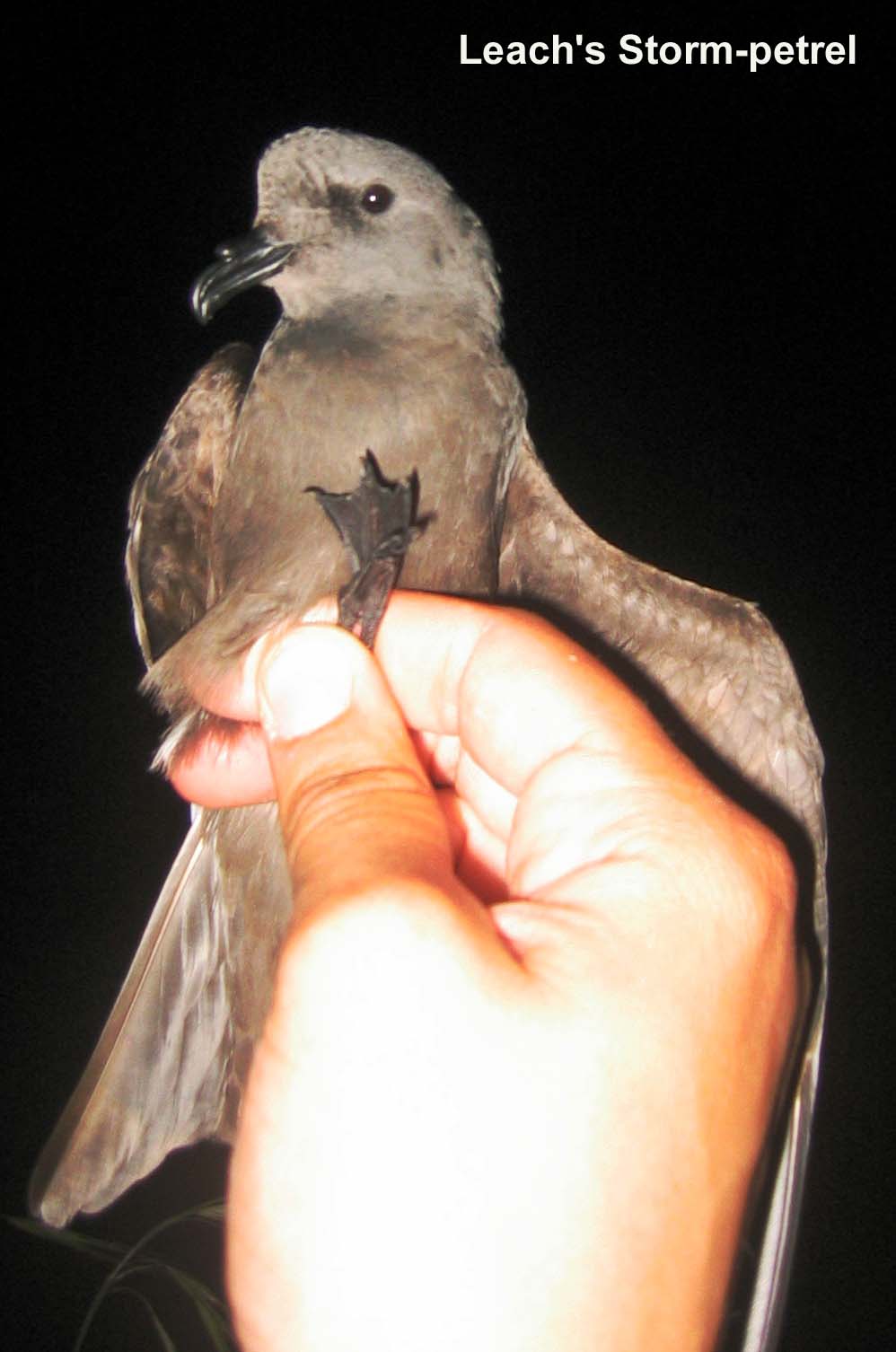 over the surface of the ocean. They are part of an order of birds know as Procellarids, more commonly called the "tubenoses" for the presence of a specialized structure that encases the nasal openings on the top of the bill. They are long lived, with records of individuals in excess of 35 years old, lay a single egg each season which they will rear over the course of several months, and are the most pelagic of all seabirds which breed on the Farallones. Storm-petrels travel great distances from their breeding colonies in search of food, sometimes up to 250 km in a single foraging trip, and spend most of their lives in the open ocean. They are primarily nocturnal at the colony, returning only after full dark in order to take their turn incubating the egg or to feed waiting chicks. Approximately half of the world's population of Ashy Storm-petrel breeds at the Farallones along with a small population of Leach's Storm-petrel.
Twice a month, we go out in the middle of the night to mist net these incredible birds as they return to the colony. This work is part of a long-term mark/recapture study to assess population status and trends and to estimate survival. But on April 22, we had an unexpected visitor to our colony, the Black Storm-petrel.
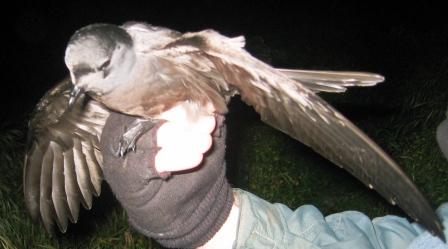 Black Storm-petrels are the largest of the storm-petrel species commonly seen along the west coast of North America, and are considerably larger than both Ashy and Leach's, as can be seen in the photo below. The bird on the left is an Ashy while the bird on the right is the Black. It also has a much stockier build, longer wings, larger bill, and stronger bite than the Ashy (as the person in this photo discovered just prior to releasing the bird).
  Black Storm-petrels breed on offshore islands from Baja California, Mexico north to the Channel Islands and in the Gulf of California, but the majority of the world's population breeds on San Benito Island in southern Mexico. They are typically seen off the coast of southern California, but may also be seen in Monterey Bay and the Gulf of the Farallones during the winter. However, it is rare for this species to be observed this far north during the breeding season and is the first spring record for the Farallones as well as the only one ever caught on the island. The occurrence of this Black Storm-petrel on the Farallones, in addition to being exciting for those of us living here, illustrates the impressive foraging range of these birds and the unpredictable nature of life on this island.
Seabird breeding begins on the Farallones
 The seabird breeding season has officially begun with the first eggs laid by Cassin’s Auklets on April 11th. This is the true start of the seabird research season. We will now begin monitoring the success of seabirds by determining the number of birds that breed, the number of eggs that are laid, the number that hatch, and the number of chicks which fledge. Cassin’s Auklets are one of the many species that breed on the island and we have studied their populations and reproductive success here since 1972. They are small seabirds (about the size of a robin) that spend most of their lives at sea, feed on zooplankton and nest underground in burrows, rocky crevices, or in nest boxes.
Biologists from PRBO check nest boxes every five days beginning on March 2nd each year. We monitor these boxes throughout the season looking for birds with their eggs and eventually chicks.
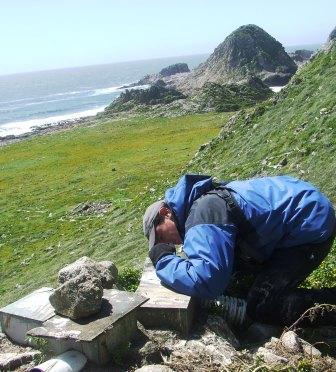 When we find a bird in a box, we capture the adults, determine their band number or place a band on them, and take a variety of measurements (wing length, weight, bill size) which help us to determine the sex of the bird and give us an index of their overall health. Banding birds allows us to keep track of individuals through time and to examine survival, fidelity to nest locations and mates, and the overall reproductive success of individual birds throughout their lives. These boxes create additional nesting habitat and allow us to collect valuable breeding information with a minimum of disturbance to the birds.
Cassin’s Auklets are usually the first birds to breed on the island and the timing of their reproduction can often indicate if it will be a productive year for seabirds at the Farallones. Auklets tend to initiate breeding earlier when the ocean is cold and conditions are favorable for the production of their favorite food, krill.
 In warmer years, there is less food available and they will delay breeding until conditions improve. So, this species serves as an "early warning" system for overall seabird productivity. For example, last year the ocean was warm, food was scarce and the first eggs were not observed until May 1st, a full three weeks later than this year. As a result the auklets (and other seabirds at the Farallones) were able to rear few chicks. Hopefully, the earlier breeding observed this season is a sign of more favorable conditions and higher productivity for auklets.
While Cassin's Auklets are the first to lay their eggs, the other seabird species are getting ready. Western Gulls, Brandt's, Pelagic and Double-crested Cormorants are all establishing their territories and building nests. Common Murres have been at their breeding sites every day and have been practicing by incubating rocks or small bits of vegetation. Puffins have returned to the colony and the Rhinoceros Auklets and Ashy Storm-petrels have been in at night. Soon these species will have eggs too and things will get very busy for the next few months.
Friday, March 24, 2006
Return of "The Birds"
After a complete change with the winter crew, we seabird biologists have returned to the Farallones for another season. PRBO has been studying seabirds here for over 35 years. Our research focuses on using information from the birds, like how well they reproduce and what they eat, to learn about changes in the ocean environment.
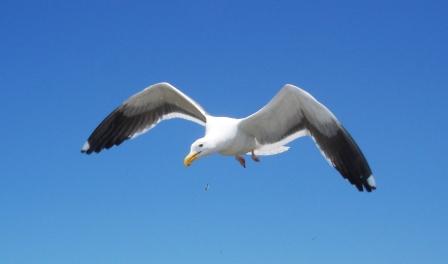
When you step on the island at this time of year - it becomes quickly apparent that it's a "gull's world". The island supports the world's largest breeding colony of Western Gulls, almost 20,000 strong. These are the birds from the Hitchcock movie"The Birds"! Or at least their descendants - the film was shot in Bodega where some Farallon gulls spend their winter. Right now gulls are reconnecting with mates and fighting for breeding territories. As you can see in this recent video - life isn't easy for a gull on the Farallones. Every year I return to the island I am more amazed by the resilience and pure toughness of the gulls. From our banding studies we know that Western Gulls can live more than 30 years! So I sing the gulls' praises - but wait a few months when they are dive bombing us nonstop - maybe I'll change my tune...
Saturday, March 11, 2006
Risso's Dolphins
We finally had a nice calm day here, so I went up to the light for some whale-watching. In 2.5 hours, I saw 1 gray whale and a huge herd of ~200 Risso's Dolphins. It was amazing to watch as the Grampus surfed down the faces of the huge ocean swells that are running today. Tomorrow, if the seas calm down, the seabird biologists will take over the island. Winter season is over, and I'm going back to the mainland, but the work here goes on with a new focus on the seabirds that breed here. Elephant seal season is over, but we had a great year. The population grew again this year, with big jumps in numbers for Pastel Cave Highlands and Marine terrace harems. Reproductive success (number of weaners per cow) was about average, and altogether we had 132 weaners. Another year of elephant seal data added to the long-term ecological dataset for the Farallones that adds to our understanding of this amazing, constantly changing, incredibly productive portion of the world ocean.
Tuesday, February 14, 2006
Molly
Saturday, November 27th 1993. The Farallon journal (our island diary) lists "Black Brant: 1". One Black Brant seen on the island that day. Unbeknownst to the biologists, with this simple entry they recorded the starting of a Farallon era, the era of Molly.
Who is Molly ?
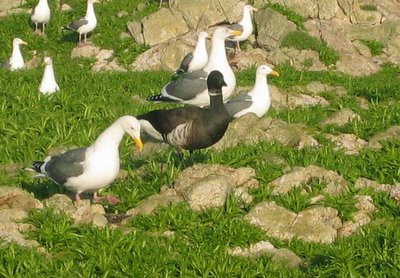
At first glance Molly appears to be a common specimen of the species Branta bernicla nigricans (Brant goose or Black Brant). A species that is described as “small and dark with bright white around tail, about 25 inches in length, weighing about 3 pounds. An almost exclusively coastal goose, found in flocks on shallow bays and marshes, feeding on eelgrass.”
Who is Molly ?
At first glance Molly appears to be a common specimen of the species Branta bernicla nigricans (Brant goose or Black Brant). A species that is described as “small and dark with bright white around tail, about 25 inches in length, weighing about 3 pounds. An almost exclusively coastal goose, found in flocks on shallow bays and marshes, feeding on eelgrass.”
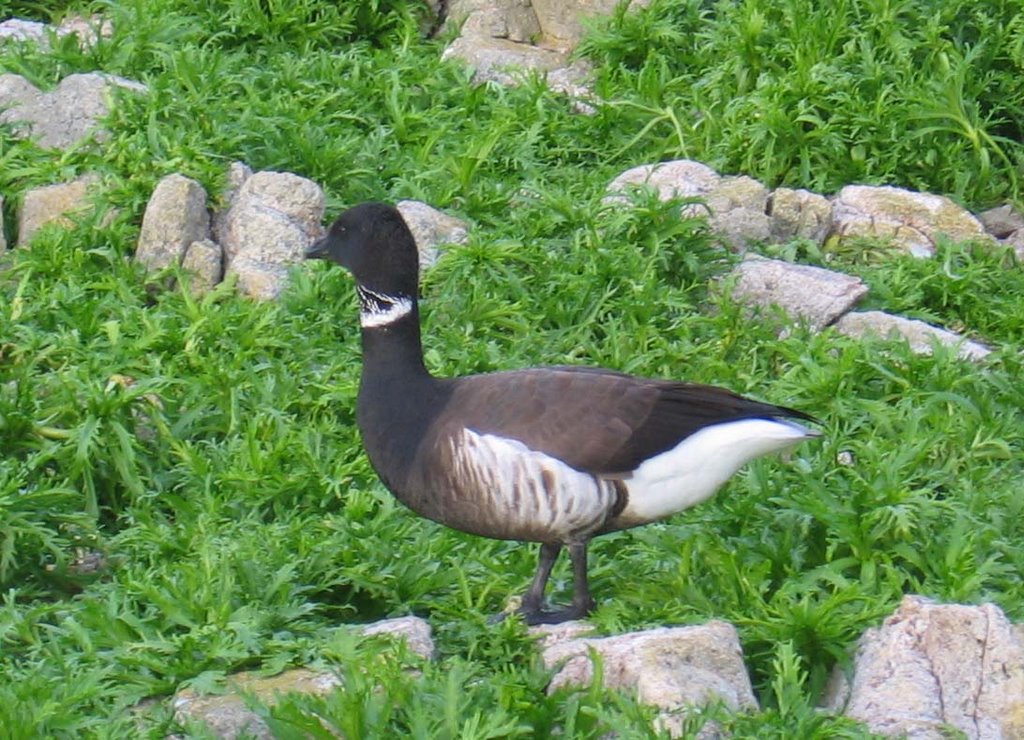 But Molly is more than your average Brant. As time went on, it became apparent that this Brant was not just some flyby migrant, she was here to stay! Not only does she not seem to care about the company of her own kind (during migrations many Brant stop on the island for a day or so), she apparently prefers the company of Western Gulls. Gulls are not very fond of other birds tresspassing on their territories and any other bird is chased away. But Molly (or “La Molly” as some Farallon biologists call her) taught them that she is no pushover, coming at them with her head low and her neck stretched out, hissing. The gulls never stood a chance.

So now, the gulls accept Molly as one of them, nothing to be surprised about and just the way it has always has been. She is sometimes seen foraging on algae in the intertidal, but mostly she stays among the gulls, nibbling at Farallon weed or spurry. Everyday between fall and early summer Molly can be seen at her preferred hangouts, by the old foghorn system or on the Marine Terrace next to Sandflat. We will know she has gone completely gull when she starts scavenging on the dead elephant seal pups.
Several years back Molly seems to have had an accident of some kind while she was away, because she came back sporting a little limp that has persisted to this day. Then, 2 years ago Molly was believed dead because she was not seen for several months. There was even a “Molly Memorial” picture posted in the living room. Then, like nothing had happened, she was seen again waddling along with the other gulls – and our 10 year anniversary party was saved!
So now, for over 12 years, Molly has made every day out here more special, seeing her makes our day. Like overprotective parents not seeing the Farallon mascot in 24 hours makes us nervous. Her long coexistence with the gulls is a model to us all on sharing this special, fragile habitat with the seabirds, seals, and sea lions that call the Farallones home.
Friday, February 10, 2006
Hot Winter Days- Seals hit the beaches
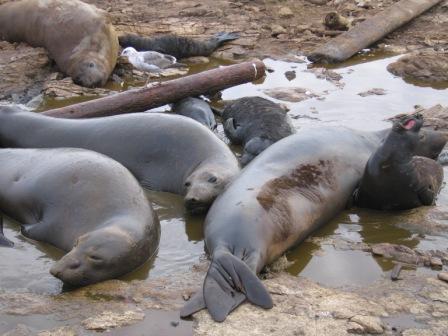 While we biologists have been enjoying the beautiful, sunny, warm (mid 60's) weather this week, the seals have not. Elephant seals are built for swimming in 40-degree water, not sun bathing on the beach. The calm, sunny, warm conditions don't just make the seals uncomfortable, it can kill them from overheating.
In the afternoon heat, the seals move to any source of water or shade. They splash water or sand or rocks over their backs to cool themselves. Some of the weaners on the Marine Terrace have been tossing Farallon weed, the most abundant vegetation on the island, onto their backs.
A few cows have found small puddles or tide pools of their own, but most try to cram into a few overcrowded spots with all the others. This results in chaos as the seals crowd into the puddle on Sand Flat (above, on a slightly cooler day, not quite as crowded as it has been this week) and down by the water's edge at Log Channel Beach (below). On these hot days, all the cows are grouchy and many fights erupt.
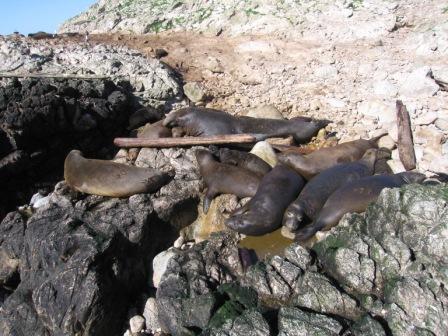 Unfortunately this chaos is bad news for the pups. Several pups have managed to get themselves stuck in Log Channel, requiring a long struggle to crawl back up. Others have fallen off ledges into the water below- a pretty terrifying first swimming lesson! A few have even been crushed or drowned as bigger seals pile on top of them while trying to get to the cooling water.
The hot weather has also resulted in a lot of new weaners this week. Many of the cows on Marine Terrace had been pups that were quite fat and able to be on their own. The first hot day of the week, these moms headed out to enjoy the cool waters at sea and to find their first meal in over a month. Now the Terrace is home to clusters of weaners who have stopped searching for mom and begun getting to know each other.
Subscribe to:
Posts (Atom)