Thursday, March 13, 2008

Jewel Cave Revealed

With ocean swells constantly pounding the island day and night, all year long, the intertidal zone on the Farallones is a harsh environment indeed. Nonetheless, a variety of tenacious plants and animals survive in this zone, and they are revealed during low tides. Only then can we observe the temporary pools left behind by the receeding waters on calm days. The stunning beauty of the tidepools is captured in names like "Jewel Cave" and "Pastel Cave."

Neon orange sponges, fuschia algaes, electric green anemones, and vivid purple sea urchins are part of the mindbogglingly colorful palette typically hidden deeper underwater. Pisasters patrol the pools feeding on mussels, and delicate hydroids filter plankton.

If we are lucky, we might spot a chitin clinging tightly to the wall of the pool.


Or a snail...


Or even a nudibranch.

The Farallon National Wildlife Refuge jurisdiction ends at the high-tide line. Therefore the inhabitants of the intertidal zone actually live in the Gulf of the Farallones National Marine Sanctuary. These hardy creatures are adapted to the turbulent natural environment of the intertidal region, but are vulnerable to an oil spill near the Farallones. As we learned from Cosco Busan, oil spills are still an unfortunate reality. Thousands of ships transit the area each year, and ship numbers are projected to double over the next decade.

Monday, March 10, 2008

Spring wildflowers on SEFI

Early spring is perhaps the most beautiful time of the year on Southeast Farallon Island as wildflowers burst into bloom, carpeting the island with lovely colors and sweet smells. The most abundant wildflower species here is the maritime goldfields (also known as Farallon weed) which covers a majority of the island. From the marine terrace to the top of Lighthouse Hill, the maritime goldfields form a thick carpet of vivid green and yellow. Purple and white sticky sand spurry blooms on rocky outcrops.


Other wildflowers found on SEFI include seaside daisy, marsh sand spurry, red maids, chickweed, miner's lettuce, pygmy stonecrop, and (non-native) fiddleneck.


\


Friday, March 07, 2008

Superweaner!

Once an elephant seal cow is done nursing her pup, she mates with one or more of the dominant males and heads back out to sea, leaving her pup behind. The weaned pups live off their blubber, sleeping and playing with each other for a few months before venturing into the water for the first time to find food.

Some pups are able to suckle successfully from two females. Sometimes a cow will share her pup with another cow, or a weaned pup is adopted by a foster mother after the real mom has departed. Usually the foster mother has lost her own pup. These shared pups are called "superweaners" or "double mother suckers," and they typically grow much fatter than other pups. We had three superweaners in our Mirounga Beach colony this year, all males.

Colleen shared her pup with another cow. The other cow's pup washed out to sea during one of the big winter storms. Below is a picture of Colleen's weaner hauling himself out of Mirounga Beach.
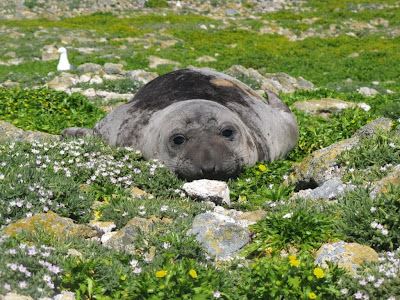
Grasshopper's pup was adopted by a another cow after Grasshopper departed. The foster mother nursed him for an additional 12 days. He is the biggest weaner on the Farallones. In the second picture, he is stuck in a pile of driftwood that washed into Mirounga Beach after one of the big storms. He eventually worked his way out after being stuck there for two days.

Tuesday, February 19, 2008

Weaner Patrol

During the winter, pregnant female northern elephant seals travel upwards of a thousand miles from their deep-ocean foraging waters to breeding beaches at SEFI and other colonies along the coast of California and Mexico. Here, the cows will give birth and nurse their pups, fasting the entire time they are on land.
January is by far the busiest month, with up to ten new cows arriving and 6 pups born each day. A cacophany of noise resounds throughout the beaches, with males bellowing to each other to assert their dominance, cows calling anxiously to their pups and snarling at each other to defend their personal space, and pups crying for more milk. The peak number of cows this year on SEFI was 117, recorded on January 31.
After the cows have nursed their pups for 3 to 4 weeks, their energy resources and stored fat are depleted, transferred to their pups who will usually triple their birth weight. Elephant seal milk is extremely rich, with some of the highest fat content of any mammal's milk.
When a cow has transferred her fat reserves to her pup, she is ready to leave. Before she departs, each cow mates with one or more of the big adult males, who have been awaiting this moment for weeks. To us, the males seem to form an obstacle course through which a cow must navigate on her way back out to sea. Some sneaky guys will even lurk in the water waiting for a final chance to mate with cows before they reach the deep water. We've seen cows copulating with 3 different males, but they have little choice, since the males are 2 to 3 times larger than the cows. Below, the bull Gimli mates with a cow while her pup looks on. You can see the battle wounds from a recent fight, when Bedlam Boy took a large bite out of Gimli's nose (see previous blog posting).
When the cow departs, she leaves behind her weaned pup, called a "weaner." On SEFI, the number of weaners surpassed the number of pups on February 16. Now, PRBO biologists are on weaner patrol, heading to the beaches each morning to see which cows have departed and to record the sex and size of their weaners. We also give each weaner a small plastic flipper tag so we can permanently identify the individual. Some day, if the animal survives, it may return to SEFI to breed as an adult, and the flipper tag will allow us to know its age, birthplace, and mother.

Friday, February 01, 2008

Bedlam Boy defeats Gimli


Another big battle today, as Bedlam Boy defeated Gimli by driving him off the Marine Terrace harem. These fights are how the elephant seals determine whose genes are the best, and who earns the right to copulate with the harem of females. Harem-based mating is called polygyny and often results in the most bizarre male appearance and behaviors in the animal world through a process called sexual selection.


Click here to see a video of this contest.

Sunday, January 20, 2008

Today in Farallon History

Today is 'Elephant Seal Day' on the Farallones. We celebrate this day to remember January 20, 1972: the birthday of the first elephant seal pup born on the Farallones after over 100 years of absence.

PRBO biologists have been observing the Farallon Islands from our field station on Farallon National Wildlife Refuge since June 7, 1967. Every evening, the biologists write a journal of all the noteworthy happenings on the islands, including the birds, marine mammals, and facilities. Here are a few gleanings from this day in Farallon Journal History.

2008


PRBO folks on the Island: Lee, Bond, Bogle, Chinn.
Southeast Farallon Island Elephant seal scorecard:
Sand Flat = 65 cows, 38 pups, 2 weaners, Salvatore is alpha bull.
Mirounga Beach = 19 cows, 13 pups, Rusty is alpha bull.
Marine Terrace Sand Flat = 14 cows and 12 pups, Bedlam Boy alpha.
Marine Terrace Mirounga Beach = 2 cows, 2 pups, Don Quixote alpha.
Huge fight between the two highest ranking bulls, Salvatore and Rusty, left Upper Mirounga Beach bloodstained, both bulls battered, and no change in dominance or harem control.

On this day in 1972 - PRBO staff on the island was: Lewis.
- First elephant seal pup born on SEFI since the species was extirpated and presumed extinct in late 1800s. Female pup was tagged Pink 1.
- Total number of elephant seals on Farallones = 2.

Also noteworthy events from 1972
- Nixon president of the US, Salvador Allende president of Chile.
- “Streets of San Francisco” TV show premieres.
- Transamerica pyramid building completed in downtown San Francisco.

30 years ago today- 1978
- PRBO staff on the island was: Huber, Morrell, Nisbet, Peaslee, Peterson, Potash, and Rovetta.
- A 20’ white shark killed and ate a cow-sized elephant seal off Sea Pigeon Gulch.
- Stormy weather created a waterspout in Mirounga Bay, and large swells washed across Sand Flat taking 1 pup out to sea.
- Sand Flat e-seal numbers = 71 cows, 43 pups, 1 weaner, Dimple is alpha bull.

Other noteworthy local events from 1978
- Dianne Feinstein, president of the San Francisco Board of Supervisors, announces that former Board of Supervisors member Dan White had murdered Mayor George Moscone and Supervisor Harvey Milk at City Hall in San Francisco. "Twinkie defense" gets White's conviction down to manslaughter.
- Johnnie Rotton quits Sex Pistols after final show of US tour at Winterland Ballroom, San Francisco.

20 years ago today- 1988 - PRBO staff on the island was: Calder, Emslie, Ferone, Lerdau, Montgomery, and Sydeman.
- Storm winds tore hundreds of shingles off the roof and blew out a window of the Salamander house. Fresh water supply tested, found to be turbid and E. coli contaminated. Boom won’t raise/lower at east landing.
- SEFI e-seal numbers = 93 cows, 43 pups. Pilgrim alpha bull at Sand Flat and Sherlock alpha at Mirounga Beach.

Other noteworthy local events from 1988
- Mandatory rationing of water for 2.1 million residents of the San Francisco area after two consecutive dry winters and a failure of voluntary efforts.

10 years ago today- 1998 - PRBO staff on the island was: Nusbaum, Pitkin, and Windsor.
- Pod of ~1000 common dolphins swam past East Landing (a sign of El NiƱo).
- Electrical power generator died during dinner.
- Sand Flat e-seal numbers = 50 cows, 37 pups. Meaty Boy alpha bull at Sand Flat, Sashimi alpha at Mirounga Beach.

- one of the strongest El Nino events in history brought the wettest San Francisco winter since 1862.

Sunday, January 06, 2008

Big swells flood Sand Flat


The big swells that accompanied this storm hit us at high tide and flooded areas of the seal colony that are normally high above the waterline. Luckily, few cows are here and none had their pups in the flooded areas of Mirounga Beach. The only pup that did wash away was already dead.


We did manage to collect a bit of rainwater to augment our dwindling supplies, but we're still way below the level we need to serve our needs for the coming year. We survive on rainwater we collect for all our fresh water needs, but last year was dry, and this winter hasn't delivered enough yet to make up our deficit. Even though the mainland received several inches of rainfall, we only got about 1 inch.


In other news, we've missed our resupply boat due to the rough seas, and we're having to get creative with cabbage and carrots for dinner since these are the only vegetables remaining. Don't worry, we have plenty of food in the pantry and we're saving energy now that the third fridge is empty and unplugged.

Tuesday, January 01, 2008

End of an Era


Joelle Buffa, Farallons Refuge Manager for US Fish and Wildlife Service for the past 13 years, is moving on to a new job.

Joelle took the ragtag, limping island facilities where electricity was rare, North Landing a crushing hazard, and water tasted strongly of gull, and she improved every aspect of island life and operations. To list her extensive improvements would take many pages, but a short list of the major projects includes:
Replacing cranky and breakdown plagued generators with 3 new gensets and installing a huge solar power system. Demolishing the ancient, defunct north landing crane and installing a new crane, stairs and landing decks including a new Zodiac. When the Coast Guard suddenly stopped delivering water, she revitalized the 100-year-old rainwater collection system and installed multiple filters, ozone and UV treatment. Replacing the tiny Boston whaler we used for east landing with a burly SAFE boat that vastly enlarged the landing possibilities. Remodeling the Murre house interior and replacing windows and exterior siding for both houses. Rebuilding the dry-stacked masonry lighthouse trail. And more.

Joelle has always worked overtime to protect these unique islands and their precious natural resources. The wildlife has always been her first priority, but a close second was always our safety and comfort. The biologists and interns of the Farallon Program at PRBO Conservation Science have all benefited from Joelle's tireless energy and passion for these islands, and she accomplished all of this without a boat.

Thank you Joelle, we'll miss you, but will continue to enjoy your legacy for many years.

One last token of Joelle's affection (and her desire to give everything a nickname) was the rechristening of the two houses on the island as 'Murre' and 'Salamander' after two of her favorite island denizens. Accompanying the new names were beautiful original artwork that now adorn the front doors.

Friday, December 28, 2007

Battle Royale 2007


We had an awesome fight for Mirounga Beach between a couple of evenly-matched bulls. Sean Bogle, our cinematic intern made a terrific video of the conflict.
Here are also some great still photos of the same battle by Sarah Chinn.


Here is a link to the raw footage of the video, for those who don't want to miss a single shove or bite.

Thursday, December 27, 2007

Weanerschnitzel!

You may remember the cow Schnitzel and her two difficult years of failed reproduction. Schnitzel's pup died in 2004 and in 2005 she abandoned her pup. However, last year her pup survived to weaning. Weaning is when a mother goes back to sea, leaving a milk-fattened offspring on the beach to fend for itself. From that day forward, these pups (now weaners), who have never known anything but the island and their mother's care, must instinctively learn to swim in the ocean, avoid predators, and feed themselves.

We tag all of our pups every year, but so few return to the Farallones in subsequent years – either because they failed to survive the sharks or because they emigrated to another colony – that we only name animals older than 1 year, and typically just breeding adults.

This month, a tagged immature was spotted on Mirounga Beach, and when we looked up his tags we discovered that he was Schnitzel's weaner from 2006. Weanerschnitzel survived his first season in the ocean where he apparently found plenty to eat.


Saturday, December 22, 2007

See Who's Back

With today’s arrival of the first elephant seal pup of the 2008 breeding season, to First Cow, we are finally starting to see some action on the main breeding beaches of the Farallon Islands. Although we only have three cows so far (including First Cow and Robin Robertson), this is typical of the beginning of December. In the past two years we documented unusually early cow arrivals, as well as the earliest pup ever born here, and we wondered whether the trend would continue, but the timing of seal arrivals appears to be back to “average.”

The big males are starting to sort out their hierarchy. Last year the three largest harems on Southeast Farallon Island were dominated by Don Francisco (Sultan of Sand Flat, by far the biggest harem), Bob Bond (Master of Mirounga Beach) and Brendan (Titan of the Terrace). None of the bull males have yet arrived, but we’re watching and waiting with bated breath. To date, we have seven large males who are potential contenders for access to females, although none of them are true bulls.

Aubrey, although relatively small in size, appears to be an aggressive fighter. Aubrey easily has everyone else – including Salvatore – running scared, and is currently the master of Sand Flat (and its two cows).


Salvatore hung out on the periphery of Sand Flat last year, constantly sneaking up on females under Don Francisco’s (very large) nose but then high-tailing it when Don bellowed his anger. Salvatore is back in the same spot this year, and has been in at least one big fight because we found him one morning on Mirounga Beach nursing some bloody wounds on his nose. When Aubrey leaves Sand Flat, Salvatore takes over, but then flees when Aubrey returns. He is bigger than Aubrey and beat him last year, so we’re still waiting to see how things shape up between them.


Bedlam Boy is another larger-sized male with a big nose who has been coming to the Farallones for several years. He has many fighting scars which make him easy to spot from afar. So far he has fled from both Aubrey and Salvatore, but he is certainly in the running for at least one of the smaller harems.


Rusty is an old favorite of ours, and was the first big male to show up this year. He has been hanging out on the Marine Terrace, perhaps saving up his energy to take over one of the harems once the cows show up in full force.


Don Quixote is a new male tagged and named this year. He first arrived on Sand Flat, but promptly was kicked off by Salvatore. Don Quixote had some bloody wounds on his back, so he’s been taking it easy at Sea Lion Cove for the past few days.


DMX is smaller but a very insistent male who aggressively pursues the females. He still flees from the bigger males but always has his eyes on the cows. Today he just took Mirounga Beach, with its one cow.


Let us know who you think is going to be the King of the Farallones this year!

Wednesday, December 05, 2007

Winter Season is Here

December 1 marked the seasonal changing of the guard for PRBO Conservation Science biologists at the Farallon Islands National Wildlife Refuge. We set right to work monitoring survival, reproduction, and population growth of one of the most intensively studied northern elephant seal breeding colonies in the world.

On our first check of Sand Flat, we discovered an immature female elephant seal with a plastic strap (the kind used to bind stacks of newspapers) stuck tightly around her neck. The ring was cutting into her flesh, making a very nasty wound, choking her slowly and painfully, and ultimately would have resulted in her death. PRBO biologist Derek Lee fashioned a hook with a sharpened inner edge on a long pole, and was able to cut off the plastic strap. After four days she is still on the beach and her wound is healing nicely.


Although people think that plastic trash is going to the landfill, very often it washes out to sea and kills wildlife. About 80% of the plastic in the ocean has been transported from non-point source pollution from storm drains, creeks, rivers, streams and beaches into the ocean, where it becomes a threat to marine life. Clear plastic bags that look like jellyfish are eaten by endangered leatherback sea turtles. Albatrosses in the North Pacific (and other seabirds) feed small plastic items to their chicks, and they eventually die. Animals are entangled in plastic straps, rings, and nets, and either drown or slowly choke to death – we typically see at least a dozen ringnecked sea lions on the Farallones every year.

An enormous area twice the size of Texas that is covered with plastic debris swirls around the central Pacific Ocean, known as the Eastern Garbage Patch. There is also a smaller area off the coast of Japan known as the Western Garbage Patch. Areas in the oceans that concentrate plastic items and fragments can threaten thousands of seabirds, sea turtles, pinnipeds, and other marine animals. In fact, according to ecologist David Laist of the Marine Mammal Commission, plastics may kill as many marine mammals as oil spills, heavy metals, or other toxic materials.

Our incident on the Farallones serves as a reminder that vast amounts of plastic, which can persist up to 1,000 years, finds its way into our ocean and ends up having severe unintended consequences. This female elephant seal was lucky, but how many other marine animals are not? One way you can help is to reduce your own consumption of plastics, and to lobby your elected officials for local measures to control storm drain runoff.