Today we had light east to southeast winds, but fog through the morning prevented many new birds from finding the island. New arrivals included Greater White-fronted Goose, Aleutian Cackling Goose, Surf Scoter, Ruddy Turnstone, Least Sandpiper, Ancient Murrelet, Cliff Swallow and Varied Thrush. The complete bird list follows.
Location: Southeast Farallon Island
Observation date: 10/26/08
Number of species: 48
Greater White-fronted Goose 7
Cackling Goose (Aleutian) 3
Surf Scoter 1
Pacific Loon 4
Eared Grebe 40
Pink-footed Shearwater 4
Black-vented Shearwater 1
Ashy Storm-Petrel 1
Brown Pelican 584
Brandt's Cormorant X
Pelagic Cormorant X
Peregrine Falcon (Continental) 2
Killdeer 1
Black Oystercatcher 33
Wandering Tattler 3
Greater Yellowlegs 1
Willet 1
Whimbrel 4
Ruddy Turnstone 1
Black Turnstone 42
Least Sandpiper 4
Heermann's Gull 1
Western Gull X
Herring Gull 10
Glaucous-winged Gull 1
Common Murre 5
Pigeon Guillemot 1
Ancient Murrelet 1
Cassin's Auklet 100
Rhinoceros Auklet 2
Barn Owl 1
Burrowing Owl 3
Black Phoebe 9
Say's Phoebe 2
Cliff Swallow 3
Rock Wren 2
House Wren 1
Varied Thrush 1
European Starling 1
American Pipit 1
Cedar Waxwing 1
Yellow-rumped Warbler (Myrtle) 3
Yellow-rumped Warbler (Audubon's) 1
Chipping Sparrow 2
White-throated Sparrow 2
Dark-eyed Junco (Oregon) 2
Western Meadowlark 4
Pine Siskin 1
Thursday, October 30, 2008

Tuesday, October 28, 2008
18th-25th October 2008
As always the internet connection has been very uncooperative, so we'll just try to post a large block of lists now that it's working. Over the past week the winds have generally been out of the northwest with varying degrees of cloud cover. There have been a smattering of new arrivals including Swamp Sparrow, Grasshopper Sparrow, Clay-colored Sparrow, Lapland Longspur, and some fly-over Cackling Geese. One of the more interesting birds on the island was a Song Sparrow, likely coming from the Pacific Northwest. We average only around two Song Sparrows a year on the island, so we were very excited to see this bird. Also on the 23rd we had a nice flight of Black-vented Shearwaters just offshore. The bird lists follow.
Song Sparrow (c) McAllister

Swamp Sparrow (c) McAllister

Grasshopper Sparrow (c) McAllister

Clay-colored Sparrow (c) McAllister

Lapland Longspur (c) McAllister

Location: Southeast Farallon Island
Observation date: 10/25/08
Number of species: 42
Eared Grebe 103
Pink-footed Shearwater 2
Brown Pelican 802
Brandt's Cormorant X
Pelagic Cormorant X
Peregrine Falcon (Continental) 3
Black Oystercatcher X
Wandering Tattler 1
Willet 1
Whimbrel 9
Black Turnstone 45
Least Sandpiper 1
Heermann's Gull 2
Western Gull X
California Gull 218
Herring Gull 2
Glaucous-winged Gull 1
Common Murre X
Burrowing Owl 2
Black Phoebe 9
Say's Phoebe 3
Brown Creeper 1
Rock Wren 1
House Wren 1
Golden-crowned Kinglet 1
European Starling 8
American Pipit 1
Cedar Waxwing 1
Yellow-rumped Warbler (Myrtle) 2
Yellow-rumped Warbler (Audubon's) 3
Palm Warbler (Western) 1
Chipping Sparrow 2
Clay-colored Sparrow 2
Grasshopper Sparrow 1
Song Sparrow 1
White-throated Sparrow 1
White-crowned Sparrow 1
Golden-crowned Sparrow 3
Dark-eyed Junco (Oregon) 3
Red-winged Blackbird 1
Western Meadowlark 9
Pine Siskin 1
Location: Southeast Farallon Island
Observation date: 10/24/08
Number of species: 42
Eared Grebe 103
Pink-footed Shearwater 2
Brown Pelican 802
Brandt's Cormorant X
Pelagic Cormorant X
Peregrine Falcon (Continental) 3
Black Oystercatcher X
Wandering Tattler 1
Willet 1
Whimbrel 9
Black Turnstone 45
Least Sandpiper 1
Heermann's Gull 2
Western Gull X
California Gull 218
Herring Gull 2
Glaucous-winged Gull 1
Common Murre X
Burrowing Owl 2
Black Phoebe 9
Say's Phoebe 3
Brown Creeper 1
Rock Wren 1
House Wren 1
Golden-crowned Kinglet 1
European Starling 8
American Pipit 1
Cedar Waxwing 1
Yellow-rumped Warbler (Myrtle) 2
Yellow-rumped Warbler (Audubon's) 3
Palm Warbler (Western) 1
Chipping Sparrow 2
Clay-colored Sparrow 2
Grasshopper Sparrow 1
Song Sparrow 1
White-throated Sparrow 1
White-crowned Sparrow 1
Golden-crowned Sparrow 3
Dark-eyed Junco (Oregon) 3
Red-winged Blackbird 1
Western Meadowlark 9
Pine Siskin 1
Location: Southeast Farallon Island
Observation date: 10/23/08
Number of species: 51
Eared Grebe 66
Pink-footed Shearwater 5
Buller's Shearwater 1
Sooty Shearwater 2
Black-vented Shearwater 33
Brown Pelican 1054
Brandt's Cormorant X
Pelagic Cormorant X
Merlin 1
Peregrine Falcon (Continental) 2
Black Oystercatcher X
Wandering Tattler 1
Willet 1
Whimbrel 7
Black Turnstone 32
Black-legged Kittiwake 1
Heermann's Gull 1
Western Gull X
California Gull 503
Herring Gull 3
Thayer's Gull 1
Glaucous-winged Gull 1
Pomarine Jaeger 3
Parasitic Jaeger 1
Common Murre X
Barn Owl 1
Burrowing Owl 3
Anna's Hummingbird 1
Black Phoebe 9
Say's Phoebe 2
Red-breasted Nuthatch 1
Rock Wren 2
House Wren 1
Golden-crowned Kinglet 1
Ruby-crowned Kinglet 2
European Starling 28
American Pipit 2
Cedar Waxwing 1
Yellow-rumped Warbler (Myrtle) 3
Yellow-rumped Warbler (Audubon's) 2
Common Yellowthroat 1
Chipping Sparrow 2
Clay-colored Sparrow 1
Song Sparrow 1
White-throated Sparrow 1
White-crowned Sparrow 2
Golden-crowned Sparrow 2
Dark-eyed Junco (Oregon) 8
Western Meadowlark 14
Pine Siskin 3
Lesser Goldfinch 1
Location: Southeast Farallon Island
Observation date: 10/22/08
Number of species: 51
Common Loon 1
Eared Grebe 95
Pink-footed Shearwater 5
Sooty Shearwater 3
Black-vented Shearwater 3
Brown Pelican 986
Peregrine Falcon (Continental) 2
Killdeer 1
Black Oystercatcher X
Wandering Tattler 1
Willet 1
Whimbrel 5
Black Turnstone 41
Heermann's Gull 41
Western Gull X
California Gull 141
Herring Gull 2
Glaucous-winged Gull 1
Common Murre X
Burrowing Owl 3
Anna's Hummingbird 1
Northern Flicker (Red-shafted) 1
Black Phoebe 7
Say's Phoebe 2
Red-breasted Nuthatch 1
Rock Wren 2
House Wren 1
Ruby-crowned Kinglet 1
Hermit Thrush 1
Varied Thrush 2
American Pipit 2
Cedar Waxwing 1
Yellow-rumped Warbler 2
Yellow-rumped Warbler (Myrtle) 5
Yellow-rumped Warbler (Audubon's) 3
Palm Warbler (Western) 1
Common Yellowthroat 1
Spotted Towhee 1
Chipping Sparrow 1
Savannah Sparrow 3
Fox Sparrow 2
Song Sparrow 1
White-throated Sparrow 2
White-crowned Sparrow 2
Golden-crowned Sparrow 3
Dark-eyed Junco (Oregon) 4
Red-winged Blackbird 1
Western Meadowlark 11
Brewer's Blackbird 1
Pine Siskin 3
Lesser Goldfinch 2
Location: Southeast Farallon Island
Observation date: 10/21/08
Number of species: 42
Common Loon 120
Eared Grebe 52
Pink-footed Shearwater 16
Buller's Shearwater 126
Sooty Shearwater 2
Brown Pelican 582
Peregrine Falcon (Continental) 3
Black Oystercatcher X
Wandering Tattler 1
Willet 1
Whimbrel 5
Black Turnstone 44
Heermann's Gull 3
Western Gull X
California Gull 520
Pomarine Jaeger 2
Common Murre X
Burrowing Owl 2
Anna's Hummingbird 1
Black Phoebe 8
Say's Phoebe 2
Red-breasted Nuthatch 2
Rock Wren 2
House Wren 1
Varied Thrush 1
American Pipit 2
Yellow-rumped Warbler 1
Yellow-rumped Warbler (Myrtle) 4
Yellow-rumped Warbler (Audubon's) 2
Black-throated Gray Warbler 1
Spotted Towhee 1
Fox Sparrow 1
Lincoln's Sparrow 1
White-throated Sparrow 1
White-crowned Sparrow 3
Golden-crowned Sparrow 1
Dark-eyed Junco (Oregon) 1
Lapland Longspur 1
Red-winged Blackbird 1
Western Meadowlark 5
House Finch 1
Lesser Goldfinch 1
Location: Southeast Farallon Island
Observation date: 10/20/08
Number of species: 40
Eared Grebe 56
Western Grebe 1
Pink-footed Shearwater 6
Buller's Shearwater 3
Brown Pelican 424
Peregrine Falcon (Continental) 2
Black Oystercatcher X
Wandering Tattler 1
Willet 1
Whimbrel 4
Black Turnstone 47
Heermann's Gull 3
Western Gull X
Western x Glaucous-winged Gull (hybrid) 1
California Gull 315
Herring Gull 4
Glaucous-winged Gull 2
Common Murre X
Burrowing Owl 1
Black Phoebe 9
Say's Phoebe 2
Red-breasted Nuthatch 3
Rock Wren 2
Ruby-crowned Kinglet 1
American Pipit 3
Yellow-rumped Warbler 3
Yellow-rumped Warbler (Myrtle) 9
Yellow-rumped Warbler (Audubon's) 7
Black-throated Gray Warbler 1
Spotted Towhee 1
Chipping Sparrow 1
Clay-colored Sparrow 1
Fox Sparrow 1
White-crowned Sparrow 2
Golden-crowned Sparrow 5
Dark-eyed Junco (Oregon) 3
Lapland Longspur 1
Western Meadowlark 4
Pine Siskin 1
Lesser Goldfinch 1
Location: Southeast Farallon Island
Observation date: 10/19/08
Number of species: 52
Cackling Goose 26
Eared Grebe 45
Pink-footed Shearwater 5
Brown Pelican 930
Brandt's Cormorant X
Pelagic Cormorant X
Peregrine Falcon (Continental) 2
Peregrine Falcon (Peale's) 1
Black Oystercatcher X
Willet 1
Whimbrel 3
Black Turnstone 55
Heermann's Gull 4
Western Gull X
California Gull 846
Herring Gull 2
Thayer's Gull 1
Glaucous-winged Gull 1
Common Murre X
Barn Owl 1
Burrowing Owl 1
Black Phoebe 6
Say's Phoebe 4
Violet-green Swallow 1
Red-breasted Nuthatch 1
Rock Wren 2
House Wren 1
Golden-crowned Kinglet 1
Ruby-crowned Kinglet 2
Hermit Thrush 1
American Pipit 1
Cedar Waxwing 2
Yellow-rumped Warbler 7
Yellow-rumped Warbler (Myrtle) 17
Yellow-rumped Warbler (Audubon's) 6
Black-throated Gray Warbler 2
Palm Warbler (Western) 2
Spotted Towhee 1
Chipping Sparrow 1
Clay-colored Sparrow 1
Fox Sparrow 1
Lincoln's Sparrow 1
Swamp Sparrow 1
White-throated Sparrow 3
White-crowned Sparrow 1
Golden-crowned Sparrow 4
Dark-eyed Junco (Oregon) 6
Red-winged Blackbird 2
Western Meadowlark 2
Brown-headed Cowbird 1
Purple Finch 1
Pine Siskin 2
Location: Southeast Farallon Island
Observation date: 10/18/08
Number of species: 39
Eared Grebe 73
Pink-footed Shearwater 5
Brown Pelican 791
Brandt's Cormorant X
Pelagic Cormorant X
Northern Harrier 1
Peregrine Falcon 2
Black Oystercatcher X
Wandering Tattler 1
Whimbrel 2
Black Turnstone 66
Heermann's Gull 2
Western Gull X
California Gull 281
Herring Gull 4
Glaucous-winged Gull 1
Common Murre X
Pigeon Guillemot X
Cassin's Auklet X
Rhinoceros Auklet X
Barn Owl 1
Burrowing Owl 3
Black Phoebe 8
Say's Phoebe 3
Red-breasted Nuthatch 2
Rock Wren 2
House Wren 1
American Pipit 1
Magnolia Warbler 1
Yellow-rumped Warbler (Myrtle) 4
Yellow-rumped Warbler (Audubon's) 2
Black-throated Gray Warbler 1
Palm Warbler (Western) 1
Chipping Sparrow 1
Fox Sparrow (Sooty) 1
White-crowned Sparrow 1
Golden-crowned Sparrow 1
Western Meadowlark 3
House Finch 1
Saturday, October 25, 2008
A Seabird guy in a Songbird season
 There are three main "seasons" on the Farallones. These are not defined by weather or hours of daylight, but rather by the species of animals that inhabit the island. December to early March is "the elephant seal season" when research activities center on the breeding biology of the Northern Elephant Seal. Mid-March through August is "the seabird season", when the life of island residents is dedicated to studying and monitoring the large colonies of seabirds which breed on the island. Finally from September to December is the "songbird season". During these months our primary focus is monitoring western landbird migration with the occasional off-course vagrant showing up to provide some identification challenges.
Can you find the vagrant clinging
to the side of the lighthouse in this photo?
Last weekend we had a crew change in which four people left the island and three new people arrived. Among those leaving was the regular songbird season biologist, who has gone off island for a two week break. We couldn't leave the island unsupervised for those two weeks so I got the opportunity to come out for a rare two week visit during songbird season. Although I have spent more then 1,000 nights on the island, most of my time has been during the spring/summer seabird breeding season.
Last weekend we had a crew change in which four people left the island and three new people arrived. Among those leaving was the regular songbird season biologist, who has gone off island for a two week break. We couldn't leave the island unsupervised for those two weeks so I got the opportunity to come out for a rare two week visit during songbird season. Although I have spent more then 1,000 nights on the island, most of my time has been during the spring/summer seabird breeding season.

View out the front door during summer with Western Gulls dominating the landscape.
Upon arriving at the island I immediately noticed many differences between the island I normally see and the island during the fall. First of all, there are no birds here! The 300,000 seabirds that occupy these rocky shores all summer are all finished breeding and have departed,  giving the island the impression of a desolate and lifeless place. Most striking is the absence of Western Gulls which seemingly cover every inch of the island during the summer. The island is also amazingly quiet. The seabird symphony of gulls screaming, guillemots whistling, and murres complaining to each other has been replaced by an eerie silence. But, there are benefits to the fall as well. There is more freedom of movement for the island biologists. Areas of the island which are normally closed for seabird breeding are once again accessible, and you can walk around without fear of being pecked in the head by an angry gull or becoming covered in bird guano.
Similar view of the Marine Terrace during the fall season.
Of course, there are still birds here. They are just smaller, quieter, and harder to find then those that inhabit the island during the summer. Brightly colored warblers and cryptic sparrows now dominate the island avifauna.  Peregrine Falcons, Burrowing Owls and Eared Grebes have returned to spend the winter. Large numbers of marine birds which are not present here during the summer stream past the island - species such as Buller's and Black-vented Shearwaters. Vagrant landbirds often make an appearance during this season when they get off course during their migration. Many songbirds that normally occur only on the East Coast or in Asia visit the Farallones during the fall giving us a unique opportunity to view some unusual species. In fact, the Farallones have been the site for many first recorded sightings of some species in California (and even a few for North America).
 Although we haven’t had any rarities during my stay, we have had many common migrants such as the Yellow-rumped warbler, Oregon Junco, and Golden-crowned Sparrow. There have also been a few notable birds including a Magnolia Warbler (above), Palm Warbler, Lapland Longspur, Clay-colored Sparrow, Violet-green Swallow, Yellow-headed Blackbird, South Polar Skua, and a Barn Owl which seems to want to come into my room at night.
Whether you study seabirds, songbirds, or elephant seals, the Farallones always stand out as a special place and a true refuge for many types of wildlife. When this week is over, I will return to the mainland and will probably not be back until the seabirds return to breed in the spring. That is the nature of my Farallones migration. I suppose my short, “out of season” visit to the island makes me just one more vagrant to find my way to the island this fall.
Below is a list of the birds that we have seen over the past week.
October 15th:
Eared Grebe 45
Pink-footed Shearwater 31
Buller's Shearwater 78
Sooty Shearwater 2
Ashy Storm-Petrel X
Brown Pelican 947
Merlin 1
Peregrine Falcon 2
Black Oystercatcher 28
Wandering Tattler 2
Whimbrel 6
Ruddy Turnstone 1
Black Turnstone 52
Heermann's Gull 6
Western Gull X
California Gull 1107
Herring Gull 3
Parasitic Jaeger 1
Common Murre X
Barn Owl 1
Black Phoebe 6
Say's Phoebe 2
Western Kingbird 1
Red-breasted Nuthatch 2
Rock Wren 2
House Wren 1
Golden-crowned Kinglet 4
Ruby-crowned Kinglet 3
American Robin 1
Yellow Warbler 1
Yellow-rumped Warbler (Myrtle) 7
Yellow-rumped Warbler (Audubon's) 3
Black-throated Gray Warbler 1
Savannah Sparrow 1
White-throated Sparrow 1
White-crowned Sparrow 1
Golden-crowned Sparrow 1
Dark-eyed Junco (Oregon) 2
Western Meadowlark 9
October 16th:
Eared Grebe 60
Pink-footed Shearwater 16
Buller's Shearwater 44
Sooty Shearwater 1
Black-vented Shearwater 7
Ashy Storm-Petrel X
Brown Pelican 641
Brandt's Cormorant X
Pelagic Cormorant X
Peregrine Falcon 3
Wandering Tattler 2
Whimbrel 8
Ruddy Turnstone 1
Black Turnstone 60
Least Sandpiper 4
Heermann's Gull 2
Western Gull X
California Gull 406
Herring Gull 9
Pomarine Jaeger 4
Parasitic Jaeger 1
Common Murre X
Cassin's Auklet X
Barn Owl 1
Burrowing Owl 3
Black Phoebe 7
Say's Phoebe 4
Western Kingbird 1
Red-breasted Nuthatch 4
Rock Wren 2
House Wren 1
Hermit Thrush 1
American Robin 1
American Pipit 1
Yellow-rumped Warbler (Myrtle) 3
Yellow-rumped Warbler (Audubon's) 3
Black-throated Gray Warbler 1
Chipping Sparrow 1
Clay-colored Sparrow 1
Lark Sparrow 1
White-throated Sparrow 1
Golden-crowned Sparrow 1
Dark-eyed Junco (Oregon) 1
Western Meadowlark 8
Pine Siskin 1
October 17th:
Cackling Goose 14
Eared Grebe 82
Pink-footed Shearwater 1
Ashy Storm-Petrel X
Brown Pelican 921
Brandt's Cormorant X
Pelagic Cormorant X
Northern Harrier 1
Peregrine Falcon 3
Wandering Tattler 3
Willet 1
Whimbrel 2
Black Turnstone 85
Least Sandpiper 3
Heermann's Gull 4
Ring-billed Gull 2
Western Gull X
California Gull 363
Herring Gull 5
Glaucous-winged Gull 1
Common Murre X
Pigeon Guillemot X
Cassin's Auklet X
Rhinoceros Auklet X
Barn Owl 1
Burrowing Owl 1
Anna's Hummingbird 2
Black Phoebe 8
Say's Phoebe 2
Red-breasted Nuthatch 4
Rock Wren 2
House Wren 1
Golden-crowned Kinglet 1
Swainson's Thrush 1
American Robin 2
American Pipit 1
Magnolia Warbler 1
Yellow-rumped Warbler (Myrtle) 5
Yellow-rumped Warbler (Audubon's) 5
Black-throated Gray Warbler 1
Spotted Towhee 1
Chipping Sparrow 2
Lark Sparrow 1
White-throated Sparrow 1
Western Meadowlark 7
Yellow-headed Blackbird 1
Yellow-headed Blackbird (c) McAllister

Monday, October 20, 2008
14-October-2008
Light and variable winds with cloud cover overnight gave us hope for a wave day, but by morning we were in some pretty heavy fog. Since any migrating birds would have a hard time finding the island, we ended up only seeing a few new arrivals (flock of Cackling Geese flying over, Cassin's Vireo, and Tree Swallow). We saw a few more pods of Risso's Dolphins as well.
The other big island news is that the powerhouse roof/solar panel refurbishing was completed today. We are now back up and running on solar again.
The bird list follows.
Location: Southeast Farallon Island
Observation date: 10/14/08
Number of species: 48
Cackling Goose 34
Eared Grebe 24
Northern Fulmar 1
Pink-footed Shearwater 1
Buller's Shearwater 21
Brown Pelican 501
Merlin 1
Peregrine Falcon 3
Killdeer 1
Wandering Tattler 1
Whimbrel 2
Black Turnstone 37
Black-legged Kittiwake 1
Heermann's Gull 5
Western Gull X
California Gull 438
Herring Gull 2
Glaucous-winged Gull 1
Common Murre X
Burrowing Owl 1
Anna's Hummingbird 1
Northern Flicker (Red-shafted) 2
Black Phoebe 5
Say's Phoebe 3
Western Kingbird 1
Cassin's Vireo 1
Tree Swallow 3
Red-breasted Nuthatch 6
Rock Wren 2
House Wren 1
Golden-crowned Kinglet 5
American Robin 2
American Pipit 2
Yellow-rumped Warbler 3
Yellow-rumped Warbler (Myrtle) 4
Yellow-rumped Warbler (Audubon's) 11
Black-throated Gray Warbler 1
Palm Warbler 1
Spotted Towhee 1
Savannah Sparrow 1
Lincoln's Sparrow 1
White-throated Sparrow 2
White-crowned Sparrow 3
Golden-crowned Sparrow 2
Dark-eyed Junco (Oregon) 3
Red-winged Blackbird 1
Western Meadowlark 5
Pine Siskin 1
13-October-2008
Light winds with high visibility meant only a handful on new arrivals, but with most of the birds from yesterday sticking around. New birds included: Band-tailed Pigeon, Western Flycatcher, American Robin, Varied Thrush, Black-throated Gray Warbler, Spotted Towhee, Fox Sparrow, and Lincoln's Sparrow. We also saw a shark attack off of Saddle Rock, a couple pods of Risso's Dolphins, and a good flight of California Tortoiseshell butterflies. The bird list is below.
Location: Southeast Farallon Island
Observation date: 10/13/08
Number of species: 55
Pacific Loon 1
Eared Grebe 43
Pink-footed Shearwater 8
Buller's Shearwater 12
Sooty Shearwater 1
Brown Pelican 318
Merlin 1
Peregrine Falcon 4
Killdeer 2
Wandering Tattler 2
Willet 1
Whimbrel 2
Black Turnstone 30
Heermann's Gull 2
California Gull 197
Herring Gull 4
Band-tailed Pigeon 1
Mourning Dove 1
Burrowing Owl 2
Anna's Hummingbird 1
Northern Flicker (Red-shafted) 3
Pacific-slope/Cordilleran Flycatcher (Western) 1
Black Phoebe 7
Say's Phoebe 3
Western Kingbird 1
Red-breasted Nuthatch 8
Rock Wren 2
House Wren 1
Golden-crowned Kinglet 7
Ruby-crowned Kinglet 19
Hermit Thrush 1
American Robin 1
Varied Thrush 1
American Pipit 2
Orange-crowned Warbler 1
Yellow-rumped Warbler 3
Yellow-rumped Warbler (Myrtle) 15
Yellow-rumped Warbler (Audubon's) 12
Black-throated Gray Warbler 1
Palm Warbler 1
Spotted Towhee 1
Clay-colored Sparrow 1
Savannah Sparrow 14
Fox Sparrow (Sooty) 5
Lincoln's Sparrow 2
White-throated Sparrow 2
White-crowned Sparrow 5
Golden-crowned Sparrow 7
Dark-eyed Junco (Oregon) 8
Red-winged Blackbird 5
Western Meadowlark 11
Brewer's Blackbird 1
Brown-headed Cowbird 1
House Finch 5
Pine Siskin 6
12-October-2008
Today was a boat day, meaning that we were transferring people and supplies from a boat to the island. The transfer was made easier because yesterday a helicopter ferrying the crew working on the roof back to the mainland, brought out all of our food. That left just people and gear to move back and forth. Four of our crew left and three new biologists came on. The winds lightened up even more today and we saw more new arrivals. Highlights include: Sharp-shinned Hawk, Merlin, Western Kingbird, Wilson's Warbler, Clay-colored Sparrow and Pine Siskin. A shark attack was seen off of Great Arch. The full bird list is below.
Location: Southeast Farallon Island
Observation date: 10/12/08
Number of species: 56
Surf Scoter 1
Common Loon 2
Eared Grebe 30
Pink-footed Shearwater 30
Buller's Shearwater 20
Sooty Shearwater 2
Ashy Storm-Petrel X
Brown Pelican 580
Brandt's Cormorant X
Double-crested Cormorant X
Pelagic Cormorant X
Sharp-shinned Hawk 1
Merlin 1
Peregrine Falcon 2
Killdeer 1
Black Oystercatcher 6
Wandering Tattler 2
Greater Yellowlegs 1
Whimbrel 4
Black Turnstone 14
Sabine's Gull 2
Heermann's Gull 2
Western Gull X
California Gull 453
Herring Gull 2
Thayer's Gull 1
Common Murre X
Cassin's Auklet X
Mourning Dove 1
Anna's Hummingbird 1
Northern Flicker (Red-shafted) 1
Black Phoebe 4
Say's Phoebe 2
Western Kingbird 1
Red-breasted Nuthatch 8
Rock Wren 1
House Wren 1
Golden-crowned Kinglet 2
Ruby-crowned Kinglet 5
Hermit Thrush 3
Orange-crowned Warbler 4
Yellow-rumped Warbler (Myrtle) 4
Yellow-rumped Warbler (Audubon's) 6
Palm Warbler (Western) 1
Wilson's Warbler 1
Clay-colored Sparrow 1
Savannah Sparrow 3
White-throated Sparrow 1
White-crowned Sparrow 3
Golden-crowned Sparrow 1
Dark-eyed Junco (Oregon) 1
Red-winged Blackbird 3
Western Meadowlark 4
Brewer's Blackbird 2
Pine Siskin 1
Lesser Goldfinch 1
Location: Southeast Farallon Island
Observation date: 10/12/08
Number of species: 56
Surf Scoter 1
Common Loon 2
Eared Grebe 30
Pink-footed Shearwater 30
Buller's Shearwater 20
Sooty Shearwater 2
Ashy Storm-Petrel X
Brown Pelican 580
Brandt's Cormorant X
Double-crested Cormorant X
Pelagic Cormorant X
Sharp-shinned Hawk 1
Merlin 1
Peregrine Falcon 2
Killdeer 1
Black Oystercatcher 6
Wandering Tattler 2
Greater Yellowlegs 1
Whimbrel 4
Black Turnstone 14
Sabine's Gull 2
Heermann's Gull 2
Western Gull X
California Gull 453
Herring Gull 2
Thayer's Gull 1
Common Murre X
Cassin's Auklet X
Mourning Dove 1
Anna's Hummingbird 1
Northern Flicker (Red-shafted) 1
Black Phoebe 4
Say's Phoebe 2
Western Kingbird 1
Red-breasted Nuthatch 8
Rock Wren 1
House Wren 1
Golden-crowned Kinglet 2
Ruby-crowned Kinglet 5
Hermit Thrush 3
Orange-crowned Warbler 4
Yellow-rumped Warbler (Myrtle) 4
Yellow-rumped Warbler (Audubon's) 6
Palm Warbler (Western) 1
Wilson's Warbler 1
Clay-colored Sparrow 1
Savannah Sparrow 3
White-throated Sparrow 1
White-crowned Sparrow 3
Golden-crowned Sparrow 1
Dark-eyed Junco (Oregon) 1
Red-winged Blackbird 3
Western Meadowlark 4
Brewer's Blackbird 2
Pine Siskin 1
Lesser Goldfinch 1
11-October-2008
The winds of the past few days finally started to calm down, though they were still blowing 15 knots. Compared to the 30 knot winds, it felt like a light breeze. With this slight change in weather we saw a handful of new arrivals. They included: Least Sandpiper, Anna's Hummingbird, another pure Yellow-shafted Flicker, Red-breasted Nuthatch, Hermit Thrush, Varied Thrush, American Pipit, Orange-crowned Warbler, Audubon's Warbler, Myrtle Warbler, Common Yellowthroat, Golden-crowned Sparrow, Lapland Longspur, Red-winged Blackbird, and Lesser Goldfinch. The complete species list is below.
Location: Southeast Farallon Island
Observation date: 10/11/08
Number of species: 48
Surf Scoter 3
Pacific Loon 1
Eared Grebe 19
Pink-footed Shearwater 23
Buller's Shearwater 11
Sooty Shearwater 4
Ashy Storm-Petrel X
Brown Pelican 253
Brandt's Cormorant X
Pelagic Cormorant X
Peregrine Falcon 3
Black Oystercatcher 28
Wandering Tattler 2
Whimbrel 5
Black Turnstone 22
Least Sandpiper 1
Red Phalarope 1
Black-legged Kittiwake 1
Heermann's Gull 15
Western Gull X
California Gull 774
Herring Gull 4
Thayer's Gull 1
Pomarine Jaeger 1
Barn Owl 1
Burrowing Owl 1
Anna's Hummingbird 2
Northern Flicker (Yellow-shafted) 1
Black Phoebe 4
Say's Phoebe 2
Red-breasted Nuthatch 1
Hermit Thrush 1
Varied Thrush 1
European Starling 7
American Pipit 1
Orange-crowned Warbler 2
Yellow-rumped Warbler (Myrtle) 3
Yellow-rumped Warbler (Audubon's) 2
Palm Warbler (Western) 1
Common Yellowthroat 1
Savannah Sparrow 1
White-throated Sparrow 2
White-crowned Sparrow 2
Golden-crowned Sparrow 1
Lapland Longspur 1
Red-winged Blackbird 1
Western Meadowlark 2
Lesser Goldfinch 1
10-October-2008
Our third straight day of very high NW winds was relected in our low species total. We only had 10 individual passerines of 7 species. A tough day for all of the biologists. The "list" is below.
Location: Southeast Farallon Island
Observation date: 10/10/08
Number of species: 20
Pacific Loon 4
Eared Grebe 18
Pink-footed Shearwater 25
Buller's Shearwater 25
Sooty Shearwater 14
Brown Pelican 11
Peregrine Falcon (Continental) 3
Wandering Tattler 2
Whimbrel 1
Black Turnstone 14
Heermann's Gull 1
California Gull 166
Pomarine Jaeger 3
Black Phoebe 3
Say's Phoebe 2
House Wren 1
Palm Warbler (Western) 1
Savannah Sparrow 1
White-crowned Sparrow 1
Western Meadowlark 1
Thursday, October 16, 2008
Playing catch-up
The internet connection has been very spotty and so we haven't been able to get the bird lists up in a timely fashion. For the 6th-9th of October the winds started out moderate and increased to heavy from the NW. The bird lists reflect that by not having many new birds and decreasing diversity as the winds picked up. Highlights were a South Polar Skua on the 7th and a pure Yellow-shafted Flicker on the 8th. Red-shafted and Yellow-shafted Flickers hybridize so we always make sure to check all the flickers for traits of both subspecies. The birds lists are below.
Location: Southeast Farallon Island
Observation date: 10/6/08
Number of species: 42
Greater White-fronted Goose 1
Northern Pintail 1
Eared Grebe 28
Brown Pelican X
Brandt's Cormorant X
Pelagic Cormorant X
Peregrine Falcon (Continental) 2
Killdeer 5
Black Oystercatcher X
Wandering Tattler 5
Whimbrel 8
Black Turnstone 59
Least Sandpiper 1
Heermann's Gull 5
Western Gull X
California Gull 81
Common Murre X
Pigeon Guillemot X
Cassin's Auklet X
Rhinoceros Auklet X
Burrowing Owl 1
Least Flycatcher 1
Black Phoebe 7
Say's Phoebe 3
House Wren 1
Hermit Thrush 3
American Pipit 2
Yellow Warbler 1
Magnolia Warbler 1
Yellow-rumped Warbler (Myrtle) 1
Yellow-rumped Warbler (Audubon's) 5
Palm Warbler (Western) 1
Common Yellowthroat 1
Clay-colored Sparrow 1
Lark Sparrow 1
Savannah Sparrow 2
Fox Sparrow (Sooty) 1
White-crowned Sparrow 4
Golden-crowned Sparrow 3
Dark-eyed Junco (Oregon) 4
Brewer's Blackbird 1
Lesser Goldfinch 1
Location: Southeast Farallon Island
Observation date: 10/7/08
Number of species: 43
Pacific Loon 1
Eared Grebe 15
Pink-footed Shearwater 18
Buller's Shearwater 11
Sooty Shearwater 1
Brown Pelican 280
Brandt's Cormorant X
Pelagic Cormorant X
Peregrine Falcon (Continental) 1
Killdeer 2
Black Oystercatcher X
Wandering Tattler 1
Whimbrel 3
Black Turnstone 19
Heermann's Gull 4
California Gull 460
South Polar Skua 1
Pomarine Jaeger 2
Common Murre X
Cassin's Auklet X
Rhinoceros Auklet X
Burrowing Owl 1
Black Phoebe 5
Say's Phoebe 3
Violet-green Swallow 3
Barn Swallow 1
Red-breasted Nuthatch 1
American Pipit 3
Yellow Warbler 2
Yellow-rumped Warbler (Myrtle) 2
Yellow-rumped Warbler (Audubon's) 4
Palm Warbler (Western) 1
Common Yellowthroat 1
Chipping Sparrow 1
Clay-colored Sparrow 1
Lark Sparrow 1
Savannah Sparrow 1
Fox Sparrow (Sooty) 1
White-crowned Sparrow 2
Golden-crowned Sparrow 2
Dark-eyed Junco (Oregon) 4
Western Meadowlark 1
Lesser Goldfinch 1
Location: Southeast Farallon Island
Observation date: 10/8/08
Number of species: 36
Northern Pintail 1
Eared Grebe 25
Pink-footed Shearwater 22
Buller's Shearwater 15
Sooty Shearwater 4
Brown Pelican 270
Brandt's Cormorant X
Pelagic Cormorant X
Peregrine Falcon (Continental) 1
Black Oystercatcher X
Whimbrel 5
Black Turnstone 20
Least Sandpiper 8
Heermann's Gull 1
Western Gull X
California Gull 60
Pomarine Jaeger 4
Common Murre X
Cassin's Auklet X
Rhinoceros Auklet X
Burrowing Owl 2
Northern Flicker (Yellow-shafted) 1 adult male
Black Phoebe 6
Say's Phoebe 3
Red-breasted Nuthatch 1
House Wren 1
American Pipit 6
Yellow-rumped Warbler (Myrtle) 2
Yellow-rumped Warbler (Audubon's) 4
Palm Warbler (Western) 2
Common Yellowthroat 1
Lark Sparrow 1
Savannah Sparrow 2
Golden-crowned Sparrow 2
Lapland Longspur 1
Western Meadowlark 1
Location: Southeast Farallon Island
Observation date: 10/9/08
Number of species: 17
Pacific Loon 1
Pink-footed Shearwater 1
Buller's Shearwater 21
Sooty Shearwater 1
Short-tailed Shearwater 1
Brown Pelican 7
Peregrine Falcon 2
Wandering Tattler 2
Whimbrel 1
Black Turnstone 5
California Gull 8
Burrowing Owl 1
Black Phoebe 5
Say's Phoebe 1
American Pipit 1
Palm Warbler 1
Western Meadowlark 1
Location: Southeast Farallon Island
Observation date: 10/6/08
Number of species: 42
Greater White-fronted Goose 1
Northern Pintail 1
Eared Grebe 28
Brown Pelican X
Brandt's Cormorant X
Pelagic Cormorant X
Peregrine Falcon (Continental) 2
Killdeer 5
Black Oystercatcher X
Wandering Tattler 5
Whimbrel 8
Black Turnstone 59
Least Sandpiper 1
Heermann's Gull 5
Western Gull X
California Gull 81
Common Murre X
Pigeon Guillemot X
Cassin's Auklet X
Rhinoceros Auklet X
Burrowing Owl 1
Least Flycatcher 1
Black Phoebe 7
Say's Phoebe 3
House Wren 1
Hermit Thrush 3
American Pipit 2
Yellow Warbler 1
Magnolia Warbler 1
Yellow-rumped Warbler (Myrtle) 1
Yellow-rumped Warbler (Audubon's) 5
Palm Warbler (Western) 1
Common Yellowthroat 1
Clay-colored Sparrow 1
Lark Sparrow 1
Savannah Sparrow 2
Fox Sparrow (Sooty) 1
White-crowned Sparrow 4
Golden-crowned Sparrow 3
Dark-eyed Junco (Oregon) 4
Brewer's Blackbird 1
Lesser Goldfinch 1
Location: Southeast Farallon Island
Observation date: 10/7/08
Number of species: 43
Pacific Loon 1
Eared Grebe 15
Pink-footed Shearwater 18
Buller's Shearwater 11
Sooty Shearwater 1
Brown Pelican 280
Brandt's Cormorant X
Pelagic Cormorant X
Peregrine Falcon (Continental) 1
Killdeer 2
Black Oystercatcher X
Wandering Tattler 1
Whimbrel 3
Black Turnstone 19
Heermann's Gull 4
California Gull 460
South Polar Skua 1
Pomarine Jaeger 2
Common Murre X
Cassin's Auklet X
Rhinoceros Auklet X
Burrowing Owl 1
Black Phoebe 5
Say's Phoebe 3
Violet-green Swallow 3
Barn Swallow 1
Red-breasted Nuthatch 1
American Pipit 3
Yellow Warbler 2
Yellow-rumped Warbler (Myrtle) 2
Yellow-rumped Warbler (Audubon's) 4
Palm Warbler (Western) 1
Common Yellowthroat 1
Chipping Sparrow 1
Clay-colored Sparrow 1
Lark Sparrow 1
Savannah Sparrow 1
Fox Sparrow (Sooty) 1
White-crowned Sparrow 2
Golden-crowned Sparrow 2
Dark-eyed Junco (Oregon) 4
Western Meadowlark 1
Lesser Goldfinch 1
Location: Southeast Farallon Island
Observation date: 10/8/08
Number of species: 36
Northern Pintail 1
Eared Grebe 25
Pink-footed Shearwater 22
Buller's Shearwater 15
Sooty Shearwater 4
Brown Pelican 270
Brandt's Cormorant X
Pelagic Cormorant X
Peregrine Falcon (Continental) 1
Black Oystercatcher X
Whimbrel 5
Black Turnstone 20
Least Sandpiper 8
Heermann's Gull 1
Western Gull X
California Gull 60
Pomarine Jaeger 4
Common Murre X
Cassin's Auklet X
Rhinoceros Auklet X
Burrowing Owl 2
Northern Flicker (Yellow-shafted) 1 adult male
Black Phoebe 6
Say's Phoebe 3
Red-breasted Nuthatch 1
House Wren 1
American Pipit 6
Yellow-rumped Warbler (Myrtle) 2
Yellow-rumped Warbler (Audubon's) 4
Palm Warbler (Western) 2
Common Yellowthroat 1
Lark Sparrow 1
Savannah Sparrow 2
Golden-crowned Sparrow 2
Lapland Longspur 1
Western Meadowlark 1
Location: Southeast Farallon Island
Observation date: 10/9/08
Number of species: 17
Pacific Loon 1
Pink-footed Shearwater 1
Buller's Shearwater 21
Sooty Shearwater 1
Short-tailed Shearwater 1
Brown Pelican 7
Peregrine Falcon 2
Wandering Tattler 2
Whimbrel 1
Black Turnstone 5
California Gull 8
Burrowing Owl 1
Black Phoebe 5
Say's Phoebe 1
American Pipit 1
Palm Warbler 1
Western Meadowlark 1
Wednesday, October 08, 2008
Farallonathon Postscript
During this year’s dismal Farallonathon, which we knew could be the worst on record, we looked back into past journals to determine what the lowest total had ever been. We found that 1992 was the first year of the Farallonathon. From 1993-1995 they called it the Farallon Research Week, but continued with the same point system as 1992. Over the past 16 years the lowest total was 133 points in 1995. The point system has gone through some slight modifications over the years, and because of this, the totals are not fairly compared. In an effort to put all years on an equal playing field (and possibly bring this year out of last place) we recalculated previous totals with the current point system (began in 2004).
In the current point system, the following sightings receive points:
breeding birds (1 point), pinnipeds (1), cetaceans (1), bats (1), butterflies (1), dragonflies (1), salamanders (1), shark sighting (1), shark attack (5), fish (1), turtles (1), migrant birds (1), CBRC birds (5), and any new island record (10). For most of the above, each new species for the week sighted gets awarded a point. The exceptions are shark sightings, shark attacks, and CBRC birds in which each individual sighting is awarded points (i.e., 3 shark attacks in one day gets 15 points, 2 Red-throated Pipits receive 10 points). In the past, all shark sightings were worth 5 points, and they didn’t give fish any points.
Below we list the past totals as they were recorded at the time as well as the recalculated totals under the current point system. Unfortunately, this year was still, by far, the worst Farallonathon on record. Doh!

Year Journal Total Recalculated Total
1992 147 152
1993 149 149
1994 200 202
1995 133 133
1996 175 178
1997 188 164
1998 230 222
1999 196 180
2000 240 216
2001 244 240
2002 174 175
2003 195 183
2004 216 216
2005 146 146
2006 185 185
2007 139 139
2008 129 129
5-October-2008
****FARALLONATHON DAY 7****
The last day of Farallonathon was somewhat eventful….though, much less than we had hoped for. The winds were light out of the SSW, but visibility was good enough that we (and the birds) could see the mainland. We added 11 points, making this the lowest final total (129 points) for the history of the Farallonathon. We all cried shamelessly and endlessly, possibly raising the level of the Pacific Ocean with our tears. Ok, ok….it really wasn’t that bad. We all shook our hands at the sky at the end of the day and continued on our daily activities on the Island while trying to move on with our lives. So, what did we see on our last day of the FARALLONATHON?
FISH 1 China Rockfish (1point)
DAMSELFLIES: 1 Swift Forktail (1; possibly a first island record)
BIRDS: 1 Tufted Puffin (1; our last breeder to be found since most finished breeding weeks ago and have left the island by now)
3 Common Loons (1)
1 Northern Pintail (1)
1 Glaucous-winged X Western Gull (1; yeah, a point for a hybrid….that’s right!)
1 Rufous/Allen’s Hummingbird (1)
1 Wilson’s Warbler (1)
1 Lapland Longspur (1)
1 Brewer’s Blackbird (1)
ebird list below:
Location: Southeast Farallon Island
Observation date: 10/5/08
Number of species: 42
Greater White-fronted Goose 1
Northern Pintail 1
Common Loon 3
Eared Grebe 23
Pink-footed Shearwater 13
Buller's Shearwater 3
Sooty Shearwater 4
Brown Pelican 801
Brandt's Cormorant X
Pelagic Cormorant X
Peregrine Falcon 3
Black Oystercatcher 41
Wandering Tattler 3
Whimbrel 6
Black Turnstone 78
Heermann's Gull 19
Western Gull X
Western x Glaucous-winged Gull (hybrid) 1
California Gull 77
Common Murre X
Pigeon Guillemot X
Cassin's Auklet X
Rhinoceros Auklet X
Tufted Puffin 1
Barn Owl 1
Burrowing Owl 1
Rufous/Allen's Hummingbird 1
Least Flycatcher 1
Black Phoebe 4
Say's Phoebe 2
House Wren 1
American Pipit 3
Magnolia Warbler 1
Yellow-rumped Warbler (Myrtle) 1
Yellow-rumped Warbler (Audubon's) 1
Wilson's Warbler (Pacific Coast) 1
Chipping Sparrow 2
Clay-colored Sparrow 1
Savannah Sparrow 1
Dark-eyed Junco (Oregon) 1
Lapland Longspur 1
Brewer's Blackbird 1
The last day of Farallonathon was somewhat eventful….though, much less than we had hoped for. The winds were light out of the SSW, but visibility was good enough that we (and the birds) could see the mainland. We added 11 points, making this the lowest final total (129 points) for the history of the Farallonathon. We all cried shamelessly and endlessly, possibly raising the level of the Pacific Ocean with our tears. Ok, ok….it really wasn’t that bad. We all shook our hands at the sky at the end of the day and continued on our daily activities on the Island while trying to move on with our lives. So, what did we see on our last day of the FARALLONATHON?
FISH 1 China Rockfish (1point)
DAMSELFLIES: 1 Swift Forktail (1; possibly a first island record)
Swift Forktail (teneral female)
Photo © Matt Brady
SALAMANDER 1 Arboreal Sally (1; due to the evening search by one of the hopelessly dedicated interns)Photo © Matt Brady
BIRDS: 1 Tufted Puffin (1; our last breeder to be found since most finished breeding weeks ago and have left the island by now)
3 Common Loons (1)
1 Northern Pintail (1)
1 Glaucous-winged X Western Gull (1; yeah, a point for a hybrid….that’s right!)
1 Rufous/Allen’s Hummingbird (1)
1 Wilson’s Warbler (1)
1 Lapland Longspur (1)
1 Brewer’s Blackbird (1)
ebird list below:
Location: Southeast Farallon Island
Observation date: 10/5/08
Number of species: 42
Greater White-fronted Goose 1
Northern Pintail 1
Common Loon 3
Eared Grebe 23
Pink-footed Shearwater 13
Buller's Shearwater 3
Sooty Shearwater 4
Brown Pelican 801
Brandt's Cormorant X
Pelagic Cormorant X
Peregrine Falcon 3
Black Oystercatcher 41
Wandering Tattler 3
Whimbrel 6
Black Turnstone 78
Heermann's Gull 19
Western Gull X
Western x Glaucous-winged Gull (hybrid) 1
California Gull 77
Common Murre X
Pigeon Guillemot X
Cassin's Auklet X
Rhinoceros Auklet X
Tufted Puffin 1
Barn Owl 1
Burrowing Owl 1
Rufous/Allen's Hummingbird 1
Least Flycatcher 1
Black Phoebe 4
Say's Phoebe 2
House Wren 1
American Pipit 3
Magnolia Warbler 1
Yellow-rumped Warbler (Myrtle) 1
Yellow-rumped Warbler (Audubon's) 1
Wilson's Warbler (Pacific Coast) 1
Chipping Sparrow 2
Clay-colored Sparrow 1
Savannah Sparrow 1
Dark-eyed Junco (Oregon) 1
Lapland Longspur 1
Brewer's Blackbird 1
4-October-2008
****FARALLONATHON DAY 6****
Absolutely no new birds arrived on the island, allowing us to delve deeply into the fun-filled world of data entry!!! Even though we were not socked in with fog today, the light westerly winds must have pushed the birds towards the mainland. Although there were no birds to look at today, the White Sharks put on quite a show for us with 3 attacks: 2 off Shubrick and one in Mirounga Bay. All three attacks appeared to be on California Sea Lions because they happened quickly with the carcass and shark disappearing under the water after a just a minute or two, and the blood and gulls dissipated rapidly. At five points a piece, these three shark attacks gave us 15 points for the day and brought our overall total up to118 points.
ebird list below:
Location: Southeast Farallon Island
Observation date: 10/4/08
Number of species: 34
Greater White-fronted Goose 6
Eared Grebe 13
Pink-footed Shearwater 26
Buller's Shearwater 15
Sooty Shearwater 8
Short-tailed Shearwater 1
Ashy Storm-Petrel X
Brown Pelican 651
Brandt's Cormorant X
Pelagic Cormorant X
Peregrine Falcon (Continental) 2
Black Oystercatcher X
Wandering Tattler 2
Greater Yellowlegs 1
Whimbrel 3
Black Turnstone 45
Western Sandpiper 1
Least Sandpiper 1
Pectoral Sandpiper 1
Heermann's Gull 12
Western Gull X
California Gull 129
Pomarine Jaeger 3
Barn Owl 1
Burrowing Owl 1
Black Phoebe 3
Say's Phoebe 3
House Wren 1
Magnolia Warbler 1
Yellow-rumped Warbler (Myrtle) 1
Palm Warbler (Western) 1
Chipping Sparrow 4
Clay-colored Sparrow 1
Savannah Sparrow 3
3-October-2008
****FARALLONATHON DAY 5****
Today was a major boat day, with 14 people arriving on the Island. Most were contractors that began work on refurbishing our solar panel system. Amazingly, virtually everything on the Island is powered entirely by 30 solar panels on the roof of the Power House. We derive all of the power we need to live on the Island from the sun! Even the lighthouse, with its six powerful beams, is powered by the sun. The only thing on the Island that is not powered by solar power is the boom that we use to move the boat on and off the island. It is powered by two diesel generators that also serve as a back-up power supply. The new solar power array will be new-and-improved and modernized and the project will (hopefully) be finished by the end of the week.
Similar to yesterday, the morning winds were light out of the SSW, but with a thick blanket of fog concealling the island from most of the wayward migrants. Despite this, we added four new species of birds to our Farallonathon total today: a Greater Yellowlegs flew by the Lighthouse, a Least Flycatcher was found near E-Seal Blind Hill, an Eastern Phoebe was at Sea Lion Cove, and a Bay-breasted Warbler was on Corm Blind Hill. A mid-sized Mola Mola, or Ocean Sunfish, was spotted from the Lighthouse during shark watch, for another point. Mola Molas generally only show up in ‘warm water’ years, so seeing this odd fish from the Island was a nice treat. Finally, a shark attack on an immature Elephant Seal east of Fisherman’s Bay gave us five points. We gained ten new points for the day, leaving us at 103 Farallonathon points.
Eastern Phoebe
Photo © Matt Brady Bay-breasted Warbler
 Photo © Matt Brady 
ebird list below:
Location: Southeast Farallon Island
Observation date: 10/3/08
Number of species: 34
Greater White-fronted Goose 13
Eared Grebe 17
Pink-footed Shearwater 14
Ashy Storm-Petrel X
Brown Pelican X
Brandt's Cormorant X
Pelagic Cormorant X
Peregrine Falcon (Continental) 2
Black Oystercatcher X
Wandering Tattler 4
Greater Yellowlegs 1
Whimbrel 7
Black Turnstone 20
Least Sandpiper 1
Heermann's Gull 43
Western Gull X
California Gull 412
Barn Owl 1
Burrowing Owl 1
Least Flycatcher 1
Black Phoebe 6
Eastern Phoebe 1
Say's Phoebe 3
House Wren 1
Chestnut-sided Warbler 1
Magnolia Warbler 1
Yellow-rumped Warbler (Myrtle) 1
Yellow-rumped Warbler (Audubon's) 1
Palm Warbler (Western) 1
Bay-breasted Warbler 1
Ovenbird 1
Chipping Sparrow 4
Clay-colored Sparrow 1
Savannah Sparrow 2
2-October-2008
****FARALLONATHON DAY 4****
Farallonathon Day 4 was very quiet and yielded only a couple of new additions to our list. The winds were light out of the SSW, which is not bad, but a thick fog settled in making it difficult for birds to find the island. A shark attack on a California Seal Lion just off the East Landing Buoy gave us five points, while a flock of 45 Greater White-fronted Geese and 2 Barn Owls granted us one point each. With these additions our Farallonathon total stood at 93 points by the end of the day.
ebird list below:
Location: Southeast Farallon Island
Observation date: 10/2/08
Number of species: 37
Greater White-fronted Goose 45
Pacific Loon 1
Eared Grebe 11
Pink-footed Shearwater 6
Ashy Storm-Petrel X
Brown Pelican X
Brandt's Cormorant X
Pelagic Cormorant X
Peregrine Falcon (Continental) 2
Black Oystercatcher X
Wandering Tattler 3
Willet 1
Whimbrel 9
Black Turnstone 64
Western Sandpiper 2
Least Sandpiper 1
Heermann's Gull 15
Western Gull X
California Gull 118
Common Murre X
Pigeon Guillemot X
Cassin's Auklet X
Rhinoceros Auklet X
Barn Owl 2
Burrowing Owl 1
Black Phoebe 5
Say's Phoebe 2
House Wren 1
Chestnut-sided Warbler 1
Magnolia Warbler 1
Yellow-rumped Warbler (Myrtle) 1
Yellow-rumped Warbler (Audubon's) 1
Palm Warbler (Western) 1
Ovenbird 1
Chipping Sparrow 4
Clay-colored Sparrow 1
Savannah Sparrow 1
Friday, October 03, 2008
1-October-2008
****FARALLONATHON DAY 3****
We keep hoping that the winds will turn southeast, but they maintained their weste rly flow for yet another day. At least they were light, but the excellent visibility meant that most birds that found themselves over the ocean could choose to fly back to the mainland where there would be more food and better habitat. We did add a couple of new landbirds to our Farallonathon
 list, though, such as the Sharp-shinned Hawk, American Kestrel, Burrowing Owl, Western Wood-Pewee, and an Oregon Junco. We wondered whether the junco could be a pink-sided due to its mostly blue-gray head and dark lores, but the peach color on the sides was not extensive enough. A drab little sparrow also caused some debate as to whether it was a Clay-colored or a Brewer's. We decided that it was a Clay-colored because it lacked a complete eyering, had a vague, but definite central crown streak, and broad, but pale, moustachial and malar streaks. Neither the junco or the sparrow flew into the mistnets.

Amazingly, the Burrowing Owl was a bird that we captured and banded in 2007 and has returned for another year! We did not capture it and did not need to because it is the only Burrowing Owl in North America that has a blue band with an A over a 5 in this particular configuration. Last year, when we banded it, we aged it as a juvenile. We also cut a piece off its central rectrix so that we could analyze its isotopic signature to determine where it was born. Hopefully we'll capture it again so we can cut off another piece and see if it summered this year near where it was born.
More exciting than the birds was a Fin Whale that we observed from the island. It was travelling with two Blue Whales and appeared to be fairly close to the island, so we hopped into our boat and tried to check it out since none of us had ever had a good look at one. We thought that we were getting close because we suddenly caught a whiff of something that I thought was garbage, or one of the interns having intestinal problems. I quickly realized that this pungent smell was the breath of the whales. When we finally got out to the whales, we were only able to find the two blues. They were immense and truly awe inspiring.
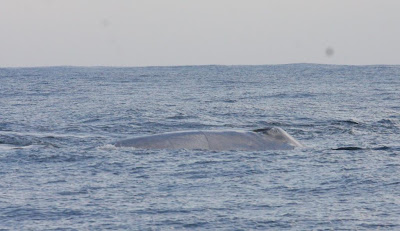
 We also found more evidence that the sharks were around the island when we found a shark-bitten sea lion that had hauled out on Mussel Flat. Yowza! Those sharks need to improve their aim!

On day 3 we only added eight points to bring our total up to 86. The forecasted big storm gave us high hopes that it would bring something interesting. The forecast was for southeast winds.
Location: Southeast Farallon Island
Observation date: 10/1/08
Number of species: 35
Eared Grebe 15
Pink-footed Shearwater 30
Buller's Shearwater 7
Sooty Shearwater 40
Brown Pelican 1061
Brandt's Cormorant X
Pelagic Cormorant X
Sharp-shinned Hawk 1
American Kestrel 1
Peregrine Falcon 3
Wandering Tattler 6
Willet 1
Whimbrel 9
Black Turnstone 69
Western Sandpiper 1
Heermann's Gull 30
California Gull 225
Herring Gull 1 juvenile
Western Gull X
Common Murre X
Pigeon Guillemot X
Cassin's Auklet X
Rhinoceros Auklet X
Burrowing Owl 1 A returning bird from last year!
Anna's Hummingbird 1
Western Wood-Pewee 1
Black Phoebe 5
Say's Phoebe 3
House Wren 1
American Pipit 1
Tennessee Warbler 1
Yellow Warbler 1
Chestnut-sided Warbler 1
Magnolia Warbler 1
Yellow-rumped Warbler (Myrtle) 1
Yellow-rumped Warbler (Audubon's) 1
Palm Warbler (Western) 1
Ovenbird 1
Chipping Sparrow 6
Clay-colored Sparrow 3
Savannah Sparrow 2
Dark-eyed Junco (Oregon) 1
This report was generated automatically by eBird v2(http://ebird.org)
We keep hoping that the winds will turn southeast, but they maintained their weste
 rly flow for yet another day. At least they were light, but the excellent visibility meant that most birds that found themselves over the ocean could choose to fly back to the mainland where there would be more food and better habitat. We did add a couple of new landbirds to our Farallonathon
 list, though, such as the Sharp-shinned Hawk, American Kestrel, Burrowing Owl, Western Wood-Pewee, and an Oregon Junco. We wondered whether the junco could be a pink-sided due to its mostly blue-gray head and dark lores, but the peach color on the sides was not extensive enough. A drab little sparrow also caused some debate as to whether it was a Clay-colored or a Brewer's. We decided that it was a Clay-colored because it lacked a complete eyering, had a vague, but definite central crown streak, and broad, but pale, moustachial and malar streaks. Neither the junco or the sparrow flew into the mistnets.

Amazingly, the Burrowing Owl was a bird that we captured and banded in 2007 and has returned for another year! We did not capture it and did not need to because it is the only Burrowing Owl in North America that has a blue band with an A over a 5 in this particular configuration. Last year, when we banded it, we aged it as a juvenile. We also cut a piece off its central rectrix so that we could analyze its isotopic signature to determine where it was born. Hopefully we'll capture it again so we can cut off another piece and see if it summered this year near where it was born.
More exciting than the birds was a Fin Whale that we observed from the island. It was travelling with two Blue Whales and appeared to be fairly close to the island, so we hopped into our boat and tried to check it out since none of us had ever had a good look at one. We thought that we were getting close because we suddenly caught a whiff of something that I thought was garbage, or one of the interns having intestinal problems. I quickly realized that this pungent smell was the breath of the whales. When we finally got out to the whales, we were only able to find the two blues. They were immense and truly awe inspiring.
We also found more evidence that the sharks were around the island when we found a shark-bitten sea lion that had hauled out on Mussel Flat. Yowza! Those sharks need to improve their aim!On day 3 we only added eight points to bring our total up to 86. The forecasted big storm gave us high hopes that it would bring something interesting. The forecast was for southeast winds.
Location: Southeast Farallon Island
Observation date: 10/1/08
Number of species: 35
Eared Grebe 15
Pink-footed Shearwater 30
Buller's Shearwater 7
Sooty Shearwater 40
Brown Pelican 1061
Brandt's Cormorant X
Pelagic Cormorant X
Sharp-shinned Hawk 1
American Kestrel 1
Peregrine Falcon 3
Wandering Tattler 6
Willet 1
Whimbrel 9
Black Turnstone 69
Western Sandpiper 1
Heermann's Gull 30
California Gull 225
Herring Gull 1 juvenile
Western Gull X
Common Murre X
Pigeon Guillemot X
Cassin's Auklet X
Rhinoceros Auklet X
Burrowing Owl 1 A returning bird from last year!
Anna's Hummingbird 1
Western Wood-Pewee 1
Black Phoebe 5
Say's Phoebe 3
House Wren 1
American Pipit 1
Tennessee Warbler 1
Yellow Warbler 1
Chestnut-sided Warbler 1
Magnolia Warbler 1
Yellow-rumped Warbler (Myrtle) 1
Yellow-rumped Warbler (Audubon's) 1
Palm Warbler (Western) 1
Ovenbird 1
Chipping Sparrow 6
Clay-colored Sparrow 3
Savannah Sparrow 2
Dark-eyed Junco (Oregon) 1
This report was generated automatically by eBird v2(http://ebird.org)
Thursday, October 02, 2008
September 30th
****FARALLONATHON DAY 2****
This was the 2nd day of the "Farallonathon", the annual fall fundraising event for all of PRBO's ongoing studies on Southeast Farallon Island. Yesterday, (29 Sept.) was a good day for us to start "Farallonathon", with the interesting arrivals noted in that day's blog. But today didn't continue that trend since the island experienced light west winds and clear skies. Only an Anna's Hummingbird and a Brown-headed Cowbird were new landbird arrivals. Wait...what is the Farallonathon, anyways? The Farallonathon is a week long event that would be similar to a week-long bird-a-thon except that all vertebrate species count for a point (e.g., cetaceans, pinnipeds, birds, fish, and the salamander), and butterflies and dragonflies count for a point. In addition, CBRC birds and shark attacks count for 5 points and every shark sighting counts for 1 point; it used to be even more shark-centric, but we recently toned it down from 5 points to only 1 point for shark sightings. So, today new points added (in parentheses) were 1 Gray Whale (1), 4 Blue Whales (1), 200 Pacific White-sided Dolphins (1), 1 Monarch butterfly (1), 1 White Shark sighting (1), 1 Short-tailed Shearwater (1), 1 South Polar Skua (1), 2 Pomarine Jaegers (1), and the aforementioned Anna's Hummingbird (1), and Brown-headed Cowbird (1) for 10 new points, equaling 78 points total for this years "Farallonathon". We need more birds and more shark attacks!
Also of note was the departure of a hatch-year male Rose-breasted Grosbeak that had been present on the island since 14 Sept.! We wish it well (how anthropromorphic!).

Below is the ebird list from the day:
This was the 2nd day of the "Farallonathon", the annual fall fundraising event for all of PRBO's ongoing studies on Southeast Farallon Island. Yesterday, (29 Sept.) was a good day for us to start "Farallonathon", with the interesting arrivals noted in that day's blog. But today didn't continue that trend since the island experienced light west winds and clear skies. Only an Anna's Hummingbird and a Brown-headed Cowbird were new landbird arrivals. Wait...what is the Farallonathon, anyways? The Farallonathon is a week long event that would be similar to a week-long bird-a-thon except that all vertebrate species count for a point (e.g., cetaceans, pinnipeds, birds, fish, and the salamander), and butterflies and dragonflies count for a point. In addition, CBRC birds and shark attacks count for 5 points and every shark sighting counts for 1 point; it used to be even more shark-centric, but we recently toned it down from 5 points to only 1 point for shark sightings. So, today new points added (in parentheses) were 1 Gray Whale (1), 4 Blue Whales (1), 200 Pacific White-sided Dolphins (1), 1 Monarch butterfly (1), 1 White Shark sighting (1), 1 Short-tailed Shearwater (1), 1 South Polar Skua (1), 2 Pomarine Jaegers (1), and the aforementioned Anna's Hummingbird (1), and Brown-headed Cowbird (1) for 10 new points, equaling 78 points total for this years "Farallonathon". We need more birds and more shark attacks!
Also of note was the departure of a hatch-year male Rose-breasted Grosbeak that had been present on the island since 14 Sept.! We wish it well (how anthropromorphic!).
Rose-breasted Grosbeak
Photo © Matt Brady
Photo © Matt Brady
Below is the ebird list from the day:
Location: Southeast Farallon Island
Observation date: 9/30/08
Number of species: 39
Pacific Loon 1
Eared Grebe 17
Western Grebe 1
Buller's Shearwater 6
Sooty Shearwater 10
Short-tailed Shearwater 1
Brown Pelican 1243
Peregrine Falcon 2
Wandering Tattler 2
Willet 1
Whimbrel 14
Black Turnstone 30
Pectoral Sandpiper 1
Heermann's Gull 20
California Gull 226
Elegant Tern 11
South Polar Skua 1
Pomarine Jaeger 2
Anna's Hummingbird 2
Black Phoebe 4
Say's Phoebe 2
House Wren 1
American Pipit 3
Tennessee Warbler 1
Yellow Warbler 3
Chestnut-sided Warbler 1
Magnolia Warbler 1
Cape May Warbler 1
Yellow-rumped Warbler 2
Yellow-rumped Warbler (Myrtle) 1
Yellow-rumped Warbler (Audubon's) 3
Townsend's Warbler 2
Palm Warbler (Western) 1
Ovenbird 1
Chipping Sparrow 5
Clay-colored Sparrow 1
Savannah Sparrow 7
Rose-breasted Grosbeak 1
Brown-headed Cowbird 1
This report was generated automatically by eBird v2(http://ebird.org)
Wednesday, October 01, 2008
September 29th
****FARALLONATHON DAY 1****
Today brought more new arrivals as the southerly winds continued. Visibility was a bit better than we would have liked, as many birds likely saw the mainland and headed there instead of the island. Later in the day as we started seeing reports from Point Reyes, it was obvious that's what had happened. While we had a good diversity of species we didn't get the rarer species like the Point (i.e. Prothonotary, Blackburnian, Virginia's and Black-throated Blue Warblers). We did see 12 species of warbler, with Cape May and Tennessee being the most uncommon. Some photos and a complete species list follow.

Eared Grebe 6
Western Grebe 3
Pink-footed Shearwater 58
Buller's Shearwater 53
Sooty Shearwater 123
Brown Pelican 781
Peregrine Falcon 2
Wandering Tattler 3
Willet 1
Whimbrel 8
Ruddy Turnstone 1
Black Turnstone 56
Least Sandpiper 1
Pectoral Sandpiper 1
Heermann's Gull 12
California Gull 350
Elegant Tern 3
Parasitic Jaeger 3
Vaux's Swift 1
Black Phoebe 5
Say's Phoebe 2
House Wren 1
Blue-gray Gnatcatcher 1
Swainson's Thrush (Russet-backed) 5
Hermit Thrush 2
American Pipit 1
Tennessee Warbler 1
Yellow Warbler 2
Chestnut-sided Warbler 3
Magnolia Warbler 3
Cape May Warbler 1
Yellow-rumped Warbler 1
Yellow-rumped Warbler (Myrtle) 3
Yellow-rumped Warbler (Audubon's) 3
Black-throated Gray Warbler 1
Townsend's Warbler 2
Palm Warbler (Western) 2
American Redstart 2
Ovenbird 1
Common Yellowthroat 1
Western Tanager 1
Chipping Sparrow 6
Clay-colored Sparrow 1
Savannah Sparrow 7
Grasshopper Sparrow 1
Rose-breasted Grosbeak 1
Black-headed Grosbeak 1
Bobolink 1
Today brought more new arrivals as the southerly winds continued. Visibility was a bit better than we would have liked, as many birds likely saw the mainland and headed there instead of the island. Later in the day as we started seeing reports from Point Reyes, it was obvious that's what had happened. While we had a good diversity of species we didn't get the rarer species like the Point (i.e. Prothonotary, Blackburnian, Virginia's and Black-throated Blue Warblers). We did see 12 species of warbler, with Cape May and Tennessee being the most uncommon. Some photos and a complete species list follow.
Chestnut-sided Warbler (M. Dettling)
Magnolia Warbler (M. Dettling)
Cape May Warbler (M. Brady)
Location: Southeast Farallon Island
Observation date: 9/29/08
Number of species: 49
Eared Grebe 6
Western Grebe 3
Pink-footed Shearwater 58
Buller's Shearwater 53
Sooty Shearwater 123
Brown Pelican 781
Peregrine Falcon 2
Wandering Tattler 3
Willet 1
Whimbrel 8
Ruddy Turnstone 1
Black Turnstone 56
Least Sandpiper 1
Pectoral Sandpiper 1
Heermann's Gull 12
California Gull 350
Elegant Tern 3
Parasitic Jaeger 3
Vaux's Swift 1
Black Phoebe 5
Say's Phoebe 2
House Wren 1
Blue-gray Gnatcatcher 1
Swainson's Thrush (Russet-backed) 5
Hermit Thrush 2
American Pipit 1
Tennessee Warbler 1
Yellow Warbler 2
Chestnut-sided Warbler 3
Magnolia Warbler 3
Cape May Warbler 1
Yellow-rumped Warbler 1
Yellow-rumped Warbler (Myrtle) 3
Yellow-rumped Warbler (Audubon's) 3
Black-throated Gray Warbler 1
Townsend's Warbler 2
Palm Warbler (Western) 2
American Redstart 2
Ovenbird 1
Common Yellowthroat 1
Western Tanager 1
Chipping Sparrow 6
Clay-colored Sparrow 1
Savannah Sparrow 7
Grasshopper Sparrow 1
Rose-breasted Grosbeak 1
Black-headed Grosbeak 1
Bobolink 1
September 28th
On the 28th we saw the arrival of some new birds with the overcast conditions and SSW winds. The complete list of birds seen on the island follows.
Location: Southeast Farallon Island
Observation date: 9/28/08
Number of species: 39
Eared Grebe 6
Pink-footed Shearwater 41
Buller's Shearwater 6
Sooty Shearwater 29
Brown Pelican 349
Peregrine Falcon 2
Wandering Tattler 10
Willet 1
Whimbrel 13
Ruddy Turnstone 1
Black Turnstone 54
Western Sandpiper 1
Least Sandpiper 2
Pectoral Sandpiper 1
Heermann's Gull 49
California Gull 605
Elegant Tern 4
Pomarine Jaeger 2
Parasitic Jaeger 4
Western Wood-Pewee 1
Black Phoebe 4
Say's Phoebe 1
Red-breasted Nuthatch 1
House Wren 1
Blue-gray Gnatcatcher 1
Hermit Thrush 1
Chestnut-sided Warbler 1
Yellow-rumped Warbler 1
Yellow-rumped Warbler (Myrtle) 1
Yellow-rumped Warbler (Audubon's) 4
Black-throated Gray Warbler 1
Palm Warbler (Western) 2
American Redstart 1
Common Yellowthroat 1
Chipping Sparrow 6
Savannah Sparrow 3
Rose-breasted Grosbeak 1
Indigo Bunting 1
Lesser Goldfinch 1
Location: Southeast Farallon Island
Observation date: 9/28/08
Number of species: 39
Eared Grebe 6
Pink-footed Shearwater 41
Buller's Shearwater 6
Sooty Shearwater 29
Brown Pelican 349
Peregrine Falcon 2
Wandering Tattler 10
Willet 1
Whimbrel 13
Ruddy Turnstone 1
Black Turnstone 54
Western Sandpiper 1
Least Sandpiper 2
Pectoral Sandpiper 1
Heermann's Gull 49
California Gull 605
Elegant Tern 4
Pomarine Jaeger 2
Parasitic Jaeger 4
Western Wood-Pewee 1
Black Phoebe 4
Say's Phoebe 1
Red-breasted Nuthatch 1
House Wren 1
Blue-gray Gnatcatcher 1
Hermit Thrush 1
Chestnut-sided Warbler 1
Yellow-rumped Warbler 1
Yellow-rumped Warbler (Myrtle) 1
Yellow-rumped Warbler (Audubon's) 4
Black-throated Gray Warbler 1
Palm Warbler (Western) 2
American Redstart 1
Common Yellowthroat 1
Chipping Sparrow 6
Savannah Sparrow 3
Rose-breasted Grosbeak 1
Indigo Bunting 1
Lesser Goldfinch 1
Sunday, September 28, 2008
Farallon Fall update -- 24 Aug to 27 Sept
The first two weeks of our stay were very slow with very few arrivals. The occasional mega-vagrant kept our spirits high. The weather finally gave us a big push of birds the following week. On the 9th, we banded a total of 30 birds, 10 of which were Yellow Warblers; we estimated that there were 14 on the island. For Tow nsend’s Warbler, though, we estimated there were 23 individuals, but didn’t catch a single bird because they were all up at the lighthouse. With so many individuals of a single species, it is impossible to keep track of them all so we try to color band the six most frequently-caught species with unique color-band combinations. These species are Yellow Warbler, Townsend’s Warbler, Yellow-rumped Warbler, White-crowned Sparrow, Golden-crowned Sparrow, and Dark-eyed Junco. On the 10th we put a net up at the lighthouse and banded 18 Townsend’s Warblers of an estimated 33 on the island. In total we banded 82 birds on the 10th and 68 on the 11th. We had a small lull o
 n the 12th before another big wave hit on the 13th and 14th. The birds then tapered off a bit until the 20th when we had another small wave. The timing of this last wave occurred during the VIP trip that was awarded to Reese and Amory Willis at the Blue Ball last year. Boat days often occur during wave days; it might be statistically significant. This is probably because calm conditions that are good for landings also tend to bring birds. Over the last week, strong NW winds and/or fog have kept the birds and bats away from the island, but the weather appears to be changing for the better.
As far as bird vagrants go, this fall has been nothing short of spectacular. On 25-August, just a few days after our arrival, an intern stated that he had found and photographed a Gray-tailed Tattler in Sea Pigeon Gulch. We all got great looks at it a half hour later at East Landing when it flew up calling its diagnostic "chuweet-chuweet-chuweet" several times in the company of 2 Wanderings. This is a Siberian species with only a single previously accepted record for California that occurred in 1981. While this bird was in the company of the Wanderings, it was clearly paler gray with more restricted gray on the sides, and it had more conspicuous pale spots on its tertials. The nasal groove was about 2/3 the length of the bill, which is considered a better characteristic for Wandering Tattler. The nasal groove on a Gray-tailed Tattler should be less than half the length of the bill. The call has been stated by many to override the other features so it will be interesting to see how the California Bird Records Committee (CBRC) handles this bird. We also had a Semipalmated Sandpiper from Aug 23 to Aug 24.
During a migrant gull survey, we found a second year Laughing Gull mixed into the Western Gulls. This is only the 4th island record. On 16-Sept, we found a first-year Franklin's Gull during a gull count, another very rare bird on the island. In late summer, we mostly see California Gulls on this survey, but also a few Heermann’s and Ring-billed. Most of the juvenile California Gulls out here have an interesting peach phase plumage with varying amounts of pale peach color on their underparts and head and occasionally scattered on their back. For some reason, this plumage is far more common at sea than on the coast. The answer seems as though it should be due to wear or bleaching, but all the feathers look fresh. In October, gull diversity usually picks up when we get an influx of Herring, Glaucous-winged, and Thayer’s Gulls.
On Sept 3rd, we had poor looks at a bird on the Terrace he th ought may have been a Baird’s Sparrow. We relocated it a few hours later under the Coast Guard Trees. One intern tried to flush it into the net, but it kept bouncing out. He eventually got photos of it perched in the trees (see attached photo). This species breeds in grasslands of the northern Great Plains and winters in grasslands from SE Arizona to Texas; there probably aren't many records of this species in trees. Because they are cryptic and skulky, they are very difficult to observe in their native winter/stopover habitat. On the Farallones where land and vegetation are limited, they are relatively easy to find and relocate. This was only the 4th record for the island and just the 5th for California.
 We found and banded a Red-eyed x Philadelphia Vireo the next day; a first for the island and possibly the first west of the Rocky Mts. This was not an easy bird to identify and required an in-hand analysis of the length of its 10th primary feather (p10) relative to its primary coverts. Its p10 was >5 mm shorter than its primary coverts. The similar appearing eastern Warbling Vireo would have had a p10 that wa
 s longer than the primary coverts. In our opinion, the plumage and structure of this bird were halfway between a Red-eyed and Philadelphia Vireo. All the in-hand measurements were right in between these two species. The flat, sloping forehead met the bill at a relatively acute angle that reminded us a lot of a Red-eyed or a Yellow-green Vireo rather than a Philadelphia, and it had a dark eyeline and lateral crown stripe. None of these characteristics are good for Philadelphia, but the bird was too small for a Red-eyed or Yellow-green. We feel fairly confident in this bird’s ID, but would appreciate input from others.
The first of 3 Eastern Kingbirds showed up on the 8th. The first of 4 Blue- headed Vireos showed up on the 9th along with a Canada Warbler. A nice wave of eastern birds arrived on the 10th, but nothing too unusual except for a briefly seen Bay-breasted Warbler. The next day from the lighthouse, two of us got great looks at 3 Chimney Swifts flying below us. We also had the island high count of Ovenbirds with 5. On the 13th,
 we were lucky to catch and band a Merlin (a female taiga). A few minutes later we found a Yellow-billed Cuckoo in the cave on the back side of Corm Blind Hill. A crew change the next day brought a truly spectacular fallout with 103 species of migrants and at least 8 more resident species for a total of 111 species. Highlights for the day were Golden-winged and Virginia's Warbler at the lighthouse, another Baird's Sparrow on the Terrace, a Mourning Warbler in the Heligoland Tree, and 2 Black Swifts over the lighthouse. The highest species count for the island, set back in the 1980’s, was 117 during late October.
On the 15th, an intern was doing an area search at Sea Pigeon Point and had what appeared to be a dark-morph Wedge-tailed Shearwater (1st island record if accepted by CBRC) fly in off the ocean and fly several laps over his head. The bird flew with deep, languid wing strokes that were reminiscent of a frigatebird (a good characteristic for this species). It appeared long
 -billed and long-tailed, but its tail length was difficult to judge because it was molting its central rectrices. There are only seven records of this tropical species for California. There is some debate, though, as to the ID of this bird because its plumage looked very similar to that of a Sooty Shearwater.
 On the 17th, we found the island's 2nd Blue-winged Warbler on Corm Blind Hill. It was a neat looking bird in that it probably has a bit of Golden-winged genes in its distant past. The mask extended back a little further than a typical BWWA with a little downward curl at the posterior end of the mask. Other than that, it looked just like an adult male BWWA. Amongst the small wave on the 20th was a Black-throated Sparrow and a Vesper Sparrow. We've also found a few other odd birds such as a hybrid Blue-winged Teal x something, and a Western Kingbird with a huge bill and strong face pattern.
In addition to birds, the calm conditions we experienced also brought migratory hoary bats out to the island. Calm conditions combined with a new moon often bring bats in September and we found 10 on the 10th.
Lately, we’ve been recording numerous whales around the island. From the 17th to the 20th there was a large feeding flock consisting of thousands of shearwaters and dozens of humpback whales. The humpbacks were frequently observed breaching and fin slapping. As if in response to this loud commotion, whales were frequently observed traveling towards the feeding flock. I wonder if the breaching and fin slapping whales are communicating the food news to others to help them cooperatively hunt their prey.
In the future, if the internet is working, we will try to provide daily updates of bird migration and other stuff we’re seeing. Yesterday was a foggy day that did not allow many birds to find their way to the island. The only arrivals were a Great Blue Heron, Western Wood-Pewee, Red-breasted Nuthatch, Townsend’s Warbler, Common Yellowthroat, and a Fox Sparrow.
Location: Southeast Farallon Island
 nsend’s Warbler, though, we estimated there were 23 individuals, but didn’t catch a single bird because they were all up at the lighthouse. With so many individuals of a single species, it is impossible to keep track of them all so we try to color band the six most frequently-caught species with unique color-band combinations. These species are Yellow Warbler, Townsend’s Warbler, Yellow-rumped Warbler, White-crowned Sparrow, Golden-crowned Sparrow, and Dark-eyed Junco. On the 10th we put a net up at the lighthouse and banded 18 Townsend’s Warblers of an estimated 33 on the island. In total we banded 82 birds on the 10th and 68 on the 11th. We had a small lull o
 n the 12th before another big wave hit on the 13th and 14th. The birds then tapered off a bit until the 20th when we had another small wave. The timing of this last wave occurred during the VIP trip that was awarded to Reese and Amory Willis at the Blue Ball last year. Boat days often occur during wave days; it might be statistically significant. This is probably because calm conditions that are good for landings also tend to bring birds. Over the last week, strong NW winds and/or fog have kept the birds and bats away from the island, but the weather appears to be changing for the better.
As far as bird vagrants go, this fall has been nothing short of spectacular.
 On 25-August, just a few days after our arrival, an intern stated that he had found and photographed a Gray-tailed Tattler in Sea Pigeon Gulch. We all got great looks at it a half hour later at East Landing when it flew up calling its diagnostic "chuweet-chuweet-chuweet" several times in the company of 2 Wanderings. This is a Siberian species with only a single previously accepted record for California that occurred in 1981. While this bird was in the company of the Wanderings, it was clearly paler gray with more restricted gray on the sides, and it had more conspicuous pale spots on its tertials. The nasal groove was about 2/3 the length of the bill, which is considered a better characteristic for Wandering Tattler. The nasal groove on a Gray-tailed Tattler should be less than half the length of the bill. The call has been stated by many to override the other features so it will be interesting to see how the California Bird Records Committee (CBRC) handles this bird. We also had a Semipalmated Sandpiper from Aug 23 to Aug 24.
During a migrant
 gull survey, we found a second year Laughing Gull mixed into the Western Gulls. This is only the 4th island record. On 16-Sept, we found a first-year Franklin's Gull during a gull count, another very rare bird on the island. In late summer, we mostly see California Gulls on this survey, but also a few Heermann’s and Ring-billed. Most of the juvenile California Gulls out here have an interesting peach phase plumage with varying amounts of pale peach color on their underparts and head and occasionally scattered on their back. For some reason, this plumage is far more common at sea than on the coast. The answer seems as though it should be due to wear or bleaching, but all the feathers look fresh. In October, gull diversity usually picks up when we get an influx of Herring, Glaucous-winged, and Thayer’s Gulls.
On Sept 3rd, we had poor looks at a bird on the Terrace he th
 ought may have been a Baird’s Sparrow. We relocated it a few hours later under the Coast Guard Trees. One intern tried to flush it into the net, but it kept bouncing out. He eventually got photos of it perched in the trees (see attached photo). This species breeds in grasslands of the northern Great Plains and winters in grasslands from SE Arizona to Texas; there probably aren't many records of this species in trees. Because they are cryptic and skulky, they are very difficult to observe in their native winter/stopover habitat. On the Farallones where land and vegetation are limited, they are relatively easy to find and relocate. This was only the 4th record for the island and just the 5th for California.
 We found and banded a Red-eyed x Philadelphia Vireo the next day; a first for the island and possibly the first west of the Rocky Mts. This was not an easy bird to identify and required an in-hand analysis of the length of its 10th primary feather (p10) relative to its primary coverts. Its p10 was >5 mm shorter than its primary coverts. The similar appearing eastern Warbling Vireo would have had a p10 that wa
 s longer than the primary coverts. In our opinion, the plumage and structure of this bird were halfway between a Red-eyed and Philadelphia Vireo. All the in-hand measurements were right in between these two species. The flat, sloping forehead met the bill at a relatively acute angle that reminded us a lot of a Red-eyed or a Yellow-green Vireo rather than a Philadelphia, and it had a dark eyeline and lateral crown stripe. None of these characteristics are good for Philadelphia, but the bird was too small for a Red-eyed or Yellow-green. We feel fairly confident in this bird’s ID, but would appreciate input from others.
The first of 3 Eastern Kingbirds showed up on the 8th. The first of 4 Blue-
 headed Vireos showed up on the 9th along with a Canada Warbler. A nice wave of eastern birds arrived on the 10th, but nothing too unusual except for a briefly seen Bay-breasted Warbler. The next day from the lighthouse, two of us got great looks at 3 Chimney Swifts flying below us. We also had the island high count of Ovenbirds with 5. On the 13th,
 we were lucky to catch and band a Merlin (a female taiga). A few minutes later we found a Yellow-billed Cuckoo in the cave on the back side of Corm Blind Hill. A crew change the next day brought a truly spectacular fallout with 103 species of migrants and at least 8 more resident species for a total of 111 species. Highlights for the day were Golden-winged and Virginia's Warbler at the lighthouse, another Baird's Sparrow on the Terrace, a Mourning Warbler in the Heligoland Tree, and 2 Black Swifts over the lighthouse. The highest species count for the island, set back in the 1980’s, was 117 during late October.
On the 15th, an intern was doing an area search at Sea Pigeon Point and had what appeared to be a
 dark-morph Wedge-tailed Shearwater (1st island record if accepted by CBRC) fly in off the ocean and fly several laps over his head. The bird flew with deep, languid wing strokes that were reminiscent of a frigatebird (a good characteristic for this species). It appeared long
 -billed and long-tailed, but its tail length was difficult to judge because it was molting its central rectrices. There are only seven records of this tropical species for California. There is some debate, though, as to the ID of this bird because its plumage looked very similar to that of a Sooty Shearwater.
 On the 17th, we found the island's 2nd Blue-winged Warbler on Corm Blind Hill. It was a neat looking bird in that it probably has a bit of Golden-winged genes in its distant past. The mask extended back a little further than a typical BWWA with a little downward curl at the posterior end of the mask. Other than that, it looked just like an adult male BWWA. Amongst the small wave on the 20th was a Black-throated Sparrow and a Vesper Sparrow. We've also found a few other odd birds such as a hybrid Blue-winged Teal x something, and a Western Kingbird with a huge bill and strong face pattern.

In addition to birds, the calm conditions we experienced also brought migratory hoary bats out to the island. Calm conditions combined with a new moon often bring bats in September and we found 10 on the 10th.
Lately, we’ve been recording numerous whales around the island. From the 17th to the 20th there was a large feeding flock consisting of thousands of shearwaters and dozens of humpback whales. The humpbacks were frequently observed breaching and fin slapping. As if in response to this loud commotion, whales were frequently observed traveling towards the feeding flock. I wonder if the breaching and fin slapping whales are communicating the food news to others to help them cooperatively hunt their prey.
In the future, if the internet is working, we will try to provide daily updates of bird migration and other stuff we’re seeing. Yesterday was a foggy day that did not allow many birds to find their way to the island. The only arrivals were a Great Blue Heron, Western Wood-Pewee, Red-breasted Nuthatch, Townsend’s Warbler, Common Yellowthroat, and a Fox Sparrow.
Location: Southeast Farallon Island
Observation date: 9/27/08
Number of species: 27
Brown Pelican X
Brandt's Cormorant X
Pelagic Cormorant X
Great Blue Heron 1
Peregrine Falcon (Continental) 2
Wandering Tattler 7
Willet 1
Whimbrel 6
Black Turnstone 62
Western Sandpiper 2
Least Sandpiper 4
Heermann's Gull 47
California Gull 538
Western Wood-Pewee 1
Black Phoebe 7
Say's Phoebe 1
Red-breasted Nuthatch 3
House Wren 1
Blue-gray Gnatcatcher 1
Yellow-rumped Warbler (Myrtle) 1
Townsend's Warbler 2
Palm Warbler (Western) 1
Common Yellowthroat 1
Chipping Sparrow 10
Savannah Sparrow 3
Fox Sparrow (Sooty) 1
Rose-breasted Grosbeak 1
This report was generated automatically by eBird v2(http://ebird.org)
Monday, August 18, 2008
Class of the Farallones, c. 1953
One of the things I, as a first-season intern, love about the Farallones is the history that comes with them. Some of it has been rather bloody, wrought with seal hunting and egg harvesting. Over the last seventy years, however, the island has been run by first the Coast Guard, and then the U.S. Fish and Wildlife Service. Over the course of the summer, we’ve had several people come to the island who were here in the past, some from forty years ago and others from more recent times. It is a lovely tradition of the Farallones, and on Friday, August 8, we had visitors that lived on SEFI fifty-five years ago. In 1953, Del


Photo scanned from "The Farallon Islands: Sentinels of the Golden Gate" by Peter White. A fantastic history of the humans and wildlife that have called these islands home.
Naturally, a lot of things have changed. Lucky was an engineer with the Coast Guard and was stationed here for more than a year, so he brought his young family with him to this remote outpost. There were seventeen people on the island at the time and there were many more buildings than are here now. There were even streetlights along the cart path! With scarce communication,
Cleary for Del, Lucky and Linda, living on the Farallones was an important time in their lives and gave them an appreciation for teh wild beauty of the place they once lived. They were very excited to look around at all the changes and enjoyed learning about what our lives on the island are like now. Almost as much as we enjoyed hearing their stories. One thing that hasn't changed about the Farallones is their ability to shape the lives of the people that reside on them.
Posted by Marilyn
Subscribe to:
Posts (Atom)