Thursday, April 07, 2011

The Birds Have Arrived!

The seabird breeding season on the Farallons has begun! We’ve been watching Common Murres, Brandt’s Cormorants, Cassin’s Auklets, and Pigeon Guillemots arrive to the islands, as they do each spring/summer season.
Common Murres at nesting sites
The first birds to start nesting were the Cassin’s Auklets. These are cute little seabirds that hang out at night on the island (safety from the cover of darkness) and spend the day at sea or at their nest. 


Their nests are burrows in the ground that usually consist of a long tunnel with a turn right before the actual nest. Cassin’s Auklets will also nest in crevices in rocky habitat. We want to be able to collect data on these birds that breed on the Farallons as a way to monitor the health of the population. Parameters such as reproductive success, timing of breeding, and chick growth and development can be used to accomplish this, and this data can easily be collected by simulating the nest environment using nest boxes. We make the nest boxes out of plywood and construct a tunnel using PVC pipe. The top of the box has a removable lid that allows us to see inside the nest and collect the data.
Cassin's Auklet Nest Box
We are able to look at both mates of a nest because Cassin’s Auklets take turns incubating the egg each day. In most cases, if you find a bird in a box one day, the next day you should find its mate. Checking a nest box is an interesting task. First you must completely block the entrance to the tunnel using your foot or knee so that the bird can’t escape. At the same time you must be able to bend over and peer under the box lid. It’s a bit like doing yoga. If a bird is present, you need to grab it in one swift movement to avoid hurting the egg or the bird. A biologist here described this as being not unlike an alien abduction. Imagine a bright light as the roof of your home opens up, you are snatched up, measurements are taken and you’re returned with a metal band on your ankle. I try to keep this perspective in mind when I’m holding a Cassin's and its beak is clamped down on my fingers or its claws have lodged themselves under my cuticle. I also know that the collection of this data will aid in monitoring these birds.
Nest box check


We can track specific individuals in a population by putting a metal band around their leg with a unique number for each bird. We know the ages of birds that we banded as chicks, and we always check band numbers to see if a bird we find is one of known age. We also band birds that are mates of known age birds.
Banding a Cassin's Auklet
New bands
When known age individuals are found, both they and their mates have condition data recorded. This includes measuring the bill depth (used to sex the individual), wing cord length, weight, and egg size.

Measuring the length of an egg
Measuring the wing cord of a Cassin's Auklet
Weighing the bird in a bag
Bird in a bag
We have over 400 boxes that get checked every 15 days as the breeding season progresses. Our first check yielded about 70 birds and our second yielded about 150 additional birds! We continue to check the boxes without birds in them through the summer to see if any new Cassin’s Auklets decide to move in. Each time I lift the lid of a nest box is like a surprise. Will there be a Cassin’s Auklet? Will there be another species of bird? Will there be an egg? Two eggs?? Fortunately, there are over 400 surprises out there waiting for us.

Saturday, April 02, 2011

Spring, Seabirds, and Spray

In mid March, after 3.5 months on the island, the winter crew departed in one of our seasonal crew switches. It is now seabird season, and the seasons of wildlife have changed with the weather. After a very wet March with storms from the south, clear skies, and strong northwest winds have returned, as you can see from this video today of Saddle Rock on the south side of the island.

Elephant Seal cows and bulls have departed, leaving their weaners here on the island. Most will enter the ocean soon for the first time and depart the Farallones. Cassin's Auklets, the small burrow nesting and krill eating seabirds that our one of our focal species, began nesting in early March. The discovery of the first egg in a nest box on March 2nd was the earliest we have ever recorded. Common Murres, Western Gulls, Pelagic Cormorants, and now even some Brandt's Cormorants, are attending the island in preparation for their breeding seasons.

Spring is characterized by strong northwest winds, which help drive productive upwelling which feeds the Farallon food web. Today's 35 knot winds are typical for this time for year on the Farallones. The video below shows what it's like walking to the north side of the island during these conditions. I'm trying to hold the camera as steady as I can! 


These conditions can whip the ocean up into foam, check out "Farallon snow" at North Landing!


Stay tuned for regular posts from the Farallon seabird season...

Tuesday, March 01, 2011

January Showers Bring February Flowers and a Weaner Pod with Superpowers

We’re starting to notice veritable signs of spring here on Southeast Farallon Island (SEFI). The endemic Farallon Weed covering the island has morphed into a carpet of golden flowers. Some of the seabirds, such as the Pelagic and Brandt’s cormorants, are starting to display their breeding plumage. The Pelagic cormorants exhibit a white patch on the flank behind each wing which is very obvious in flight, as well as a red patch on the face and tufted feathers on the head. We have also seen several Brandt’s cormorants with white whiskery plumes on their heads. And the elephant seal breeding season is heading towards its end. The last new pup of the season was born on February 7, and all but 4 of the pups on the island have been weaned. Currently, there are 55 weaned and 4 nursing pups on SEFI.  We’ve also found 12 total weaners and 4 nursing pups on West End.

Miner's lettuce and Farallon Weed in bloom
Pelagic cormorant sporting breeding plumage
Weaner pod

Since they are often chased around by the last of the protective mothers and belligerent males, the weaners have started clustering in one half of Sand Flat, often in small groups called ‘weaner pods.’ Although they spend most of their time sleeping, some of the weaners are beginning to interact with each other, with the males clumsily play-fighting. They will remain at their natal colony for up to two and a half months before they leave for their first long foraging trip out to sea. During the time that they are here, the weaners will fast while learning to swim in shallow water.  So far, the thick blubber layer that they have accumulated during a month of nursing has impeded their mobility, and they clumsily roll and bounce about the rocky terrain. They are unable to move very quickly, and a few of the weaners have been gravely injured by falling in the way of charging breeding bulls. MC Hammer has singlehandedly killed four weaners within his territory at Mirounga Beach with deep gashes to the head. Most of the attacks happened on the days that those pups were weaned, and we are not sure why he has targeted these relatively helpless animals, many of which are probably his own offspring. They may have gotten in his way when he was mating with the cows, or it may simply be displaced aggression. We have not witnessed any other subadult or adult males injuring weaned pups in the same way, especially not our Sand Flat 'lovebug' Rusty.

Weaner pod staying out of harm's way up on Omega Terrace
Play-fighting
Rusty with cow and pup

We’ve seen a few success stories too. Several of the Sand Flat weaners have been washed out from the area during high swells, and a couple have fallen into Breaker Cove at the edge of the territory. We considered them as good as gone, but surprisingly, we’ve been finding the ‘lost’ weaners all around the island. One ended up on West End, a couple on Weather Service Peninsula between West End and Sand Flat, and some in gulches on the East and North sides of SEFI. Some have disappeared from Sand Flat and reappeared at other places on the island, returning to their natal beach several days later. While they may not be strong or experienced enough yet to undertake their first long trip to sea, they apparently have the capacity to remain afloat and even to swim back home after getting washed up on other beaches. We keep wondering how they get to where they end up, and imagine them setting 'sail' around the island.

'Missing' weaner with subadult male on Weather Service Peninsula

We have been tagging each of the pups as soon they wean, as well as measuring their length and girth to gain an estimate of nursing and weaning success. The measurements have been fairly consistent between the animals, ranging from 140 cm to 160 cm for length and 127 cm and 147 cm for girth. Similarly to previous years, we’ve found that the weaners born on Marine Terrace are larger than those born on the crowded sand flat. With the weaners being almost as large around as they are long, they will have to lose some of their ‘baby fat’ before they can navigate the water.  Some weaners, however, are not always ready to start losing weight once they lose their mother. One of the weaners in Mirounga Beach had found a surrogate mother and suckled for an additional 19 days from its second mom. It became what we call a ‘superweaner, or ‘double mother suckler.'

Superweaner

 We have had some extraordinarily warm and sunny weather this winter, brought on by a La Nina ENSO event which causes dry and mild winter weather along the Pacific coast. One of the highs so far has been 19.5 degrees Celsius (67 degrees F). Although the humans have enjoyed the weather, the blubbery Northern elephant seals found it hard to bear. To prevent overheating on sunny days, elephant seals will often throw flipperfuls of damp sand on their backs to cool down. You will often see this on sandy rookeries such as those at Point Reyes or Ano Nuevo. With little sand or loose dirt available on Sand Flat (the sands which originally covered the area were washed away over several decades by rough storms), the elephant seals at SEFI have not been able to cool down in the same way. Instead, they were trampling each other in the mad dash for the last remaining droplets of the rain and swell puddles at the edges of Sand Flat, or for the tiny bit of shade in a narrow alley between two rock terraces.

Seals vying for the last remains of a cooling rain puddle
Cooling off in the puddle
Several of the males that are subordinate to the alphas Rusty and MC Hammer spent the warm days waiting in the alley for cows to come seeking shade. There, they were able to mate with the females without being chased off by a dominant bull. As more cows became sexually receptive, the competition between males for access to them had intensified. At the height of the season, Rusty was unable to hold down the entirety of the Sand Flat territory, and many other subordinate males were able to sneak into the periphery and copulate with females leaving the colony to return to sea. After mating with the alpha male, the cows were often ambushed by at least one other male on the way back to the water. Several of the younger subadult males, often emboldened by the older guys’ pursuits, unsuccessfully tried to sneak into the colony. We often found them later in the day resting on the terrace overlooking Sand Flat with large gashes and puncture wounds on the backs, being unable to do anything other than watch and long for the rocky, cow-filled pastures below. They’ll have to wait a few more years before they can square off with the major game players. For (a lot) more photos of the elephant seals and a personal account of an intern’s experience on the Farallons, you can check out smellephantisland.

Subadult male on Marine Terrace
 
 The winter season is almost at an end, with the elephant seal crew getting ready to leave the island in a week and a half.  Like the elephant seals, the winter biologist and interns must return to their true homes. Everyone is quite wistful about leaving, but are enjoying their last days with the seals and each other. It has been a great experience for everyone new to the island, and most of us hope to return here again soon.

Saturday, February 19, 2011

Island Life for Salamanders

Farallon Arboreal Salamander Aneidis lugubris farallonensis
 Sharing its origins with the core of the Sierra Nevada Mountains, the Farallon Islands were violently shaken free from the mainland some 10,000 years ago. In the ensuing years the Farallones have drifted northwest as a result of movements from the Pacific Plate and currently reside 27 miles west of the Golden Gate and 20 miles southwest of Point Reyes. As such, an unlikely inhabitant has hitched a ride on this slow but steady drift.


The arboreal salamander, Aneidis lugubris, is a California near-endemic, occurring in coastal and interior oak forests from Humboldt County, CA to northern Baja California, Mexico. The arboreal salamander is also found on the Farallones and is in fact the only native terrestrial vertebrate inhabiting the islands. The distinctive spot pattern of the salamanders on the islands led Van Denburgh (1905) to consider the population as a sub-species A. lugubris farallonensis.   Currently, the Farallon population of arboreal salamanders has become a subject of study on the islands.

Returning a salamander to its coverboard
PRBO biologists have been checking for the presence of salamanders bimonthly since 2007 under cover boards, which are used both to provide burrowing habitat and to permanently mark study plots. Arboreal salamanders exhibit high site fidelity, and we often find the same animals under particular cover boards. Individuals are measured, weighed, and sexed by looking for eggs in a female's translucent belly or the male’s distinctive mental gland under the chin, involved in pheromone production.

Weighing each salamander
Juvenile salamander being weighed
Salamander in a tube for measuring
 These salamanders possess unique spot patterns much like finger prints on humans which allow biologists to track them over time. A photo database of captured salamanders has been created for long-term mark-recapture monitoring. Some individuals are quite easily distinguishable by anomalies such as missing limbs or extra digits. The project is ongoing and we hope to learn much more about the life history of this interesting creature. 

Mirror duplication of the left hind limb toes
Missing left fore limb
According to research conducted on the analogous mainland population, the arboreal salamander is relatively long-lived and slow to mature. This group of salamanders has no aquatic larval stage - eggs are laid in terrestrial nests and hatchlings resemble miniature adults.  They are primarily nocturnal, foraging for small prey such as spiders, beetles, grubs, ants, and centipedes on the ground or on the trunks of trees.  During the day they remain under rocks, decaying logs, and in stone walls and crevices.  Arboreal salamanders are unusual in that they have enlarged toe tips and a prehensile tail adapted for climbing, which serves them well in their habitat on the mainland. However, this adaptation may not fare so well on the Farallones, seeing how trees are few and far between.  

Salamander getting some use for its prehensile tail
So why is it important to study these wet, slimy amphibians that spend much of their time underground? Many salamander populations around the world currently are experiencing threats from chemicals, infectious diseases, global warming and increasing climatic variability.  In particular arboreal salamanders are lungless and offer unique attributes that make them good indicators of ecosystem health. Respiration and osmoregulation through moist, well-vascularized skin make them vulnerable to changes in water or air quality.  Baseline demographic data are helpful in documenting effects of existing and future threats to salamander populations. By obtaining data now and continuing to monitor into the future, we hope to be able to use salamanders as indicator species and possibly make predictions about bigger picture items.
Juvenile salamander

Wednesday, January 19, 2011

The Farallones Elephant Seal Factory

First thing is first. A new introduction is of primary importance. The winter researcher colony gained another member just before the holidays. Jaime Neill has joined the crew as our third winter intern. She hails from North Carolina and has recently been working with nesting sea turtles in Florida. She has experience with a variety of both terrestrial and aquatic species, but is really enjoying her transition into fieldwork with pinnipeds - which has really started to pick up since our last update.

Jaime preparing to stamp some seals

 The elephant seal pupping season is well underway and is keeping the winter crew quite busy here on the Farallones. The Northern Elephant seal breeds on rocky islands and coastlines such as the Farallon Islands throughout the winter and early spring. The males arrive first, generally in early December, with older sub-adults and full-grown bulls staking out their territories and battling each other for prime real estate. Pregnant cows begin to haul out shortly after the males and within a week of arriving they give birth to a single pup weighing 60-80 lbs. They nurse their pup continuously while fasting for about 27 days during which the pup gains an average of 10 lbs a day. During the breeding season, cows generally huddle in large groups, or harems, protected by a dominant bull from the pestering of younger males.  Bulls fight violently for possession of a territory and access to all the cows in one harem - up to 100 females - with whom they will mate. Sub-adult males may gain access to a few cows at the periphery of an alpha’s territory, but are often chased off. After mating, cows wean their pups and head back into open waters in search of food, returning to land only one other time during the year to molt.


Mirounga Beach harem
Sand Flat harem

We are now within the height of the breeding season on the South East Farallon Island (SEFI) and familiar patterns are beginning to emerge. Rusty, a bull that held alpha status on Sand Flat during the entirety of the breeding season last year, has claimed the same territory and is currently king of a 47 cow harem (which grows larger by the day). He is seen daily completely surrounded by rows of cows with pups on their sides. Bedlam Boy, one of the largest males that we’ve seen on SEFI, was holding down Mirounga Beach with 11 cows until he was usurped by MC Hammer a few days ago. MC Hammer was alpha of Mirounga Beach last year, so it was only a matter of time before he fought to get his territory back. Two other potential players are B-boy and Herzog, who have been hanging around the periphery of Sand Flat and may end up facing off with the alphas later in the season once cows become sexually receptive. Herzog was not tagged prior to arriving on SEFI this year and may be a bull that has not previously bred here at the island. Despite their enormous size, the bulls have been moving around the island quite a bit in their attempts to claim territories. We have not witnessed a major territorial battle just yet, but the larger males have been chasing younger animals that try to sneak into the periphery and occasionally displaying dominance by mounting females in their area. Some younger males have been seen as far away as the cart path near East Landing, undoubtedly having been forced out by more dominant animals. 

Rusty at Sand Flat
Rusty guarding his cows
Rusty performing a dominance display
Bedlam Boy at Mirounga Beach

Subadult male near old telephone pole by East Landing

The birth of the first pup on SEFI was witnessed on Sand Flat on December 23. We presume that the cow that gave birth was a young and inexperienced mother because we never observed her nursing. Cows start giving birth at 3 or 4 years of age but their pup mortality is high until they become more experienced at around 7 or 8 years. Unfortunately, this already doomed pup was unwittingly crushed by MC Hammer during a dominance display, a common fate in crowded elephant seal colonies, and did not survive. Pregnant cows started showing up in larger numbers at the beginning of the year, with at least two new cows and an average of two pups born daily starting on the 2nd of January. Currently, we have an estimated 24 live pups on SEFI and 5 on West End. We have been stamping new cows and new pups with numbers coated in hair dye in order to more easily keep track of both, a task that is becoming increasingly difficult as the colonies increase in density. Today, we counted 47 cows on Sand Flat with more cows (and pups) arriving daily. Tagging pregnant cows has proven to be a challenge because placing tags in the hindflippers of large animals is only successful if the animal is fully asleep, which cows never seem to be. Even prior to giving birth, a cow is constantly vigilant. We’ve witnessed a number of violent displays between protective mothers, some of which involved errant pups being bitten in the head by other cows. 


Stamped pup
Tagged and stamped cow
New tag!

We have been making every attempt to mark new pups with numbers matching their mothers’ stamps as pup switching can happen in crowded elephant seal colonies. One incident in particular has captured our attention. A stillborn pup was found on Sand Flat one morning with no mother in sight. Later the same day, we witnessed a very young-looking cow showing particular interest in a pup as it was being born to Gypsy, another resident Sand Flat cow. As soon as the pup emerged and started to vocalize, the young cow began vocalizing in return to the pup and seems to have imprinted on him/her. Although we have not witnessed her nursing, she seems to respond to Gypsy’s pup vocally and remains near the pup as much as possible. Occasionally, we’ve seen her touring the periphery of the harem and eyeing other pups, usually resulting in being chased off by their mothers. Although she reacted violently to her initial attempts to claim the pup, Gypsy now allows the abductor cow, whom we’ve informally named Abby Ductor (or Baby Stealer), to remain near the pup. We hypothesize that Baby Stealer is another young and inexperienced cow that gave birth to the stillborn pup and is confused about her role as a mother. We have marked the three animals and are keeping an eye on them to see where the pup ends up. Some pups become superweaners - after being weaned from their own mother, they continue sucking from other cows that may have lost or switched their pup later in the season. It is possible that Gypsy’s pup may end up as one of these “double mother sucklers.” Indeed, we've already witnessed some greedy pups nursing from moms which are not their own.

Abductor cow (top) on the prowl for pups
Three pups trying to nurse from one cow

We will continue to monitor the elephant seal population here on the Farallones throughout the winter while attending to some of our other responsibilities – one of which includes surveying the endemic Farallon Island Arboreal Salamander. More detail will be given to the salamanders in our next blog entry.

Friday, December 31, 2010

Burrowing Owls on the Farallones??!


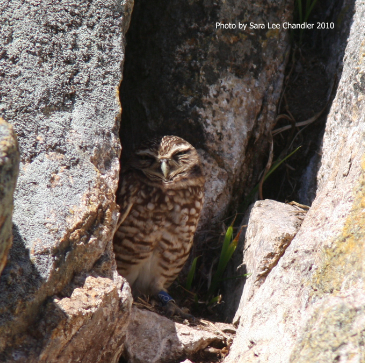
Yes, it’s true! There are burrowing owls on Southeast Farallon Island (aka, SEFI), and no, they are not an introduced species. Many people will be surprised to learn that these petite (10 inches tall and 1/3 pound) owls are here, because they are terrestrial owls, typically associated with expanses of flat grassland, open fields or lots, and medium-sized fossorial (burrowing) mammals such as ground squirrels or prairie dogs. SEFI is mostly rocky, devoid of burrowing mammals other than the introduced Siberian house mouse, is surrounded by ocean and nearly 30 miles from any expanse of land - hardly typical habitat for the burrowing owl. And yet they are here! The U.S. Fish and Wildlife Service and PRBO Conservation Science biologists have been monitoring the burrowing owls on the island for the last few years, and this year, they have brought on a graduate student to continue the owl monitoring and conduct a more in-depth look into the ecology of the owl. This student is Sara Lee Chandler, who is currently pursuing her Master of Science degree at San Jose State University.

The burrowing owl that occurs on SEFI is the western burrowing owl (Athene cunicularia hypugaea), a subspecies that ranges from Canada, through the Midwestern States of the U.S. and into Mexico. In California, the burrowing owl is a Species of Special Concern, and it is an endangered species in Canada. The burrowing owl population has long been in decline throughout its range - including within California - and many burrowing owl advocates within California are pressing for a more comprehensive conservation strategy and effort to protect the species from further decline.


A small number of burrowing owls make a seasonal appearance, arriving on SEFI from somewhere on the mainland in late September and sometimes overwintering as late as May. The burrowing owl does not breed on the island, but returns to the mainland to breed. One of the goals of monitoring the owls is to keep track of how long they stay on the island and where they are roosting. Sara conducts daily roost surveys of the accessible portions of the island (the seal crew conducts some of these surveys when she’s on break), scanning the nooks and crannies of the granite cliffs and slopes for an owl perched at its roost entrance, and keeping a keen eye on the ground to find pellets that have been deposited in the night. Many of the owls have been previously banded at SEFI and wear leg bands that uniquely identify them, which helps to keep track of which owl is at a particular roost.


The majority of the owls seem to prefer to roost in the innumerable rock crevices and fissures worn into the face of the island. Many of these crevices are used by breeding seabirds - such as Pigeon guillemot and Cassin’s auklet - in the summer. Sometimes burrows dug by Cassin’s auklets provide suitable habitat for the burrowing owl on the marine terrace. Sara collects the owl pellets at the roosts, which are regurgitated leftovers from an owl’s meal, and will analyze their contents to compare the composition of the owls’ winter and spring season diets. In general, however, it is known that owls are an opportunistic eater, feasting on the introduced house mice, but also preying upon songbirds, small seabirds (such as the ashy storm-petrel), beetles, and other terrestrial invertebrates on the island.


The burrowing owls, while relatively few in number, are a unique part of the ecology on SEFI. It is our hope that ecological studies of the burrowing owl on SEFI will contribute toward the knowledgebase of this charismatic animal.


Wednesday, December 15, 2010

Welcome to the winter season

It has been just over a week since the seasonal switchover and the winter team is settling in. We were brought to the island by a couple of wonderful Farallon patrol volunteers - Warren Sanky and Alan Weaver - who made our voyage safe and comfortable in a 40 foot power boat. During the past week the new crew has been training, becoming acquainted with the elephant seals, and getting used to an overabundant diet due to an overflowing pantry. The transition has been mediated by Russ Bradley, who is here for two weeks to show us the ropes and to entertain us in the meanwhile with many stories and the history of PRBO research on Southeast Farallon Island. He will unfortunately be leaving us on the next boat, which will be bringing the third intern to join the team, Jamie Neill.

A few introductions to the team currently on SEFI are in order:

- Ryan Berger, Winter Biologist
This is Ryan's first season as the Farallon Winter Biologist. He has a background in animal behavior with a focus on marine mammals. Before joining PRBO, he worked with manatees for the Florida Fish and Wildlife Conservation Commission. He enjoys a healthy challenge, and attempts to tag and identify Rusty have not proven disappointing.

Ryan and Rusty

-Colleen Siudzinski, Winter Intern
Colleen has been working with wildlife in the Northwestern Hawaiian Islands for the past three years. She has extensive experience working with the endangered Hawaiian monk seal. She is quite comfortable with being marooned on a small remote island, but is looking forward to an adventure in a new environment.

Colleen and MC Hammer
-Jane Khudyakov, Winter Intern
Jane studied developmental biology as a graduate student and is currently a postdoc working with microbial communities. She has been working with pinnipeds at The Marine Mammal Center during the past year. She has finally broken out of the lab for a unique field experience and is enjoying this introduction to macro-ecology.


Jane in the elephant seal blind


-Sara Chandler, Owl Biologist
Sara is a graduate student at San Jose State University who is studying the winter ecology of burrowing owls. She has long been a fan of the burrowing owl, and other raptors and songbirds too. Sara has a background in wildlife biology, environmental consulting, and vegetation monitoring. She feels very lucky to be on the island
studying one of her favorite birds.

Sara searches the cliffs for owls

The elephant seal season is underway, and the bulls are starting to show up and stake out some territory. We have identified several bulls that were here last year, including the cantankerous favorite and one of last year's alphas, Rusty, as well as others such as Bedlam Boy and MC Hammer. These bulls will soon be battling for the prime territories to gain access to their harem of females. We've been working on identifying the bulls by reading their flipper tags as well as looking out for the arrival of pregnant cows, which should start happening in the next few weeks. Once the cows settle in, they will be giving birth to pups and nursing them continuously for about 3 weeks without leaving their pup, even to feed. After the pup gains a tremendous amount of weight and is weaned, the alpha males will mate with all of the females in their territory.

Rusty
So far, we've had only three potential pregnant cows, and no sign of elephant seal pups yet. In order to be able to easily identify the potential breeders of the season, we have been working on stamping numbers on the arriving cows and bulls using hair dye. This has been a new experience for everyone on the winter team. "Crusty" Rusty especially has been quite suspicious of our attempts to read his tags and give his coat
a brand new stamp. We've been having some problems getting the "Born Blonde" hair dye to show up well on the brunette seals that we have already stamped, so we are going to try out a different dye setup which will hopefully make the numbers stand out so that we can identify the main role-players quickly from a distance.

Bedlam Boy moves up the terrace toward the house

Hind flipper tag

In between the elephant seal monitoring, our week has been consumed by extensive training for all aspects of our work on the island this season. We've practiced the routine for both the East and North boat landings, learned how to record weather conditions throughout the day, studied the names for different locations on the
island, and have been slowly becoming acquainted with the abundant bird life of the Farallones. We’re getting up to speed in terms of entering the abundant demographic data into the PRBO databases. We've also cleaned out the house and organized all of our food, fuel, and other supplies – out with the old, in with the new, for a new season.

Once we are fully settled and trained, a regular day for the elephant seal crew would go like this: a Western gull count at dawn, followed by breakfast and elephant seal monitoring. Twice a week we count all of the elephant seals present at accessible locations on the island. Once a week all of the pinnipeds are counted from the lighthouse. Twice a month, the California arboreal salamander population on SEFI is thoroughly monitored. After lunch, we go up to the elephant seal blind which hovers on a rock above Sand Flat and read elephant seal tags and note the new cow and bull arrivals. The day wraps up with a dusk gull count, data entry, and a consistently delicious dinner. After dinner, we record our findings for the day in the Farallon journal, which will eventually be bound and retained for permanent record. The workday of the burrowing owl biologist is quite different from that of the elephant seal crew, and deserves a blog post all of its own.