Saturday, March 31, 2007

March Madness!

When most people hear the term March Madness, they automatically think of a popular college basketball tournament and start laying wagers on which teams will reach the Final Four or win the championship. On the Farallones however, March is a time of maintenance madness and the only wagers are over when the first eggs will get laid.

Though we only have a few buildings and five people, the Farallon field station is effectively a self contained city with our own Department of Water and Power (the solar array and water catchment systems), Department of Transportation (boats and cranes), Department of Public Works (trail and blind maintenance) and of course Department of Housing and Urban Development (human houses and auklet boxes). There is a lot of work required to keep things functioning properly and to make it a comfortable place for the biologists to live and work. Boat motors must be serviced, cranes inspected, water heaters repaired, houses maintained, and nest boxes constructed. Every person who works on the island becomes an amateur mechanic, plumber, painter, electrician, drywaller, mason, and carpenter in addition to our regular careers as biologists.

The buildings we live in were originally constructed in the 1870’s to provide housing for the lighthouse keepers and their families. Though still structurally as sound as they day they were built, they require periodic work to keep them in good shape and to repair the damage caused during winter storms.


This year the major projects have been repairing water damage to the walls, repainting some of the bedrooms, and upgrading the electrical systems by installing grounded outlets and new energy efficient lighting.


But it’s not just our housing that needs upkeep. Cassin’s Auklets, Rhinoceros Auklets, and Pigeon Guillemots routinely breed in wooden nest boxes placed around the island. These boxes provide important habitat and aid our ability to study and monitor the birds. Of course, they eventually succumb to the forces of entropy (moisture, rockfalls, or the weight of an elephant seal to name a few) and must be replaced. The birds themselves also spend some of their time refurbishing their homes, cleaning out burrows, and building nests.


As the seabird breeding cranks up over the next few weeks, we will have less time to accomplish these tasks so March becomes a mad dash to get everything completed, repaired, or replaced before the first eggs get laid.

Tuesday, March 20, 2007

Changing Seasons

March is a period of transition on the Farallones. The typical southwesterly winds which bring in those impressive winter storms gradually shift around to the north, often blowing with a vengeance and driving the process of upwelling that makes the Gulf of the Farallones one of the most productive areas in the world. This change in the weather coincides with dramatic changes in the wildlife dominating the island. The elephant seal breeding season has come to a close. The last pups have weaned from their mothers and the cows and bulls have finally returned to the water after spending the last several months on land. There they will spend most of their time feeding and recuperating from the trials of the breeding season, regaining their energy reserves and putting on a nice thick layer of blubber.


March is also the time when the seabirds return to take over the island and set up for their own breeding efforts. Experienced birds will return to their former breeding territories, court mates, and begin nest building while younger birds will come back for the first time to try to fight for a spot of their own.

These changes of course also trigger a period of transition for the small human population on the island. On March 10th, the winter elephant seal research crew departed the island to be replaced by the seabird crew. Over the next six months we will dedicate ourselves to studying the population trends, survival, diet, and reproductive success of the 12 species of seabirds which call these rocky islands home. Western Gulls, Common Murres and Brandt’s Cormorants cover the surface of the island during the summer months.

Cassin’s Auklets, Rhinoceros Auklets, Pigeon Guillemots, Tufted Puffins, Ashy and Leach’s Storm-petrels rule the underworld. They make their nests underground in dirt burrows or rocky crevices. Pelagic Cormorants dot the cliff sides with their nests while Double-crested Cormorants prefer to stick together in one small colony on the very top of a particular hill called Maintop. Black Oystercatchers, our only breeding shorebird, fill the remaining space around the perimeter of the island.
More than a quarter million seabirds breed on the Farallones each year, including the world’s largest breeding colony of Western Gulls with almost 20,000 birds, and the largest colony of Common Murres in California with more than 210,000 birds last year!


Biologists from PRBO have been conducting research on the Farallones since 1967. The long-term datasets that we have compiled on seabird populations, reproductive success, phenology (timing of reproductive events such as egg laying) and diet has revealed some dramatic changes over the last 40 years and has allowed us to use seabirds to learn about both natural and human caused changes in the marine environment.

Wednesday, March 07, 2007

Underwater World

The past few days have been unseasonably calm in the Gulf of the Farallones, with almost no swell and a slight breeze, so we decided to take the opportunity to do some snorkeling around the island. Seeing the watery world beneath the surface of the sea reminded us of why the Farallon Islands are so biologically important. The Farallones are perched on the edge of the continental shelf, where cold waters upwelling from the deep ocean bring nutrients that support a remarkable web of life, from plants, plankton, and fish to seabirds, seals, sharks, and whales.


Near East Landing, Dungeness crabs munched on iridescent maroon kelp. Schools of larval fish swarmed among rose-colored coralina against a backdrop of bright orange sponges. Here and there a greenling or a China cod darted into the safety of a sea cave. In Fisherman’s Bay, we saw green anemone as big as a human head, abalone the size of hubcaps, and a wide variety of colorful sea stars, from giant pisasters to bat stars, and a spectacular purple sunflower star. Occasionally a harbor seal would swim over to investigate us – a welcome change from their wariness of humans on land. Typically we have to stay hidden from the seals so we don’t scare them into the water, but underwater they are in their element.


A healthy ocean ecosystem offers so much to humans, from providing food to absorbing carbon dioxide, and is critical to our survival as a species. It is easy to forget that 80% of the world exists beneath the sea surface and is vulnerable to harm if we fail to protect it. Future generations will thank us for our foresight in conserving the biological resources of the Gulf of the Farallones.

Tuesday, February 27, 2007

Weanerville

As the month of February comes to a close, the winds are howling, massive waves are crashing against the beach, rain and hail pound the Farallones, and the thermometer has dropped to 8 degrees Celsius. But the chilly weather is no problem for an elephant seal weaner, wrapped in its thick layer of blubber. Some of the heftier pups are made up of 50 percent fat just after weaning, “much like the consistency of a fine camembert” as noted by one biologist with a sense of humor. Elephant seals are built to withstand extremely cold conditions deep below the surface of the sea, and in fact it is the warm rather than cold weather that makes them uncomfortable.

Most of the cows on SEFI have finished nursing their pups, mated with the harem bull, navigated through the minefield of additional adult males hoping for a chance to mate, and headed back out to sea to eat for the first time in over a month, leaving their pups to fend for themselves. The beaches and gulches of the Farallones have been turned over to the elephant seal weaners. The 2007 crop of over 100 weaners is scattered all over the marine terrace, Sand Flat, Mirounga Beach, and West End. They far outnumber the handful of cows still nursing their pups – only 11 left as of February 27 – and the 20 or so males still relentlessly fighting for the few remaining females. These males include Don Francisco and Bob Bond, who still reign over the Sand Flat and Mirounga Beach, respectively, and Bedlam Boy, Brendan, Salvatore, DMX, Frazier, Caramba, Gimli, Rumpelstiltskin, Jiggy, Humpback, and a few others still hanging around the periphery of the harems.

The weaners will stay on land for about a month after their mothers leave, to molt their lanugo (pup hair), splash in the puddles, play-fight with each other, sleep hard, and provide a constant source of entertainment for delighted biologists. When they are ready, they will enter the sea for the first time. On their very first dive, the weaners will swim deeper than most adults of other pinniped species. After gaining hunting experience, they will begin to conduct long, biannual migrations of thousands of miles to catch and eat cephalopods and fish in the deep ocean waters.


Monday, February 19, 2007

A rocky laboratory of ecosystem science

from the San Francisco Chronicle

FARALLON ISLANDS: Researchers study how warmer waters impact marine life habits

Monday, February 19, 2007

The whale-watching boat Superfish drifted up and down with the surging waves that crashed over the rocky shore of the Farallon Islands, an ancient archipelago 27 miles off San Francisco's coast.

Derek Lee, a 35-year-old biologist who has spent the past five winters on the islands, puttered up in a small motorized raft the other day, tied up to the side of the boat and grabbed baggage handed down from the vessel.

Lee's little raft is the only way for people to get onto Southeast Farallon Island in this 211-acre chain of craggy rocks that is part of the Farallon National Wildlife Refuge. Storms and rough waters have consistently destroyed all landing docks that were built, so Lee has to ferry passengers over to a diesel-fueled crane that lifts them on, or off, the island.

It can be rough going for the small band of biologists who live in a 120-year-old Victorian house on the cold, weather-beaten rocks. But this isolated outcropping jutting out of the often stormy sea is where some of the world's most important marine wildlife research is now taking place.

"It definitely is a laboratory of ecosystem science," said Lee, a specialist in species demography for the Point Reyes Bird Observatory, now called PRBO Conservation Science. "Absolutely we are reaping a huge harvest of information about the ecosystem and about the Pacific Ocean, which is the single largest factor in global climate after the sun."

The studies on marine mammals, birds and the ocean ecosystem at the Farallon Islands are as important as any research going on anywhere in the world, especially given the recent findings of the United Nations' Intergovernmental Panel on Climate Change, which predicts lasting ecological impacts from an ocean that is heating up and rising fast.

Data from Farallones researchers are already showing how changing ocean climate conditions are devastating the Cassin's auklet, a small North American seabird that feeds on krill. Lee said the species' population has declined about 80 percent over the past three decades, and disaster has struck in the past two years.

"The species has had an absolute and complete breeding failure," he said. "Not a single egg has hatched for the last two years. That's unprecedented in the last 35 years of our data."

Studies on the islands are showing that the reproductive and dietary habits of other seabirds are also changing with ocean temperatures.

Lee's team established a connection between El Niño weather conditions and the migration of California sea lions from their usual home on the Channel Islands to the Farallones. Climate also has a mysterious effect on marine mammal reproduction, he said.

"We just started analyzing the elephant seal population and how climate affects how many males and females are born," Lee said. "We've determined that El Niño causes more males to be born. We don't know why, but we are trying to figure it out."

Even during these changing times, the archipelago and the water surrounding it are teeming with life, including five species of seals and sea lions, 13 species of seabirds and one of the largest concentrations of great white sharks in the world. Dolphins, humpback whales and blue whales are regular visitors, and fur and elephant seals are beginning to thrive on the islands after being absent for nearly two centuries.

The common murre is also making a big comeback after egg collectors nearly wiped them out a century ago. A pod of killer whales from Washington state was recently spotted near the Farallones, and a prominent computer scientist and his sailboat vanished, adding a touch of mystery to the place.

All of which contributes to a bounty of information about the health of what researchers call the California Current, the band of coastal water from Baja California to British Columbia that flows past the islands. In fact, this forlorn-looking collection of rock is one of the richest marine environments on the globe, thanks to its proximity to the continental shelf, which provides deep upwellings of cold, nutrient-rich water.

"The ocean provides a huge portion of the protein humans eat, and the California current is a big part of that productivity," Lee said. "We're talking about the food on our plate and how global climate change may affect that. The ecosystem knowledge that we provide from this natural laboratory definitely has fisheries management implications."

The current status of the Farallones as a weathervane for global climate change represents a historic new era for a place that 19th century sailors dubbed "the devil's teeth." For hundreds of years, the archipelago was used to harvest food, not information.

American Indians called these rocks the "Islands of the Dead," an earthly hell where bad spirits lived, according to historians. The Portuguese explorer Juan Rodriguez Cabrillo was said to be the first European to see them in 1542, but he never went ashore. Sir Francis Drake was the first to do that, gathering seabird eggs and killing sea lions for meat in 1579, after his five-week stay on the Point Reyes peninsula. The islands were a source of food for passing seafarers and egg hunters for the next three centuries.

Drake named the archipelago the Islands of St. James. Although the name didn't stick, one tiny island six miles north is still called the Isle of St. James.

In 1769, the explorer Juan Francisco de la Bodega renamed the islands Los Farallones de los Frailes, in honor of the Franciscan friars who were busy at the time enslaving California's natives. The islands fared better than the Indians until 1810, when a New England vessel called the O'Kain arrived with four sealing boats.

During the next 22 months, between 75,000 and 150,000 Northern fur seals and Northern elephant seals were slaughtered, their pelts sold as far away as China. When the New Englanders left, Russians from Fort Ross moved in, using Aleuts and Pomo Indians to help collect bird down, eggs, sea lions, fur seals and otters, according to various accounts.

By the time the Russians left in 1841, fur seals and elephant seals had been wiped out on the California coast, including the Farallones.

The common murre was the next victim of human gluttony. A shortage of eggs in San Francisco during the Gold Rush prompted entrepreneurs to begin collecting murre eggs on the islands. The eggs reportedly sold for $1.75 a dozen, prompting the formation of the Farallon Egg Co. and later the Pacific Egg Co.

The business was so profitable that rival gangs of eggers were formed and pirates began to ply the waters, hijacking egging vessels. A gunbattle reportedly broke out on the islands between rival eggers in 1863, leaving one man dead.

One tactic of the egg collectors, according to historians, was to break all the existing eggs, forcing the birds to lay new ones, ensuring fresh eggs for the trip back to the mainland.

As many as 600,000 eggs were taken annually from the islands. In all, an estimated 14 million eggs were removed from nests before the California Academy of Sciences and the American Ornithological Union halted commercial egg collecting some 40 years after it began. By 1900, the Farallon murre population, which was once well over a half million, had been reduced to only a few thousand.

By 1909, the North and Middle Farallon Islands had been declared a national wildlife refuge, but that wasn't the end of the trouble. Human habitation on the southeast island, which began with a lighthouse in 1855, meant the introduction of non-native animals like rabbits, mules, cats, turkeys, goats, chickens, house mice and children.

The invaders trampled nests and preyed on wildlife; ships regularly pumped out their bilges near the Farallones before entering San Francisco Bay.

The government, at various times, considered building military air strips, a harbor, a prison and a gas station for passing oil tankers on the islands. During World War II, more than 70 people lived in some 20 homes on the southeast island, which the residents referred to as Farallon City. There were movie nights, dances and even an island newspaper.

In 1969, South Farallon was declared a national wildlife refuge. The lighthouse was automated in 1972, ending 117 years of continuous occupation. The last rabbit and cat were removed from the islands in 1974. Mice, however, still scurry around the two houses.

The government established the Gulf of the Farallones National Marine Sanctuary in 1981, protecting the surrounding waters. Elephant seals returned to the islands to breed for the first time in 1972. In 1996, the first Northern fur seal pup was born on the islands, ending an absence of more than 150 years.

Monica Bond, a volunteer biologist, climbed from the Superfish into Lee's skiff. She would spend the next five weeks on the island monitoring elephant and fur seals.

The 36-year-old biologist, who has had two previous stints on the archipelago, said elephant seals have the longest migration and can dive deeper than any other mammal. The females have the richest milk, she said.

"Now's the time to study them," she said. "The females are giving birth and will be sexually receptive after a few weeks of nursing. The males are fighting."

In early January, the last time she was on the island, Nero, the alpha elephant seal, was killed in a fearsome battle with another bull named Don Francisco, throwing the seal hierarchy into chaos. She said fur seals are even more aggressive toward people than their bigger cousins.

"The reappearance of fur seals will definitely change how we do business out here, because they are so aggressive," said Bond, the only Farallon worker since seal hunters left the islands to contract "seal finger," a rare bacteria that infects the digits of people who handle the pinnipeds. "We stay really far away from them."

The work is done amid constant noise and bombardment from the 300,000 seabirds flying overhead, prompting some biologists to wear ear plugs and hardhats. Bond said elephant seals make a metallic drumming sound at night, while the endangered stellar sea lions growl like bears, a combined cacophony that can make sleep difficult.

"I love it," Lee said after another long day counting and monitoring animals. "It's a living spectacle of nature every day."

E-mail Peter Fimrite at pfimrite@sfchronicle.com.

This article appeared on page B - 1 of the San Francisco Chronicle

Sunday, February 04, 2007

Don Francisco defeats BobBond

A huge battle today established Don Francisco as the ultimate alpha male elephant seal of Southeast Farallon Island. Don defeated BobBond on Mirounga Beach and he has now beat every male on the island.

Saturday, January 27, 2007

Weaners!

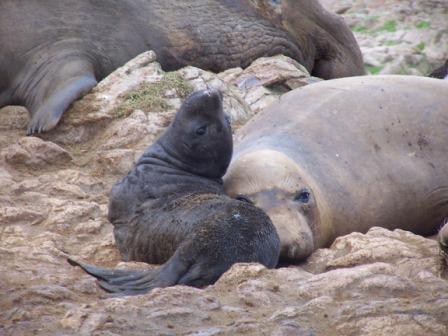
We are finally getting weaners on the Farallones. This is the weaner of Drip, a 14 year old cow born here on Shell Beach. This first wave of weaners look very fat, even though most weaned 2 days quicker than normal. Those early arriving cows get in such long bouts of uninterrupted nursing their pups are ready to wean faster than the pups born to later-arriving cows who have to fight for space on the crowded beaches.


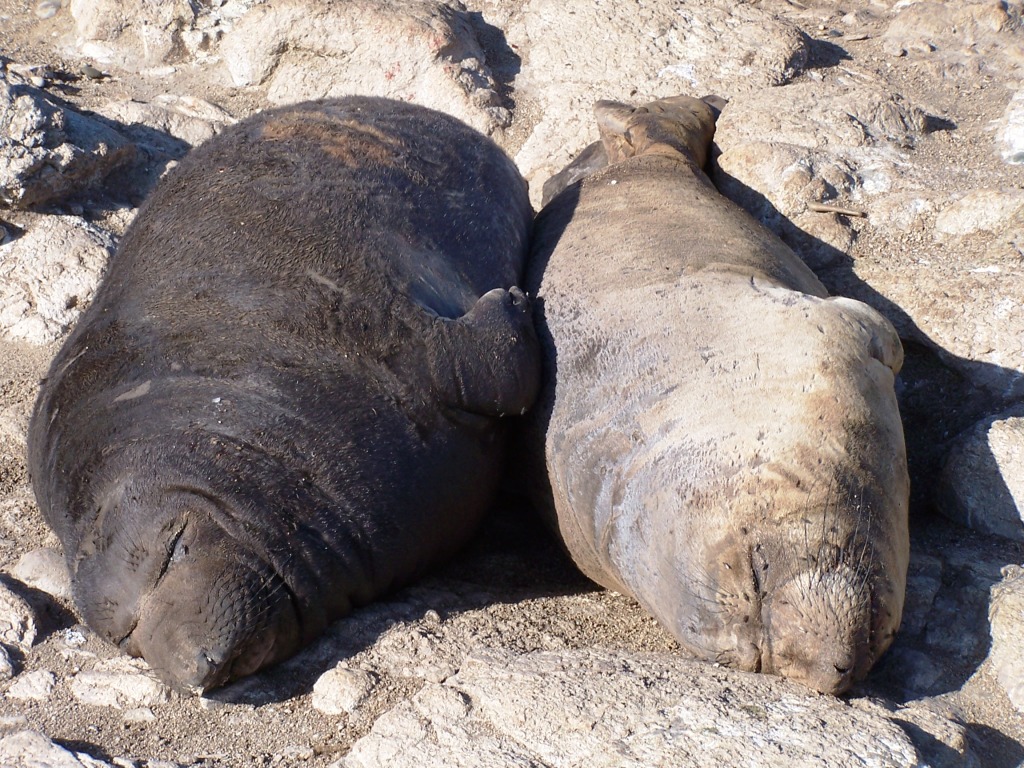
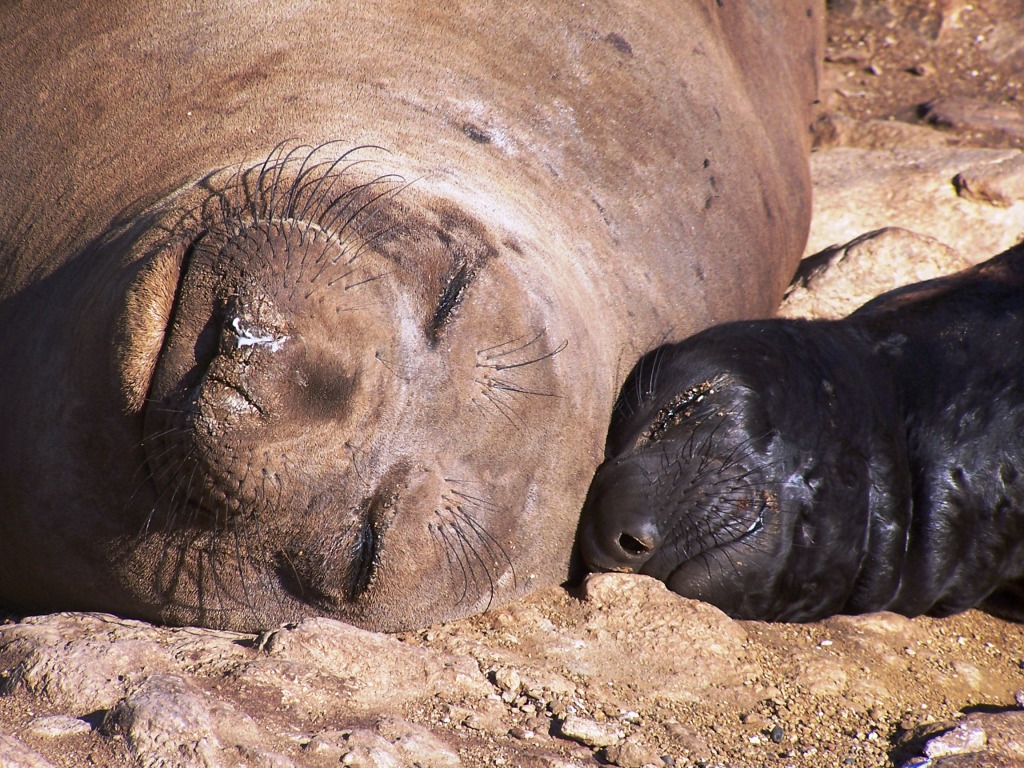
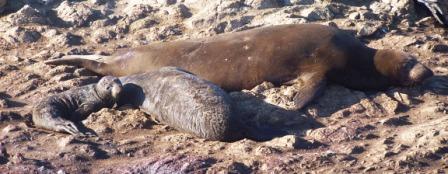
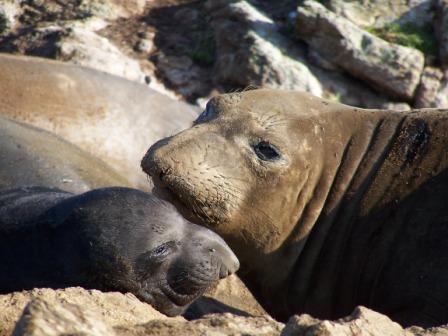
Here is the weaner of Schnitzel lying next to an immature elephant seal that was probably born last year. You can see that the weaner is much larger, I count at least 4 chins on her.

Weaner Schnitzel is the first completely successful breeding attempt for its young mother.


Although the first wave of weaners has arrived, there are still 85 pups out there with their mothers. We are about 10 pups above the average for this date so it looks like the SEFI elephant seal population is continuing to increase, as it has for the past decade.


As for the males, Don Francisco has taken over the Sand Flat and is the undisputed alpha of SEFI. He is a bit less exclusive than Nero was, allowing Brendan, Salvatore, and DMX to lay among the peripheral cows of his harem. Bedlam Boy is harem master of the Terrace, and Rusty is on Mirounga Beach, but he quickly vacates whenever Don comes down for a cooling swim. Puffy is in Garbage Gulch with 3 cows.

West End Island Bulls are Baraka and BobBond.

Monday, January 22, 2007

75 Gray Whales Today

We had a record day for gray whale sightings today. At least 75 gray whales swam past the island on their way to the calving and breeding lagoons in Baja California, Mexico. A few were observed feeding around the island, but most were making their way steadily south. Orcas have also been sighted near the island twice this winter.

Saturday, January 20, 2007

A Day in the Life of a Farallones Biologist

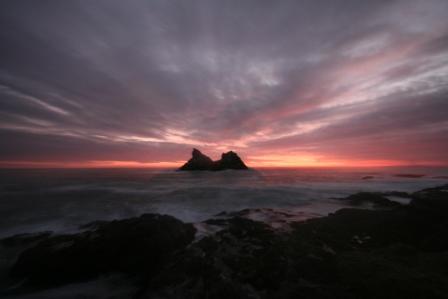
The winter crew watches the sun set on another beautiful day on the Farallones.


During the winter season we primarily study the demography (reproduction, survival, and population change) of the Farallones northern elephant seal population. These parameters can be determined by individually marking the elephant seals to see where they move, how long they live, how often they reproduce and whether their pups survive. We put permanent colored plastic tags with a unique number and letter combination in their hind flipper that we can re-read year after year – and we give each tagged animal a name.


For short-term tracking within the breeding season, we stamp a unique number on each adult elephant seal with blonde hair bleach and black hair dye generously donated by Clairol. The bleach and dye numbers disappear when the animal molts in a few months. But during the breeding season (December through March), these big, clearly stamped numbers allow us to efficiently keep a daily count of seals arriving, defending harems, giving birth, nursing, and departing. We check all the breeding beaches in the morning and again in the afternoon to get the count.

Every pup gets the same stamp number as its mother so we can monitor each female’s reproductive success and pup fate. Also, the number helps us to identify the pup so we can tag it once it is weaned and we’ll know the exact age and who its mother was when we see the animal again in future years. See the picture below of the cow Drip and her pup – they are both stamped “-25,” and Drip's tags are also visible.

At about 110-180 pounds, your average Homo sapiens biologist poses no threat to a 5,000-pound bull male northern elephant seal. These large males are remarkably tolerant of human presence and do not seem to mind if we get close enough to read their tags or stamp a number. But, of course, we still tread very carefully around these animals, as one misstep could yield some painful results!

In addition to intensively studying the elephant seals, we monitor the abundance of California and Stellar sea lions, northern fur seals, harbor seals, arboreal salamanders, and the huge variety of bird species that utilize the Farallones. As part of the overall research we record air temperature, wind speed and direction, and ocean conditions three times per day and we measure sea surface temperature once per day. This is so biologists from PRBO Conservation Science can investigate how atmospheric and ocean conditions over time affect the demography of birds and pinnipeds that breed on the Farallones. In doing so, the biologists document the impacts of climate change on the rich marine life of the Gulf of the Farallones.

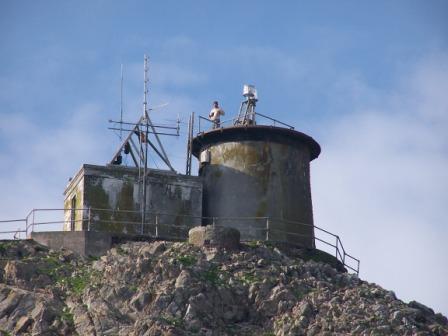
Finally, we post a lookout at the lighthouse to observe and record whales, sharks, dolphins, and any other interesting and notable wildlife that come to the island’s waters to feed or just pass by on their annual migration. For example, the other day we saw a pod of 8 Orca in the waters just off West End Island, and another day 500 Risso's Dolphins swam by. Our one-day high count of grey whales migrating south to calve and breed in Baja California, Mexico is 58.

Saturday, January 13, 2007

Nero Goes from Hero to Zero

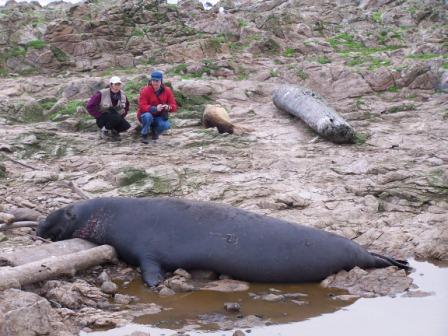
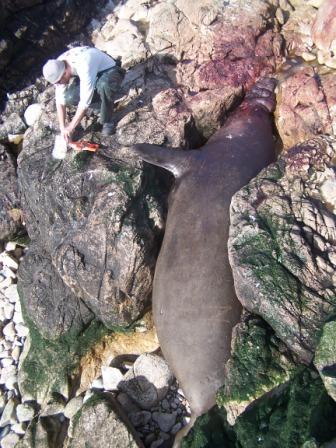
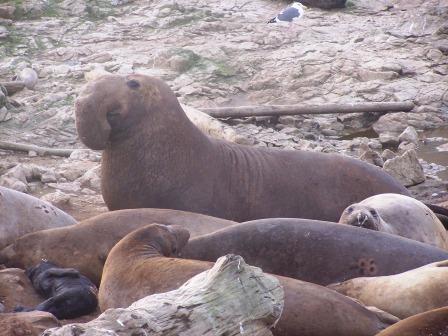
Early this morning, biologist Shawn Farry went to check the beach and discovered a phenomenal sight. Nero, the Sand Flat bull, was dead in Log Channel from severe head wounds. From the evidence we found, it appears that Nero and Don Francisco fought an epic battle that ended when Nero’s head was crushed in Don's jaws. We are all still reeling from the shock. Now that we were able to get a very close look at Nero, we were overwhelmed by his size and bulk. He was nearly 5 meters long, and 5 meters around the chest (sadly we didn’t have the equipment to weigh such a massive creature, but he likely weighed thousands of pounds). In the picture below, biologist Derek Lee prepares to take measurements.

The loss of Nero left a power vacuum on the Sand Flat. First, Aubrey (a tough fighter but not quite a bull) rushed onto Sand Flat and promptly and excitedly attempted to mate with numerous females – most of them with young pups and not yet sexually receptive. Not surprisingly, the females snarled their protest. Salvatore, a bull who had been hanging on the periphery of the Sand Flat and previously fled whenever Nero displayed his nose and bellowed, heard the ruckus and looked up from his nap. Realizing that Nero was gone, Salvatore fought Aubrey for 20 minutes across Sand Flat and Log Channel Beach, finally beating him soundly. The picture above shows Salvatore chasing a fleeing Aubrey.

With hormones still raging, Salvatore then attempted to challenge Don at Mirounga Beach. Don beat Salvatore and Salvatore retreated within about a minute. Apparently Don Francisco is the current alpha bull of SEFI, but he hasn’t yet taken over Sand Flat, the island’s largest harem. Time will tell where all the remaining males will end up, but this shake-up was certainly one of the most exciting days of the season.

We also had our first weaner today. Cow -27 was nowhere to be seen, and her pup was looking round and healthy after more than 3 weeks of nursing the richest, fattiest milk in the animal kingdom. It is likely that the weaner is the offspring of Nero from last year. While Nero’s life ended brutally after only one full year as alpha bull, he probably sired more than 90 pups.
Thursday, January 11, 2007

Seal update

The elephant seal beaches are filling up now. We have 33 cows on Sand Flat, 10 cows on Mirounga Beach, and 6 on the Marine Terrace with 27 pups altogether. Nero is still alpha bull on Sand Flat, with Salvatore loitering nearby, but never challenging the big-nose. Rusty and Aubrey had a big 20 minute fight, but neither has a harem now, so the outcome is questionable. Don Francisco is with the Mirounga Beach harem, and Bedlam Boy is with the Terrace harem.
The first cow-pup drama of the season was started by the abandonment of pup -46 by its mother. She then caused some mayhem by trying to steal the newly born pups of cows -51 and -57. In the melee, the pup of -57 was killed. Cows -51 and -57 shared the remaining pup for a couple days before -51 claimed sole rights. -57 has been wandering around trying to adopt a pup, but without success. -46 is also roaming about, trying to steal pups, continuing to cause disturbance. Meanwhile, the abandoned pup of -46 has been severely bitten in the head, but was adopted by Schnitzel. Schnitzel hasn't nursed the adoptee much, but it is still alive and alert. Two of the three pups born on Mirounga Beach have died after being crushed or bitten by other seals. The crowded and high traffic area is very tough on the new pups there.

For those readers keeping a score card, the newly-arrived cows that haven't yet been mentioned in this blog include: Grasshopper, Daphna, Arwen, Lynne R., and Galadriel.

Wednesday, January 10, 2007

The Nose Knows

Adult male elephant seals are the largest of the pinnipeds, which include seals, sea lions, and walruses. These colossal mammals can grow up to 15 feet long and weigh up to 5,000 pounds! As males get older, they develop a chest shield of wrinkled skin that is bright pink, rough, and deeply fissured like the bark on a tree.


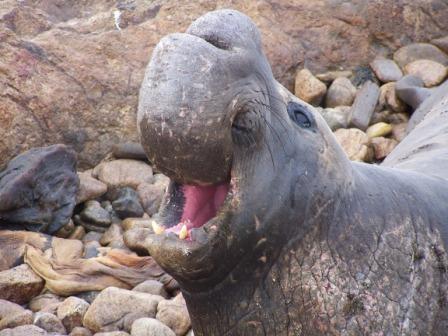
But the inflatable proboscis is without doubt the most exceptional feature of the male elephant seal. Its full size is reached when the male is about eight years old. This peculiar proboscis is an enlargement of the nasal cavity that hangs down about a foot over the mouth when the animal is relaxed (much like the trunk of an elephant, thus the name).


But when that nose inflates…watch out!

A combination of muscle action and blood pressure causes it to form a large cushion on top of the snout, with the tip hanging down so that the nostrils open immediately in front of the mouth. The seal then forces air from his lungs into the nostrils at about 3 to 5 pulses per second. The inflated proboscis acts like as a resonating chamber, projecting the rhythmic, metallic-sounding snorts for nearly a quarter of a mile.


The male elephant seal’s proboscis is a classic example of sexual selection, in which females select males with a certain characteristic that communicates the male’s fitness such that it evolves to extreme proportions. The nose does not appear to perform any particular function for the male other than to attract females and repel males with its enormous size and resulting deep bellow, and is known as a “secondary sexual characteristic.” This is similar to the large showy tail on a peacock or the massive antlers on an elk.


Friday, January 05, 2007

Crowds of Cows (and pups)

The number of cows and pups on SEFI’s main elephant seal beach, Sand Flat, is growing by the day. Once again, First Cow, Giovanna, Schnitzel, and Drip had the first pups of the breeding season – they like to arrive early so they can take advantage of the uncrowded beach to nurse their babies without too much wrangling for precious space. Later in the season Sand Flat will have scores of cows and pups and mayhem often ensues. In fact, it is starting to get a bit crowded already. There are 21 cows and 12 pups, with three or four new cows and pups arriving each day! The beach resonates with the cries of the little seals and the gentle responding “pup sound” that the mother makes to reassure her pup that she is nearby.

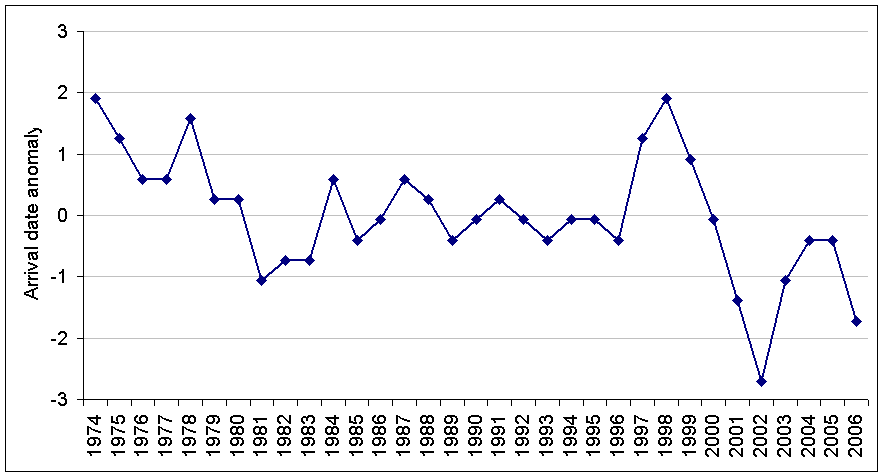
The timing of cow arrival at the Farallones each year (known as phenology) has changed over the decades. This could possibly be due to changes in the average age of the cows breeding here. The islands were first colonized in the 1960s by young animals dispersing from colonies at Año Nuevo and the Channel Islands of Southern California. The graph here shows the median arrival date of females to SEFI from 1974 until 2006. The shifting phenology could also be due to changes in the ocean climate causing periods when food was more or less abundant and cows returned to SEFI earlier or later as a result. Our research has found that during the last 15 years, earlier phenology means higher reproductive success.

Below, we profile a few of the cows we’ve been tracking since their birth.

Mercury was born on Sand Flat in 1990, making her a whopping 17 years old this year! She’s given birth 10 times on the very beach where she was born, producing seven healthy weaners. Furthermore, Mercury’s pup from 1999, Princess Superstar, returned to SEFI this year as a pregnant cow. Both of them just gave birth in the past couple of days, resulting in three generations together on the beach. Mercury and Princess Superstar spend a lot of time near each other – perhaps the bonds of kinship reduce antagonistic behavior that decreases nursing time and hinders pup development.


Another relatively old female on Sand Flat is Drip. Drip was born in 1992 at Shell Beach on West End Island. Like Mercury, Drip has been returning to Sand Flat for the past 10 years. In her first year breeding, her pup washed out to sea but since then she has also successfully produced seven weaners. Drip was one of the first cows to give birth this year and her pup is one of the fattest on the beach.


Queen Latifah was born on Sand Flat in 1999. This is her first year returning to SEFI and she’s now nursing her pup that was born on New Year’s Eve. She is a relatively calm cow who really seems to enjoy her sleep – unlike some of the others who spend lots of time snarling at neighboring cows. Since this is her first year back at SEFI, we’re not sure where and with whom she mated last year, but we’re happy to see her back home.


Maddy also was born on Sand Flat in 1999, first returned in 2003, first pupped in 2004, and has given birth here every year since. Unfortunately, she is only “one for three” so far, with only one successful weaner, but she is young yet. She hasn’t pupped yet this year but we’re checking the beach every day.

Schnitzel is a relatively young cow, born on Sand Flat in 2000. This is Schnitzel’s third year returning to SEFI to pup. Hopefully the third time’s the charm. In 2005, she did not nurse her newborn pup and it died, but we chalked it up to the terrible wounds Schnitzel had on her head and back from an attack by an over-enthusiastic male elephant seal. Last year Schnitzel abandoned her pup as soon as it was born, which often happens with younger, inexperienced cows. Happily that year, First Cow adopted Schnitzel’s abandoned pup and nursed it for several weeks. This year Schnitzel hit her stride and her pup is looking nice and fat. This year, in an interesting karmic twist, Schnitzel herself appears to have adopted an abandoned pup.

Christine is another relatively young cow from the class of 2000. She pupped successfully on Sand Flat in 2004 but she didn’t breed here for the past two years. We’re glad that she is back. She hasn’t given birth yet but it will probably happen any day now.

Thursday, December 28, 2006

Christmas presents

We're picking up the pieces, like many in the Bay Area, in the wake of the after-Christmas storm that blew across the islands with 50+ knot winds. Here, the gusts buffeted the house so heavily that it shook. We woke up thinking it was an earthquake. The gale-force winds peeled siding from the houses and sent flying everything that wasn't tied down, including the large, heavy covers to our water catchment tanks. Happily, enough rain fell during the storm to add another few inches of fresh water to our cistern storage.

All of us here on the Farallones wish the best holiday cheer to the many folks who have supported us during the past year. The rich marine life here in the Gulf of the Farallones has attracted a human community that appreciates the Farallon Islands and the wealth of natural resources that exists here, and many help us with our research on this lonely rock perched at the edge of the continental shelf.

We made a great feast for the solstice with the groceries our Farallon Patrol coordinating angel, Brandy Johnson, arranged to be delivered on the 'Chelsea Lee' out of Sausalito. After big seas and high winds scrubbed our scheduled weekend Farallon Patrol run, skipper Harry Andrews and his crew Brett and Chris graciously rearranged their schedules, making a weekday dash to the islands during the one day of decent weather in the week of the 17th. We depend on these volunteer skippers of the Farallon Patrol who use their own boats to keep the island biologists fed, and delivering parts so we can keep our self-sufficient power and water systems running. Thanks Brandy and Farallon Patrol skippers and crew.

We received an early present the week before, when Brandy and Albertha arranged for Jared on the crab boat 'Bright Future' to deliver a cell phone to the island during a period when our radio communications were down and we were cut off from the mainland. Thanks Brandy, Albertha and Jared.

Many of the working boats of the charter boat fleet support our research on the Farallones by transporting critical equipment or personnel to/from the islands during their fishing/crabbing/shark- and whale-watching trips. Special holiday greetings to Mick and company on 'Superfish,' as well as the folks on 'Butchie B.,' 'California Dawn,' ' Wacky Jacky,' and the boats of the Oceanic Society and SF Bay Whalewatching. Thanks to everyone in the charter fleet. Thanks also to and Ron on 'GW' for checking our buoys.


A big year-end thanks also goes out to Rick, Steve, Ernie and the rest of North Coast Divers for being the most enthusiastic crane installers and maintainers we've ever had the pleasure of having on the island. You guys obviously appreciate the Farallones, and that makes all the difference.

We on the island are especially grateful this winter for the kind gifts from two special Santas, Joan Lee and Margaret Lewis.


Francine at Clairol also sent us our annual gift of product to mark the elephant seals with. Thanks Francine and Mary.

Of course, we must also thank Joelle and Jesse at the Refuge, and the Sanctuary folks as well for all that they have done this past year to make our research on the Farallones a success.