Thursday, August 02, 2007

The Importance of Sea Surface Temperature

As you may know, one of our primary goals out here on Southeast Farallon Island is to monitor the reproductive success of seabirds and to use this information to indicate changes in the quality of the marine ecosystem. Often overlooked, however, is the fact that we also collect data on another very important indicator of change in the marine environment—Sea Surface Temperature.

Water temperature is one of the most important physical properties of the marine ecosystem. Not only does it strongly influence the metabolism and growth rate of marine organisms, but it affects their distribution throughout the marine environment as well.

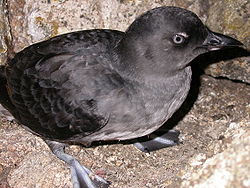
Here on the Farallones, we have recorded daily sea surface temperatures since 1920. This data is then analyzed by the Scripps Institute of Oceanography in San Diego, CA. Having such a long term and reliable data set for sea surface temperature is important because it enables us to see how both natural processes and potential anthropogenic effects have changed the local marine environment over the years. Seeing as how sea surface temperature has such profound effects on the marine environment, it makes sense that sea surface temperature would strongly influence the seabird species out here on the Farallones, who are dependent on the ocean for their food and subsequent survival.One species in which sea surface temperature plays an especially important role is the Cassin’s Auklet. Long term research here on the island has shown that the timing of egg-laying for Cassin’s Auklets is strongly correlated with sea surface temperature. This relationship suggests that local sea surface temperature affects when Cassin's Auklets breed on the Farallones. The temperature of the surface water often indicates whether cold water, rich in krill (Cassin’s Auklets primary prey) from the North has made its way down to the Farallones via the California Current System (CCS). Local winds also mix the water, bringing cooler nutrient rich water up to the surface in a process called upwelling. The breeding season is the most energetically costly time of the year for these birds, because not only do they have to eat but their chicks do too. Sea surface temperature is a good general indicator of food availability for seabirds at the onset of their breeding season.
Friday, July 13, 2007

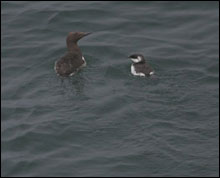
Fledging Murre Chicks take the Big Leap!

Late June into early July tends to be one of the most exciting times out here on Southeast Farallon Island because this is the time of year when our Common Murre chicks are fledging. Fledging is the term we use for when a chick is ready to leave the nest site and start its new life out on the open ocean. For the past four months, Murre parents have faithfully taken turns incubating their eggs and feeding their chicks. The adults must feed their chicks at the colony for approximately 25 days before they gain the sufficient size and grow in the appropriate feathers for life on the ocean. When the chicks are getting close to fledging, they begin exchanging intense vocalizations with their parents - almost as if they are discussing whether or not it is time to leave. Ultimately though, it appears to be the chick that makes the final decision and once the chick has decided to go there is no turning back.

For Murres, when the chick is ready to go, it is the father that takes the chick out to the sea and teaches them how to find and catch their own fish. Fledging, however, can be a difficult process. Chick and dad have to make their way through the entire colony of Murres (see diagram below) - which can be especially difficult seeing as how Common Murres have some of the most densely packed colonies of any bird in the world! Even after the father and the chick get through the colony (trying to avoid getting pecked by other territorial Murre adults), the chick still has to conquer the toughest part of its journey—the cliff jump. It is at this point, where the father flies down to the water below and calls to his chick to jump in. At some places on the island the chick has to jump off a ledge that is up to 150 feet high! That would be the equivalent of a human jumping off a building that was 1.5 times the height of the Eiffel Tower! Meanwhile they have to make sure they clear the rocks below and be cautious of the Western Gulls that are in the area and are always looking at them as an easy meal. This may seem like an unimaginable task for a chick that is only 20 days old, but they still manage to do it.

Route a typical murre chick takes to the ocean

Late evening (an hour or two before dusk) tends to be the time when most chicks begin their seaward journey and fledging continues throughout the night. It is to the chick’s advantage to fledge under low light conditions because it is more difficult for their predators to spot them at the cliff’s edge or in the water. As you can imagine watching this series of events take place can be quite exciting and is often one of the highlights of the seabird season for the biologists. On those nights that look good for chick "jumping"we often try to make dinner early so we can catch watch as many chicks fledge as possible.

It is always a memorable experience watching Murre chicks fledge because each chick’s journey is unique. Sometimes the chicks walk right down to the water's edge (as in the video above), sometimes they make a clean belly-flop into the water, and other times they belly-flop right onto the rocks below. The rocks don’t stop them though. They just get right back up, as if nothing happened, and continue on until they make it to the water, sometimes tumbling all the way down the cliff face and ploping butt end first into the crashing surf.

Once the chicks make it into the water they meet up with their dads and swim away from the island in search of food. Once on the water they are relatively safe from predators and will begin receiving their first fishing lesson. Murre dads continue to stay with and care for the chicks for about 2 months, but the chicks learn to feed themselves after only about a week on the water. With any luck these chicks will grow up fat and happy and return to the island in 5 to 6 years to find a mate and a territory of their own to call home.

Wednesday, June 06, 2007

Eggs and Chicks!!

By this time in the breeding season, most of the 12 species of seabirds nesting here on the Farallones have eggs or chicks. Below are some photos of adults, eggs and chicks taken on the Farallones. (There is plenty of debate over which species has the cutest chick. You can cast your vote by leaving a comment)
.
Rhinoceros Auklet:


Common Murre:


Black Oystercatcher:


Brandt's Cormorant:


Cassin's Auklet:

Ashy Storm-petrel:


Pigeon Guillemot:


Western Gull:


What exactly is a Rhino-Cam?


"Rhino-Cam" is a video camera head attached to a 3-meter long stiff rubber cable, which plugs into a battery pack worn about the waist. Another cord comes out of the battery pack and connects to a visor with goggles which, when worn on the head, show a clear black-and-white image of anything the camera is pointed at.


Biologist Russ Bradley, ready to "Cam-it!"


....................................................................................................................................................
Every five days we push the camera head of this expensive piece of field equipment through long, windy dirt tunnels made by nesting Rhinoceros Auklets. With the camera, we are able to collect data on egg laying, chick hatching, and chick growth. Because we do not handle or touch the birds in any way, the camera method of monitoring nesting behavior is less obtrusive. It also provides valuable information on the timing differences between birds that lay eggs and hatch chicks in natural sites versus birds that use man made "nest boxes.".

Caroline Poli scopes out a burrow (above).
Rhinoceros Auklet (below left). View of auklet as seen in the burrow-cam (below right).


In theory, it’s very easy to just thread the camera down a burrow, see an image in the visor of an auklet on its egg, and back the camera out in the direction it came. In reality, Rhino-Cam is a sweaty, dirty business where only patience and just the right flip of the cord produces success. Burrows frequently have numerous branching tunnels, turn too sharply for the camera to follow or have a hump near the back that the camera can’t jump. Once the camera has been pushed, twisted and turned through the burrow until it "sees" a Rhino sitting on an egg or hits the very last empty chamber, it must come out again. (It is rumored that certain supervisors have gotten the camera stuck in a particularly long burrow for 45 minutes or more)
While operating the camera can be frustrating, it is extremely rewarding to locate a breeding auklet at the end of a tunnel. Sometimes the birds just glare at you, but other times they bite the camera. Arboreal Salamanders, Cave Crickets, Burrowing Owl and very young Western Gull chicks also frequent the burrows. When you turn the camera on, you can never be sure exactly what you will come face to face with.


A cartoon by 2006 Rhino-Cam operator Meghan Riley. (actual burrow shown)

Wednesday, May 30, 2007

The Observation Blind: A Farallon Biologist’s Home Away From Home

Here on Southeast Farallon Island, we have several blinds from which we can observe and monitor the breeding activities of various species. These small buildings allow us to observe the Farallon wildlife, conduct studies, and collect data without causing any disturbance to the birds. They hide us from the birds and shelter us from the weather (somewhat anyway). They also provide spectacular panoramas as well as the opportunity to get close up views of some very interesting animals. Come along for a tour of these blinds and have a peek out of their windows to see what’s going on out here during the seabird breeding season.

The Murre Blind
The Murre blind sits above Shubrick Point on the northeastern side of the island. Located 120 feet above the crashing surf, the blind is constantly buffeted by strong northwesterly winds and is often a very cold and windy place to work. During mid-summer, while most people are doning their shorts and tee shirts the biologists working in the Murre Blind are reaching for their long underwear, hats, gloves, and extra layers of fleece. The birds however prefer these conditions and this blind provides an excellent vantage point from which we are able to observe the breeding activities of approximately 15,000 Common Murres.

Our main study plot on Upper Shubrick Point contains about 300 breeding pairs of Murres. Many of these birds have been fitted with unique color band combinations so that individuals can be followed throughout their lives. This information allows biologists to study survival of individuals over time, determine site and mate fidelity from year to year, understand the roles each sex plays in rearing the chick, and determine chick feeding rates among other things. Farallon biologists will typically spend 4 to 6 hours a day observing this plot to determine breeding success and diet of murres.
View from the window of the Murre Blind looking out over Shubrick Point at the murre colony.

The Cormorant Blind
Located on the west side of the island and perched atop the narrow ridge of Corm Blind Hill, this blind is primarily used for the study of ....yup, you guessed it, cormorants. Several studies require researchers to spend considerable amounts of time here monitoring Brandt’s and Pelagic Cormorants as well as a modest colony of approximately 800 Common Murres. Much like the Murres in the Upper Shubrick study plot, many of the Brandt’s Cormorants have been banded so that we can monitor the breeding success and survival of individuals over many years. However, since these birds are banded as chicks, it is possible to obtain information on survivorship and the role that the age of a bird plays in its reproductive efforts and success.
View from the window of the Corm Blind - looking down on a colony of Brandt's cormorants

Sea Lion Cove Blind
Leaving the Corm Blind and heading northward on the island we arrive at the brand new Sea Lion Cove Blind. Equal parts form and function, this blind is entirely clad in copper and is the culmination of a unique partnership between PRBO, USFWS, and Meadowsweet Dairy, a group of local artists who specialize in creating wildlife habitat through art. Once again, Brandt’s Cormorants are the main attraction at this spot located just across Seal Lion Cove from the Corm Blind. This blind is unique, not only for its appearance but for the fact that it also creates breeding habitat by providing ledges for Murres and shielding both Murres and Corms from our daily activities allowing them to colonize new areas.

An added benefit to the location of this blind is that it affords excellent photo opportunities such as this picture of two Brandt's cormorants displaying over a few scraps of nesting material. They are competing to attract a mate by fluttering their wings and showing off their bright blue throat.


These blinds provide us with the opportunity to get close enough to the breeding seabirds to observe their behavior and collect data about their reproduction, diet, and survival while also hiding us from view and protecting the seabirds from disturbance. During the summer months, we probably spend as much or more time in these blinds as we do living in the houses on the island and that is why we think of them as our home away from home.

Wednesday, May 02, 2007

Return of the Cassin's Auklets

If I asked you to name a sure sign that spring had arrived, egg laying by a krill eating seabird that nests underground likely wouldn't be your first choice. But on the Farallones, Cassin's Auklets mark the beginning of a wave of breeding at the largest seabird colony in the contiguous United States.

These diving birds are Alcids, related to Murres and Puffins, and while they can fly in the air, they are much more graceful "flying underwater" by pumping their wings in pursuit of their favorite prey: krill. The past 2 years were not good ones for Cassin's Auklets, they failed in breeding in both 2005 and 2006 - unprecedented in our over 35 years of continuous research on Farallon seabirds. While these birds normally lay eggs in underground burrows they dig with their feet- we follow their breeding activities in nest boxes which act as artificial burrows. Here we are checking some boxes for nesting auklets.


It seems that major changes in upwelling and ocean currents in the last 2 years meant very little krill available at the right time for breeding auklets. Fewer bred, later in the year, and most abandoned their eggs. But so far for 2007, there is good news! We are seeing auklets breeding in good numbers and incubating their eggs.

This year auklets are breeding in the majority of our study boxes. For the most part, both parents are regularly incubating - which was not the case last year. We have also noticed that birds appear to be heavier, and therefore in better condition, this year than the last 2 years. Here is a picture of an auklet being weighed by intern Caroline Poli. We hope that the return to a "normal spring", with many breeding Cassin's Auklets will signal the beginning of a productive seabird season. As krill feeders lower on the food chain than other seabird species, these birds often act as a "early warning system" for the ocean conditions we are likely to see this summer. So far things look good and once again nights on the Farallones are filled with the mysterious shrill cries of the auklets - think crickets on steroids. Ahh.. spring has sprung....

Saturday, March 31, 2007

March Madness!

When most people hear the term March Madness, they automatically think of a popular college basketball tournament and start laying wagers on which teams will reach the Final Four or win the championship. On the Farallones however, March is a time of maintenance madness and the only wagers are over when the first eggs will get laid.

Though we only have a few buildings and five people, the Farallon field station is effectively a self contained city with our own Department of Water and Power (the solar array and water catchment systems), Department of Transportation (boats and cranes), Department of Public Works (trail and blind maintenance) and of course Department of Housing and Urban Development (human houses and auklet boxes). There is a lot of work required to keep things functioning properly and to make it a comfortable place for the biologists to live and work. Boat motors must be serviced, cranes inspected, water heaters repaired, houses maintained, and nest boxes constructed. Every person who works on the island becomes an amateur mechanic, plumber, painter, electrician, drywaller, mason, and carpenter in addition to our regular careers as biologists.

The buildings we live in were originally constructed in the 1870’s to provide housing for the lighthouse keepers and their families. Though still structurally as sound as they day they were built, they require periodic work to keep them in good shape and to repair the damage caused during winter storms.


This year the major projects have been repairing water damage to the walls, repainting some of the bedrooms, and upgrading the electrical systems by installing grounded outlets and new energy efficient lighting.


But it’s not just our housing that needs upkeep. Cassin’s Auklets, Rhinoceros Auklets, and Pigeon Guillemots routinely breed in wooden nest boxes placed around the island. These boxes provide important habitat and aid our ability to study and monitor the birds. Of course, they eventually succumb to the forces of entropy (moisture, rockfalls, or the weight of an elephant seal to name a few) and must be replaced. The birds themselves also spend some of their time refurbishing their homes, cleaning out burrows, and building nests.


As the seabird breeding cranks up over the next few weeks, we will have less time to accomplish these tasks so March becomes a mad dash to get everything completed, repaired, or replaced before the first eggs get laid.