Friday, April 09, 2010

A Spring Transition

Blowing so hard even the gulls can't stand up!
According to my oceanography textbook, the spring transition is when weather and ocean conditions shift from predominantly winter conditions to spring/summer conditions and marks the beginning of the upwelling season. Winter is typically dominated by southerly winds, frequent storms and rain. Whereas spring and summer are typically dominated by strong north/northwesterly winds, clear skies, and more arid conditions. The wind often blows so hard during the spring that it is difficult to walk around. (see A Mighty Wind posting from April 2009).

This shift is extremely important for biological productivity in the waters around the Farallones. The strong northwesterlies drive the process of upwelling that brings cold nutrient rich water to the ocean surface and, coupled with abundant sunshine, spurs on the production of phytoplankton that forms the base of the food chain.

On the Farallones, however, the spring transition is more than just a change in the winds. The whole island is transformed to make ready for the next wave of wildlife (and wildlife biologists) to inhabit these rocky shores. The elephant seals have finished their breeding season, the last pups have been weaned and the adults have departed the island in search of food to recover the fat reserves they depleted during the long winter fast. Along with them went the winter crew. After spending the last 3 ½ months diligently caring for the island and its wildlife, they have returned to mainland to write up their findings, pursue other interests and prepare for next year. The abundant rains during this past winter have produced a lush blanket of vegetation covering the entire island. The Farallon weed (Lasthenia maritima) is in full bloom and taller than we have seen in many years. 
The marine terrace and hill in spring bloom
But most importantly to those of us now on the island, the spring is when the seabirds return to the island to set up nesting and begin breeding. Over the next six months, the seabird crew will dedicate our energy to studying the population trends, survival, diet, and reproductive success of the 13 species of seabirds which call these rocky islands home. More than a quarter million seabirds breed on the Farallones each year, including approximately half the world’s population of Ashy Storm-petrels, the world’s largest breeding colony of Western Gulls, and the largest colony of Common Murres in California with approximately 250,000 birds!
Common Murre breeding colony on Shubrick Point

Cassin's Auklet with nest box
So far, things are looking good. Cassin’s auklets have already begun breeding in good numbers and the other breeding species have returned to meet up with their mates, re-establish their territories and begin the process of nest building. Although we are in the midst of an El NiƱo, the effects seem to be minimal on the Farallones so far. We may even have a new breeding species on the island this year. A pair of Common Ravens has been present on the island for the last few months and has recently been observed gathering nest material. Raven’s haven’t bred on the Farallones since 1911! It will be interesting to see what effect these intelligent predators have on the seabird colonies.
Common Raven carrying nesting material


Wednesday, March 03, 2010

An Intertidal Journey

This past week, PRBO biologists hosted special visitors to the island - a team of scientific experts on plants and animals that inhabit the intertidal zone. The Gulf of the Farallones National Marine Sanctuary, a program of NOAA, has been conducting surveys of the South Farallon Islands' intertidal zone every year since 1992. This long-term monitoring provides valuable baseline information on species composition and richness in a relatively pristine area.

Documenting species composition in permanent plots.

The intertidal crew includes biologists from the Sanctuary, the California Academy of Sciences, and Tenera. They inventory invertebrates, take photographs for archives, and document algae cover in permanent plots at 6 sites on SEFI and West End. Surveys are conducted 3 times per year, weather permitting of course.

Working conditions in the intertidal zone can be rough, especially during winter storms.

This year, 5 new species were documented. Moreover, a black abalone (Haliotis cracherodii) was sighted here for the first time since 2000. Black abalone, once the most abundant species of abalone in California, is now perilously close to extinction due to past overfishing. It is currently federally protected under the Endangered Species Act. The South Farallon Islands are at the northern extent of its range.

Black abalone, an endangered species, was documented here for the first time in 10 years.

The intertidal crew included Dr. Rebecca Johnson, an expert on opisthobranchs from the California Academy of Sciences (you can link to the Academy's Rocky Shore Partnership blog here). These marine molluscs, also known as nudibranchs or sea slugs, have reduced, internalized, or completely lost their shells over evolutionary time. Their brilliantly luminous neon colors in distinctive patterns serve as a warning to potential predators - many are foul tasting. But their warning colors also make them some of the most beautiful animals inhabiting the oceans.

Horned Aeolid (Hermissenda crassicornis), one of the more common nudibranchs on the Farallones.

Clown Dorid (Triopha catalinae)

The intertidal zone is one of the harshest environments on Earth. The zone is exposed to the air at low tide and underwater at high tide, and is continuously pounded by the surf, which on the Farallones can be very rough indeed. The plants and animals are well-adapted to their extreme environment. The relative lack of pollution and absence of human trampling on the Farallones allow biologists a glimpse into the structure of an intertidal zone comparatively free of direct human impacts. This crucial information is yet one more reason why the Farallones are such a tremendous resource to our understanding of the ocean ecosystem.

Plants and animals compete for space in Jewel Cave, one of the loveliest tidepools on SEFI.

Strawberry anemones in Jewel Cave.

Chitins, urchins, anemones, and sea stars dwell amongst sponges and algaes.

Sunday, February 28, 2010

Farallones in Bloom

The wildflowers are in full bloom on the Farallones and due to abundant rainfall this year they are particularly prolific. While the native maritime goldfields (Lasthenia maritime) and marsh and sticky sand spurry (Spergularia spp) continuously sported a few flowers throughout this wet winter, in the past couple of weeks the island has truly burst into color. The goldfields are knee-high in some areas of the marine terrace.

Maritime goldfields (Lasthenia maritime) is the dominant plant on the Farallones.

The cart path overgrown with maritime goldfields.

Sticky sand spurry (Spergularia macrotheca)

One of the rarest and arguably most beautiful native flowers on the South Farallon Islands is the seaside daisy (Erigeron glaucus). This lovely low-growing spreading plant has curled, velvety leaves, bright yellow centers, and lavender petals and grows mostly on rocks on the north side of Little Lighthouse Hill and on the path to the murre blind on Shubrick Point. We found this specimen blooming on the rocks above the new copper Sea Lion Cove blind.

Seaside Daisy (Erigeron glaucus)

Saturday, February 13, 2010

It's a Superweaner!

Most female elephant seals nurse their own pups exclusively until weaning, and are fiercely protective of their pups - with good reason, as the main cause of pup mortality on Sand Flat is being bitten in the head by other cows. However, some cows that lose their pups will adopt orphans and raise them as they would their own. Occasionally, some lucky pups are suckled by two mothers or are adopted by a pupless female after being weaned by their own mother. They are known in the elephant seal world as "double mother suckers", or "superweaners." These weanlings can grow to be twice the mass of normal weanlings!

Below is a movie of a superweaner on Sand Flat. The cow, named Robin Robertson, either stole this pup after losing her own, or she may have accidentally switched pups with another cow and ended up with a pup older than her own. He is so old that he has already molted most of his black pup fur, yet he continues to nurse. We have two additional superweaners, both adopted by cows from Mirounga Beach who lost their pups in the mid-January storm.


Tuesday, February 09, 2010

The Farallon Arboreal Salamander

The only native terrestrial vertebrate inhabiting the South Farallon Islands year-round is the arboreal salamander, Aneides lugubris. The Farallones population is considered a sub-species, A. lugubris farallonensis, but is closely related to arboreal salamanders at Point Reyes peninsula. The Farallones were connected to Point Reyes 10,000 years ago when sea levels were much lower.


Aneides lugubris farallonensis.

On the mainland, this species is associated with oak woodlands. It is described as arboreal because of its unique ability and propensity among salamanders to climb trees: the enlarged toe tips and prehensile tail is adapted for climbing, and individuals on the mainland have been found in tree cavities as high as 60 feet above the ground!

However, trees are in rather short supply here on the Farallones - so what gives? Although its common name suggests that this salamander lives in trees, it is actually found mostly under rocks and logs and in crevices and burrows, and its arboreal tendencies may be somewhat overrated. Seabird burrows cover almost the entire Southeast Farallon Island and, together with the many rocks, provide abundant cover for salamanders.

The arboreal salamander has a prehensile tail to facilitate climbing.

One herpetologist noted that "this curious genus [Aneides] is furnished with by far the most powerful dentition of any existing salamander..." Given that the arboreal salamander is the biggest species of its genus, these guys have especially large and powerful teeth, and have even been known to bite the unsuspecting PRBO biologist!

Arboreal salamanders are lungless salamanders (family Plethodontidae) that breathe through their skin. This renders them sensitive to changes in water or air quality, making them good indicators of ecosystem health. PRBO biologists initiated a long-term monitoring study of the Farallon arboreal salamander in 2006.

In the dry season from May to October arboreal salamanders retreat to burrows deep beneath the ground where they guard their eggs and hatchlings and wait for the rains to return. They are only active near the surface during the winter rainy season. When at the surface they are strictly nocturnal, emerging at night to forage for beetles, isopods, and other insects. During the day they remain in stone walls and crevices and under rocks and boards.

Coverboards are placed in pairs along the path from the PRBO house to North Landing.

We placed more than 100 permanent cover boards along the path from the PRBO house to North Landing. We check under the boards for salamanders every 2 weeks from November to May, the period of greatest surface activity. When we capture a salamander, we measure and weigh it, check for eggs (you can see eggs through their skin), and take photos of its spot patterns. Each salamander's spot pattern is unique, so we can individually identify them using our photo database.

A biologist measures a Farallon arboreal salamander.

Each salamander has a unique spot pattern, allowing biologists to individually identify them.

Unfortunately, a larger proportion of amphibian species are at risk of extinction than any other group of animals. Salamander populations throughout the world are threatened by chemicals, infectious diseases, and habitat loss. By studying the Farallon arboreal salamanders, we can understand their population dynamics and hopefully ensure a future for this special and unique creature.

Thursday, February 04, 2010

A Superlative Creature

Noted elephant seal biologist Burney Le Boeuf once stated, "if you like superlatives, you will love this animal."
Consider this list from Le Boeuf and Laws' seminal 1994 book on elephant seals:

Elephant seals are the largest of the 34 extant species of pinnipeds in the world, and one of the most sexually dimorphic marine mammals - adult males are several times more massive than females.

Alpha bull elephant seal mates with a cow.

Elephant seals are extremely polygynous compared to any other large vertebrate.  One male might mate with up to 200 females, while most males will never mate.

Females fast the entire time while nursing their pups, and the largest breeding males fast for more than one hundred days during the breeding season.  After losing up to 40 percent of their body mass while fasting, females then migrate at least 5,500 km and males at least 11,000 km into the ocean to find food.

A cow aggressively defends her pup while nursing, but her weaned pup must learn to swim and hunt on its own.

Elephant seals dive deeper and longer than any other pinniped, and they spend more time submerged during their long aquatic wanderings than most whales!

Elephant seals even sleep underwater.

No other large vertebrate has come so close to extinction and made such a rapid recovery as the northern elephant seal.  And thank goodness it recovered:  the South Farallon Islands and indeed the world would be a much poorer place without this most superlative of creatures.

 PRBO biologists tag all weaned pups on SEFI and West End for permanent identification.

Monday, February 01, 2010

Molly is Back!

Molly, the brant who hangs out with the western gulls on SEFI from time to time, is back after a several-month absence. Welcome back, Molly!

Friday, January 29, 2010

Peak of the Elephant Seal Breeding Season

The last days of January are the peak of the northern elephant seal breeding season on the South Farallon Islands. Most cows have already arrived and given birth on the rookeries, which echo with the sounds of cows calling to their screaming pups and males bellowing to intruders. We can hear the cacophony all the way up at the PRBO house! SEFI's Sand Flat (pictured on the left), where Rusty is the reigning alpha bull, currently has 73 cows, 52 live pups (9 dead), and 2 weaned pups, including the cow Daniela's weanling. The Marine Terrace colony has 15 cows, 11 live pups (1 dead), and 2 weaned pups, including the cow Shaye's weanling, with Flaccido Domingo the alpha defending this harem. Mirounga Beach, where McHammer is alpha male, has only 4 cows and 2 pups, after last week's massive storms washed out 3 pups and forced 16 cows up to Sand Flat, including the cow Aprile and her pup who are doing fine! On West End, 8 cows and 5 live pups are at Pastel Cave Highlands, defended by Felipe, and 10 cows, 4 live pups (3 dead), and 1 weaned pup are on Shell Beach with Bedlam Boy as alpha bull.

Flaccido Domingo claims the cow Carmen, in a display to a male challenger.

Northern elephant seals are fascinating in their ability to live off their blubber for long periods of time, a critical part of their life-history strategy. Called 'capital breeders' because they feed their pups entirely from their stored blubber reserves, adult females fast the entire time they are nursing their pups, about 30-35 days. 'Income breeders' like California sea lions must leave their pup on the beach occasionally to forage for more energy to maintain themselves and their growing pups. By not having to forage while nursing, the elephant seal cow transfers a great deal of milk energy to her pup in a short time. This allows her to wean the pup quickly and return to sea to prepare for future offspring by foraging on her own without encumbrance. The largest breeding males fast for more than 100 days, allowing them to be vigilant in fighting and defending their harem of cows from other male challengers, and then mating with every receptive female as their reward. Weaned pups live off their blubber for several months while they learn to swim and dive before first heading off to sea to forage.

Rusty bellows a warning to a male attempting to intrude on "his" cows.


Rusty's reward for defending the harem is to mate with >70 receptive females!

Given that elephant seals must live entirely off their blubber while on land, it is no surprise they spend as much time as possible sleeping. Elephant seals undergo sleep apnea (holding their breath) for up to 25 minutes, enabling them to reduce water loss from respiration and to slow lipid metabolism - the only source of water for a fasting seal.

Cows, pups, and a bull sleep long hours to save water and energy.

Cows do not eat for 35 days or more while transfering milk energy to their rapidly growing pups.

Weaned pups live off a thick layer of blubber while learning to swim and dive.

Wednesday, January 20, 2010

Stormy Weather

The Farallon Islands have been pummeled by a series of major storms over the past few days. The massive swells crashing into the island are awe-inspiring and the intermittent heavy rains are filling our cistern with much-needed drinking water to last PRBO biologists the rest of the year.


The huge waves - especially at high tide - wreaked havoc in our elephant seal breeding colony. Mirounga Beach and Log Channel filled completely with water. Just prior to the storms, Mirounga Beach had 16 cows and 5 pups. Once the storms hit, we thought all pups there were washed out. However, yesterday we spotted 2 tenacious pups still alive and attempting to move to higher ground! Many of the Mirounga Beach cows moved up to the protected Sand Flat, bumping up the population on the flat from 50 to 62 cows over just 2 days.

The storms are expected to last a few more days, with a break over the weekend and then more rain next week! Luckily the new blind on the hill overlooking Sand Flat not only hides us from the skittish California sea lions, but also provides us some shelter from the elements while we continue to monitor the elephant seals every day, rain or shine.

Wednesday, January 13, 2010

20 Orca seen today!

During this morning's lighthouse watch, I saw 20 Orca swimming west of the island, headed southeast.
5 big males were in the group and perhaps 4 juveniles.
Very exciting!

Tuesday, January 05, 2010

The Battles Begin

The genus Mirounga comprises the northern and southern elephant seals, the largest pinnipeds in the world. Our large northern elephant seal bulls on Southeast Farallon Island weigh up to 5,000 pounds – some particularly massive ones are even heavier. Northern elephant seals are highly sexually dimorphic, with males weighing 3 to 6 times more than the females. While smaller than their southern counterparts, northern elephant seal bulls have a longer nose and more pronounced chest shield of scarred and thickened skin. This chest shield is associated with fighting, and the nose is thought to act as a resonating chamber that amplifies their bellow to warn off other males.


Pink chest shield and large nose on Bubba.

Winter marks the season of bull battles as males compete to dominate the harems of females who have come ashore to give birth, nurse their pups, and breed. Rusty, our alpha bull last year, has returned and is holding the Sand Flat harem again, with 15 cows as of January 3, including Daniela, Kyra, Eone, and Lodi, and 7 pups. Kyra and Eone were both born on SEFI in 1999.


Kyra with her newborn pup on Sand Flat.

Flaccido Domingo is the beta bull on Sand Flat. Time will tell whether he challenges Rusty for the top spot.


Flaccido Domingo is second on Sand Flat, but wary of mighty Rusty.

Speaking of challenging for the top spot, the bull Bubba attempted to do so on December 31, leading to his demise. Rusty killed Bubba in a brutal, hour-long battle in which Bubba got stuck between two rocks in Log Channel Beach. This happened to Nero in 2007, when he was killed by Don Fransisco after getting wedged between the same two rocks.


Rusty and Bubba battle in Log Channel Beach.

Most elephant seal fights do not end in death, but occasionally when two bulls are closely matched, the winner will continue to batter the loser until he is permanently eliminated. The battle was a sobering reminder to PRBO biologists of the realities of nature and that life itself is at stake for these animals. You can view a part of the battle below, but be warned that it is not for the faint of heart.


The harem on the Marine Terrace of Sand Flat is small but growing. There are currently 3 cows and 2 pups, including new cow Shaye. McHammer, not quite a bull, is dominating this harem. He is 9 years old, born and tagged on the Farallons in 2001.


McHammer on the Marine Terrace.

Mirounga Beach has no pups yet, and cows so far have been just passing through. Felipe, nearly a bull, has been seen in Mirounga Beach. Similarly sized Mein Gott is biding his time on Lower Arch Terrace. McHammer, Felipe, and Mein Gott are known as "SA4" seals, or 4th-year subadults. The next step up is a bull.

Monday, December 21, 2009

It's big, it's blue, it's broken!

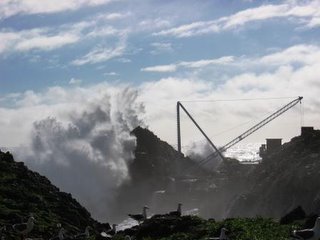
Living on a remote island wildlife refuge is a wonderful experience for the biologists and research assistants of PRBO. However, all food and personnel must come and go via boat, and the ocean is so rough at SEFI that no boat docks exist. Our main facility for getting things and people on and off the island for the last 40 years has been East Landing, which has a large, electric-powered crane that puts our SAFE boat skiff in the water.  The SAFE boat then meets with the supply vessel and transfers material.  The crane then lifts the skiff and supplies back up to the boat deck 30 feet above the sea.

A railroad cart that runs from the landing, past the powerhouse and ends at the SEFI house makes moving huge loads of supplies, generators, and fuel easy. This landing site has been used since the first human inhabitants of SEFI came to harvest skins and eggs because it lies in the protected lee of the island, sheltered from the prevailing winds and currents from the northwest. The latest incarnation of the East Landing crane was built in 1989 by Sheedy Drayage.


East Landing crane gets doused by a winter southerly storm swell.

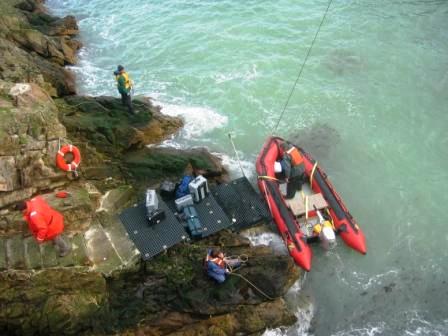
As is inevitable for machinery operating in an oceanic environment, the crane has suffered corrosion and decay and was suddenly condemned a few months ago. Since that time, we have been using our secondary landing on the north side of the island in Fisherman's Bay.  North Landing has a hand-powered crane to raise and lower our Zodiac (a small, inflatable boat).  Gear and supplies are transferred between the Zodiac and shore at a sea-level platform on the rocks. Large swells can (and often do) suddenly roll in, scouring the cove with roiling whitewater and tossing the Zodiac around like a cheap beach ball at a Phish concert.  We then hump our supplies around the island in wheelbarrows.

North Landing Zodiac at the steps where gear is unloaded.


We've begun the two week-long operation to dismantle the East Landing crane and remove it to the mainland for reconditioning and repair.  Using HH-60 Pavehawk helicopters, our friends at the 129th Rescue Wing of the California Air National Guard at Moffett Field airlifted giant toolboxes loaded with the specialized, heavy-duty tools and equipment needed to work on the crane.  Local 377 ironworkers from Sheedy Drayage tore down the crane over two days and prepared the parts for transport.  Aris Helicopters then lifted each part of the crane and moved them to the helicopter pad, except for the boom, which was immediately flown to the mainland.


East Landing crane just before Sheedy and Aris pulled all the pieces and placed them on the helo pad.

One of the crew from Sheedy was Al Pietrocelli, who worked on the original installation of the big blue crane 20 years ago. Al was happy the dismantling went smoothly and thought the damage was not too extensive. Hopefully we'll soon have East Landing back in operation, and the much more physically taxing North Landing will revert to its back-up role as a storm landing.

In a related (and nearly as important) story, early December bore brutishly down upon the island with a nasty cold snap. Not big news, except that our (in)famous Webasto boiler has been out of commission since April.  We are wildlife biologists, who think of ourselves as a hardy species used to extreme weather, difficult geography, and of course, wild animals.  But we were reduced to shivering, quavering wimps.

A handy-crafty species as well, the biologists out here at SEFI have been able to keep the Webasto (designed to heat the cabs and engines of semi trucks, buses and boats) going well past its service life.  This time, however, the diagnosis was terminal.  Its shiny new replacement is currently purring away under the back stairs, pumping hot water through the radiators, and happiness once again reigns at SEFI.

After two weeks, we barely remember the old one.

Thursday, December 10, 2009

Winter Season Begins

The 2010 winter crew has arrived at SEFI, eager to being monitoring this season's northern elephant seal reproduction. We welcomed the continued presence of California and Steller sea lions at Sand Flat and Mirounga Beach, our main elephant seal breeding beaches. Northern fur seals have even been spotted twice at Sand Flat over the past year. In spring 2009, PRBO biologists counted the largest number of California sea lions ever on the island, with a high of a whopping 13,000 individuals (the average number is about 2,500). While overall numbers of sea lions are lower this year, the concerted efforts of SEFI's human residents to minimize disturbance has paid off, and sea lions are hauling out on new areas of the island. Sometimes, however, they decide to hang out in rather inopportune places -- like on our front path, on the back doormat, and on the top of our new Sea Lion Cove blind!


Two California sea lions sleeping on the roof of the copper SLC blind.

Last year, sea lions took up residence on Sand Flat and Mirounga Beach and surrounding terraces, and have been there ever since. The sea lions on our main breeding beaches have changed the way we monitor elephant seal survival and reproduction. Because sea lions and fur seals are more skittish than elephant seals, we now read seal tags and count e-seal cows and pups by hiding behind rocks to avoid being seen by the sea lions.


Elephant seals and sea lions lounging at Upper Mirounga Beach.

This week, PRBO biologist Derek Lee and the rest of the winter crew began re-building a blind on the rocky outcrop overlooking Sand Flat. Using the blind, we can comfortably remain hidden while reading e-seal tags and monitoring the arrival and departure of cows and the births of pups. We also can keep tabs on the adult e-seal males battling for dominance.


We are grateful that the sea lions and fur seals are venturing back into places they may have abandoned many decades ago due to human disturbance. We are merely visitors to this world-renowned biologically rich haven for marine life.

It is their island, after all.