Sunday, October 17, 2010

FARALLONATHON – DAY 7 – THE FINAL DAY

The final day of our Farallonathon dawned with a light northwest wind, mostly clear skies, and 30 miles of visibility. These conditions are not great, but not terrible either. Unfortunately, there were not many landbirds around. The tailwind for easier flying and clear skies for navigating allowed most birds present over the last few days to depart the previous night. With no new landbirds, we would have to rely on the ocean to provide us with the remainder of our points. The first and only bird point would come during the AM seawatch when Noah spotted 180 Sabine’s Gulls in just 5 minutes! We had been hearing reports of large numbers of Sabine’s Gulls from pelagic birding trips, but until today, we had only seen a few from the island.

The lighthouse, though, was where we would add most of our points today. During a one-hour period at mid-morning, at least 3 different sharks were spotted from the lighthouse. The first was a shark seen surfacing behind the New El Dorado III, a shark tourism boat that puts customers into a dive cage where they can see sharks materialize out of the murky waters. A few minutes later a different shark attacked an Elephant Seal off of Indian Head. This attack lasted nearly one hour, with the first shark surfacing numerous times to tear off chunks of the carcass. White shark researchers working for Stanford’s Hopkin’s Marine Lab identified this first individual as Tip Fin, a shark they have seen around the island during previous years. Once the first shark had had its fill, a second shark came up and fed on the carcass. The two shark sightings and the attack netted us 7 points within an hour.


In addition to the sharks, the observers at the lighthouse were also preoccupied with the diversity of cetaceans around the island. In addition to the 2 Gray, 5 Blue, and 35 Humpback Whales, the observers also spotted a Fin Whale, a pelagic species that is rarely spotted from the island. Fin Whales are nearly as large as Blue Whales, but they differ in being blackish above and having a taller dorsal fin. They are also unique amongst whales in having the lower jaw white on the right and black on the left. Both species can swim quite fast, and this allowed them to escape early attempts at hunting while other species became depleted. Historically, Fin Whales in the North Pacific numbered at ~45,000 individuals. After the steam engine was invented and used to power ships in the late 1800’s, whalers turned to hunting the more abundant Blue and Fin Whales. The global populations of both were decimated until the International Whaling Commission banned hunting in the mid to late 1900s. Today, it is estimated that the populations of both species off of California number only around 2000.

As fog settled over the island at noon, our chances of spotting more shark attacks, cetaceans, or seabirds came to an end. Hence, our final point for the Farallonathon was found in a tide pool. To obtain this final point, islanders ventured into Jewel Cave where they encountered two Fluffy Sculpins, three Bald Scuplins (also seen on day 5), a sea lemon, and a starfish! Unfortunately, the only invertebrates we count on Farallonathon are butterflies and dragonflies.


With 1 bird point, 1 whale point, 1 fish point, and 7 shark points, our overall total was brought up to 160 points. So how does this year compare to the previous 18 years of Farallonathons? Including this year, the average score for a Farallonathon has been 177 points, with the high set in 2001 at 240 points, and the low set in 2008 at 129 points. This year’s effort was the 13th best, or 7th worst depending on how you want to look at it. Maybe next year, we’ll time our Farallonathon with a bird wave a little better.

Anyway, the main reason to have our Farallonathons is to have fun and raise money for our research. So, if you have not already contributed and you appreciate what we are doing out here, this will be the last reminder you’ll hear from us until next year’s Fararallonathon. If you can, please consider supporting our research by pledging either a per-point amount or a flat donation for the event. To make a donation, please go to our Farallonathon website at: www.firstgiving.com/farallonathon.  And lastly, thank you very much for making our research possible.

Wednesday, October 13, 2010

FARALLONATHON – DAY 6

Wow, three straight days of light east wind – there’s got to be a fallout here someday! The cloud cover this morning was about 50% cirrus, which isn’t great, but better than no clouds. The visibility, though, was 30 miles, which means the mainland was clearly visible. I suppose that would be where all the birds headed when, or if, they discovered themselves over the ocean in the morning.

Shark watch starts at 8AM, and from the lighthouse, I could see a fog bank slowly approaching from the west. To the east, the visibility was improving so that I could see Mt. Diablo, but this would be short-lived. Within an hour, the fog was lapping at the island, obscuring West End, and officially cancelling Shark Watch. How would we see shark attacks? Although fog really reduces our ability to see stuff on the ocean and reduces the number of birds that can find the island, it was actually pretty neat watching the fog engulf the island. As West End and Indian Head slowly became veiled in gray, Maintop (slightly east and higher than the other two) remained free of the fog and looked especially crisp in the full, bright sunlight. I was really wishing I had brought my camera. Then streamers of fog began forming off the tops of Maintop and Sugarloaf as the fog drew steadily closer. Although shark watch was officially cancelled as soon as I could not see beyond West End, I stayed at the lighthouse scanning the ocean and hoping to get another shark attack. At 10, I surrendered and headed down the hill. Luckily, the Superfish, a shark tourism boat, notified us of an attack off Indian Head, which we were not able to see well from our vantage point. But, Zach Coffman, an employee of the Fish and Wildlife Service and an islander, just happened to be going over to the Superfish and got great views of the shark as it came up to investigate the small boat he was driving. We got to see it then too and added 5 points!

With the visibility reduced to less than a mile, we figured our day was over for finding new Farallonathon birds. But we were wrong, as we still hadn’t found all the birds on the island that arrived before the fog settled on us. Around noon, Noah pulled an Empidonax flycatcher out of the Twitville net. He noted that it was all yellow below, put it in a bag, and handed it to Oscar. He told him that it was a Western, and asked him to band it because he had to start the shorebird survey. When Oscar pulled it out of the bag in the banding lab, he noticed it had a bright green back, round eyering, and black wings with contrasting white wingbars. He suspected that it was a Yellow-bellied Flycatcher, a species that is very similar in appearance to Western Flycatchers. Oscar then notified the rest of us, and we all assembled in the banding lab to check it out. With only 22 previously accepted records in California and just a 55% acceptance record by the California Bird Records Committee (CBRC) due to the difficult in identifying them, Oscar carefully measured the difference in flight feather lengths. The “wing formula” is one of safest ways to identify an Empidonax flycatcher that is not singing. About half of Oscar’s measurements were in the zone of overlap between Western and Yellow-bellied, but the other half were clearly within the range of Yellow-bellied and outside the range of Western. With the measurements and appearance of a Yellow-bellied Flycatcher, we would now need photographic evidence. For the next 10 minutes, this bird endured a barrage of shutters clicking at it. We may have taken over 200 photos of it! Why not? We’re not shooting with film anymore!


Late in the afternoon, Sara showed Oscar a photo of a gray bird with a contrasting black cap she had seen in a cave in Sea Pigeon Gulch while she was looking for Burrowing Owls at noon. Oscar recognized this as a Gray Catbird and showed me the photo. We all jumped up and headed down to Sea Pigeon Gulch. The bird was still in its cave. Although this bird is no longer reviewed by the CBRC, it was reviewed in 1992 when the first Farallonathon occurred, so to keep scoring fair between the years, we count this as a CBRC bird. Besides this is only the 17th record for the island!


With the addition of two more migrant birds, a calling Red Phalarope that flew across the Marine Terrace and a Western Palm Warbler that was banded, we added 17 more points to our total. This brought our overall total up to 150 points. With just one more day of Farallonathon, we really needed some new birds and more shark attacks. Stay tuned for the grand finale tomorrow!

Please remember that your support makes this research and conservation possible, so if you can, please pledge either a per-point amount or a flat donation for our Farallonathon by going to our donation page at: http://www.firstgiving.com/farallonathon.

Tuesday, October 12, 2010

FARALLONATHON – DAY 5

Another day dawned with light east winds and cloudy skies. Supposedly light winds and overcast skies bring lots of birds, so when we woke up and found that there was just a single knot of wind out of the east and 90% altostratus cloud cover, we thought for sure that there would be a good fallout. But where were they? Yet again, something unknown was not right. When we stepped outside there were no flight calls: just the calls of newly arriving Black Phoebes scolding each other in order to claim their winter territories. Oh well, we would try our hardest to find what was out there. Up at the lighthouse there were far fewer birds today than the day before. Many of the sparrows had departed. Of the 50 Savannah Sparrows yesterday, only 6 remained; and of the dozen Lincoln’s Sparrows, only 1 remained. There were a few new birds though. A juvenile Northern Harrier flew past the lighthouse and a Bobolink was found on the Marine Terrace before it quickly disappeared into Sea Pigeon Gulch. During the morning, the clouds headed east, and the visibility improved so that the entire coastline was visible. Any other birds looking for a place to land probably flew back to the mainland instead of landing on our desolate rock. With the nets open all day, we managed to capture just 11 birds, including a Western Flycatcher and the one Lincoln’s Sparrow.


What we lacked in birds, though, we made up with cetaceans (whales, dolphins, and porpoises). This may have been one of the most amazing cetacean days ever at the Farallones. In addition to our daily shark watch, we also conduct a whale watch from the lighthouse. At the top of every hour, we conduct a 360-degree scan with our binoculars for cetaceans. Today we found our 2-3 resident Gray Whales (sometimes we can only find two), but we also found an incredible 15 Blue Whales and 93 Humpback Whales! Even more amazing were the 265 Risso’s Dolphins, 20 Pacific White-sided Dolphins, 12 Northern Right Whale Dolphins, and 5 Dall’s Porpoises – only the last three were new for Farallonathon. All these marine mammals are attracted to the Gulf of the Farallones to feed on its bountiful food supply.


The last two points for the day would also come from the ocean in the form of fish. One point was for a very large fish, AKA, a White Shark, while the other was for a very small fish, the Bald Sculpin.


The crew dug deep today to find new Farallonathon points, but there weren’t many there. The seven new points (2 migrant birds, 3 cetaceans, 1 shark, and 1 fish) brought up our total to 133. With calm winds still in the forecast, there was still hope for that long sought fallout.

Please consider contributing to our Farallonathon by pledging your support with either a flat donation or a point-per-species amount by going to our donation at: http://www.firstgiving.com/farallonathon. Your support makes research and conservation on the Farallones possible. Thank you!

Monday, October 11, 2010

FARALLONATHON – DAY 4

The dawn weather seemed pretty good for the bird fallout we’d been waiting for. The skies were mostly cloudy, the winds were only 2 knots out of the east, and the visibility was barely 20 miles. These conditions usually bring lots of birds. Today did bring birds, but not as many as anticipated. Walking around outside at dawn was fairly quiet. On a good wave day, there should have been “zeets” and “seets” of bird giving flight calls everywhere. Instead, there was just the barking of California Sea Lions. As the day progressed, though, more migrants trickled to the island, and we ended up having a pretty good day for western migrants. The sparrows were the most numerous with 50 Savannah Sparrows and 16 White-crowned Sparrows. But we also had a good showing of a few other species such as a dozen Audubon’s Warblers, 14 American Goldfinches (new for Farallonathon), and 7 Ruby-crowned Kinglets. Two early season migrants were new for Farallonathon: Western Tanager and Lazuli Bunting. We were also able to pick up a few of the less common western migrants to the Farallones such as Surf Scoter, Sharp-shinned Hawk, Semipalmated Plover, Pacific Wren, and Varied Thrush. Overall, 43 birds were banded, which isn’t too bad, but we really needed a big fallout with lots of diversity to increase our overall point total. What was especially bothersome was that there were no vagrants.

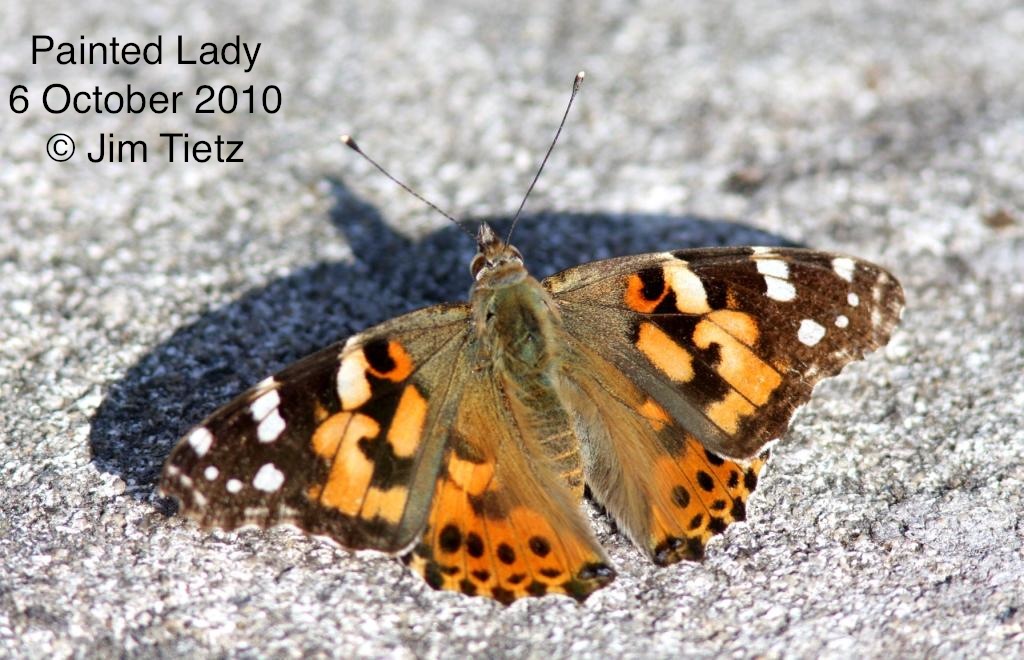
In addition to birds, we added 5 points for a shark attack that was out past Indian Head and two more points for a Black Saddlebags and the 5 Variegated Meadowhawks (dragonflies). Though not a point for the day, Painted Ladies were especially numerous with 12 being counted around the island. Earlier in the fall, West Coast Ladies were seen almost daily, but we were only able to find about one Painted Lady a week. This seasonality of West Coast Ladies preceding Painted Ladies seems to be normal on the Farallones.  It was also a decent day for whales with our 2 resident Gray Whales, and 8 Blue Whales and 39 Humpback Whales to the south.  These Gray Whales swim as close as 100 meters to the island most of day and provide great opportunities for photos.


Today’s points (8 migrant birds, 2 dragonflies, and 5 for one shark attack) brought up our Farallonathon total to just 126. We were really going to need a big wave or more shark action to bring up our total.

Please remember that your support makes this research and conservation possible, so if you can, please pledge either a per-point amount or a flat donation for our Farallonathon by going to our donation page at: http://www.firstgiving.com/farallonathon.

Friday, October 08, 2010

FARALLONATHON - DAY 3

The day started out with clear skies and a 10 knot breeze out of the northwest. The weather forecast had made it sound as though the day would be even windier, and so we were all quite excited to see that we might get more birds than anticipated. Within an hour of dawn, the wind dropped down to just 5 knots, and a small fallout of birds ensued. A dozen White-crowned Sparrows were flocking in the Lavaterra near the house trees with a few Fox Sparrows (both points). The first House Finch of the fall was in the Rixford Tree, the first White-throated Sparrow was at the water tank, and the first Spotted Towhee of the fall showed up at the Lighthouse. We also found our first Say’s Phoebe of the Farallonathon at the lighthouse. 


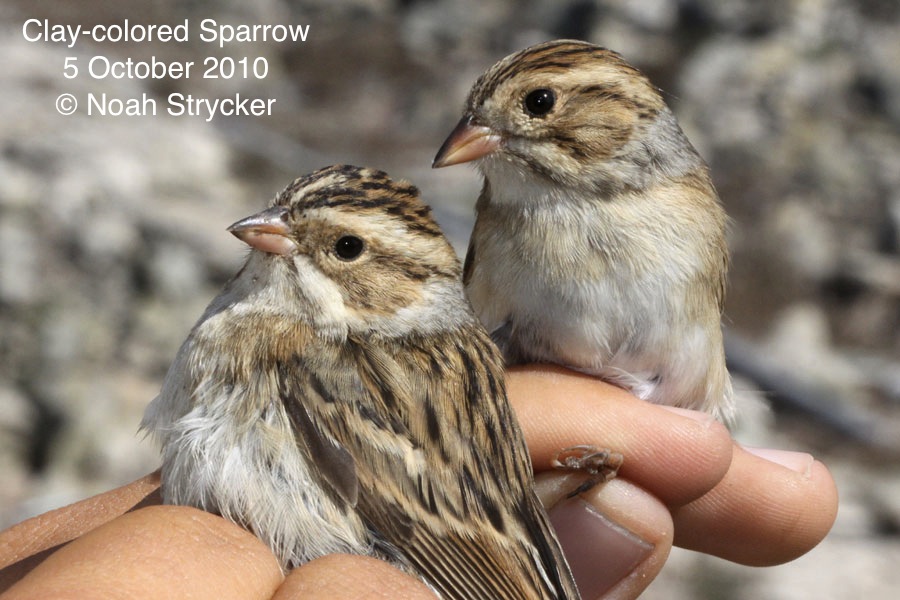
We banded several birds this day too such as these two Clay-colored Sparrows and this Western Meadowlark.


During an area search, Matt Brady encountered four flickers flocking together around Heligoland Hill. Two were Red-shafted, but Matt noticed that one had orangy-yellow wings with a red malar stripe and a red nape patch. Since male Yellow-shafted Flickers have red nape patches and black malars and male Red-shafted Flickers have red malars without a nape patch, this bird was clearly a hybrid, or intergrade as occurs between these two subspecies of the Northern Flicker. Another flicker appeared similar to a female Red-shafted Flicker, but because it had a red nape patch, it was also an intergrade – Red-shafted Flickers never have red nape patches.


Butterflies also put on a good show with 2 Monarchs, 1 Red Admiral, 4 Painted Ladies, and 5 West Coast Ladies. All of these were new Farallonathon points. It’s hard to understand how these butterflies can cross 20 miles of open ocean when a 5-10 knot wind is blowing them back to the mainland.

We also found several points on the ocean today. Scanning from the lighthouse during our whale watch survey, we were able to pick up two more cetacean species: 2 Blue Whales and 100 Risso’s Dolphins. The Risso’s Dolphins have been quite abundant around the island this fall. Risso’s are squid specialists, so there must be a lot of squid around. We also spotted a dozen Humpback Whales and our 2 resident Gray Whales. Matt also had a good seawatch in the afternoon when he picked up our first Northern Fulmar and Short-tailed Shearwater of the Farallonathon. For a day that was supposed to be a blowout, it turned out pretty well. All these points brought up our total to 111. With the wind slackening already and a forecast predicting light winds for the next few days, we were really anticipating a good fallout.


Please remember that your support makes this research and conservation possible, so if you can, please pledge either a per-point amount or a flat donation for our Farallonathon by going to our donation page at: http://www.firstgiving.com/farallonathon.

Tuesday, October 05, 2010

FARALLONATHON – Day 2

Although the forecast for the end of Farallonathon looked good, we knew day 2 would be a blow out. Gale force northwest winds are not good for much on the Farallones during the fall, as it gives all the birds on the island a tail wind to fly away, and it prevents new birds from reaching the island. It also makes the ocean rough, which makes it very difficult to spot whale spouts and shark attacks on the ocean. The wind howled all day, so we worked on finding our breeding birds, pinnipeds, and salamander. Around the island, we were able to still locate a few Ashy Storm-Petrels nesting in their crevices; numerous Brandt’s and Pelagic Cormorants still finishing up breeding after one of the later nesting years ever; at least 40 Black Oystercatchers foraging and roosting in the intertidal; a few thousand California and Western Gulls roosting on the island at night; many basic-plumaged Common Murre and Pigeon Guillemots in the bays around the island; and several Cassin’s and Rhinoceros Auklets flying past the island. The Cassin’s Auklets had an incredibly productive year, and a few are still finishing up their second broods. We also get to hear thousands of Cassin’s sing their eerie song every night after the moon sets and they return to the island to prospect for next year’s nest sites. And the newly nesting Common Raven and Peregrine Falcon are virtual residents on the island now. Twelve of the 15 species of breeding birds is a good start – we are likely to find a Double-crested Cormorant, but puffin can be tough, and Leach’s Storm-Petrel is nearly impossible.

Of the six species of pinniped that have been identified on the Farallones, five now have a year-round presence on the island. We conducted a weekly island survey today to figure out how many were present. This entailed counting all the seals and sea lions from the lighthouse and walking around to the coves to find elephant seals and other species that are hidden from the lighthouse. This survey yielded 1,939 California Sea Lions, 40 Steller’s Sea Lions, 30 Harbor Seals, 81 Northern Fur Seals, and 116 Northern Elephant Seals. It’s really great to see that these species are recovering on the island after many were absent for so many decades following the sealing days of the late 1800’s. The fur seals are the most recent comeback story for the Farallones. Prior to the Europeans setting foot on the island, fur seals blanketed the ground with over 100,000 individuals. Within a few years of commercial sealing, they were completely extirpated from the islands and were only occasionally seen for the next hundred years. Over the last few decades, a colony has begun to steadily increase at Indian Head Beach. On 1-Oct, we conducted our first survey of the year there and counted 115 pups and over 160 adults and immature – this is a true success story for conservation on the Farallones!


After the pinniped survey, we conducted our first salamander survey of the year. We checked 106 coverboards, but could only find one salamander. This is the Farallon subspecies of Arboreal Salamander, which is kind of ironic considering that the only trees on the island are three recently introduced Monterey Cypresses and a Monterey Pine. These Farallon Salamanders mostly live under rocks unless you give them a coverboard to hide under. Although only one salamander sounds bad, in reality, they don’t really emerge from their subterranean hiding places until after the first substantial rains moisten the soil. After all, lungless salamanders, such as this one, need to keep their skin moist so they can breathe through it.

Finding migrant birds was a challenge, but seven more were tallied to our list. The most exciting were the three species of jaeger seen during the PM seawatch: Long-tailed, Parasitic, and Pomarine. We also added Merlin, Red-necked Phalarope and Western Meadowlark to bring our overall point total up to 85.

Please remember that your support makes this research and conservation possible, so if you can, please pledge either a per-point amount or a flat donation for the event by going to our donation page at: http://www.firstgiving.com/farallonathon.

FARALLONATHON BEGINS

Two days ago we began our annual Farallonathon. The Farallonathon is similar to a Bird-a-thon, but on the Farallon Islands, we do things a little different. Instead of counting just species of birds, we count all of the animals we encounter including birds, fish, marine mammals, insects, and any other wildlife we find. We even assign points for rare and interesting wildlife events such as shark attacks and birds never before seen on the Farallones.

Initiated in 1992, the Farallonathon was created to recognize the truly unique elements of the Farallones, while at the same time participating in PRBO’s Annual Bird-A-Thon. The Farallonathon consists of a one week bio-blitz where we identify as many species of wildlife as possible.
Money raised from this event goes directly to supporting Farallon research allowing us to purchase biological equipment, food and supplies for island personnel, and pay PRBO staff to analyze and publish the data we collect. The information gathered from our research helps us and others protect the wildlife that use these special islands and the marine environment that surrounds it.
To pledge your financial support for our research, you can pledge a flat amount or you can make your pledge based on the Farallonathon point system. If you pledge your support, you will receive a detailed summary of our experience at the end of the Farallonathon week. Your participation allows us to continue studying this unique and vital ecosystem on the California Coast. Please consider supporting our research by pledging either a per-point amount or a flat donation for the event by going to our donation page at: http://www.firstgiving.com/farallonathon.

On October 3rd, Farallonathon – Day 1, we were not expecting to have a good day and were not planning to start Farallonathon, but the winds were very light, the skies were overcast, and visibility was limited to just 5 miles. These conditions are ideal for bird migrants to reach the island, and we started our day full of anticipation. As we began our surveys, we were not disappointed by what showed up. As I headed up to the lighthouse to begin shark watch, I flushed several Swainson’s and Hermit Thrushes from under the water tank on the hill. I also saw that the Blackburnian Warbler that arrived on 1-Oct was still present. Once I reached the lighthouse, I climbed to the top to see what was hiding under the metal grate – a place where many birds, and a few mega-rare ones, have hunkered down to get out of the wind. From under the grate, several more thrushes flew out faster than I could identify them. This was turning out to be a good day.


Meanwhile, Dan Maxwell was passing Twitville on his way to start a shorebird survey, when he heard a call that stopped him in his tracks. Dropping from the sky, a large bird flew down into the Lavaterra bushes. Dan immediately recognized it as an Evening Grosbeak and ran back up to the houses to tell the others. Although this species is not super-rare on the coast, here on the Farallones, this is a bird that we have all dreamt of seeing because this charismatic bird was the first on the island since 1979! Upon hearing the news, Matt Brady, Noah Strycker, and Oscar Johnson ran out of the house to check it out in the Coast Guard House trees where it had flown while Dan was running back to the PRBO house. While they were all enjoying close-up views of the bird, they began spotting other birds such as a female Canada Warbler and an Ovenbird from the previous few days. Up at the lighthouse, I tried in vain to see the grosbeak in the trees with my spotting scope, but it stayed hidden under the canopy. Eventually, Oscar came up to the lighthouse so I could see it. Ironically, the bird would fly to within 10 feet of me soon after I returned to the lighthouse to resume shark watch.

An hour later, Matt came up to relieve me from my shift at the lighthouse. While we were talking, a Long-billed Dowitcher flew by with a Pectoral Sandpiper. A few minutes after that, a flock of ducks came flying past the lighthouse. I noticed the pintail, but Matt immediately noticed a female-plumaged teal in the flock with big, pale blue patches on the leading edge of the wing. I studied the duck through my spotting scope and could see that the chin was white, which suggests Blue-winged Teal instead of Cinnamon Teal. My photographs also supported this identification by showing that the bill was relatively small. As I was studying the Blue-winged Teal, Matt also pointed out that there were two Northern Shoveler in the flock. Because most ducks are rare on the Farallones, a flock of three species was incredible.

We finished the day with 59 species of migrant birds, including 13 species of warbler. We also found a Green Darner (dragonfly) and a Familiar Bluet (damselfly) for two more points. Our two resident Gray Whales and 7 transient Humpback Whales gave us another two points. Overall, we finished the day with 63 points. Not spectacular, but the Evening Grosbeak and ducks are not points we are likely to get again, so after looking at the calm winds forecasted for Wed-Fri, we decided this would be a good first day for our Farallonathon.


Again, please consider supporting our research by pledging either a per-point amount or a flat donation for the event by going to our donation page at: http://www.firstgiving.com/farallonathon.  Thank you!

Sunday, September 26, 2010

Mini Migrant Wave and Fog

Here on Southeast Farallon Island during the fall songbird monitoring season, weather determines much of what we do because of the way in which it affects songbird migration. Based on work done by Pyle et al. (Condor 1993), migrating birds arriving at Southeast Farallon Island are strongly influenced by local weather conditions. During much of the fall, high pressure over the northern Pacific Ocean combined with low pressure over the interior of California creates a strong northwest wind with alternating clear skies and low fog. This weather syndrome keeps migrating birds near the mainland coast, both because the following wind allows the birds to keep migrating, and clear skies allow migrants to see and follow the coastline. Regardless of wind strength or direction, fog inhibits birds from finding the island, simply because they can’t see it. Therefore, these conditions, which are what we experienced for much of the latter half of August and the first two weeks of September, lead to very few birds arriving on the island. Very few birds on the island means that we get to do a lot of data entry and proofing.

However, this all changed on the night of the 11th of September, and when we awoke on the morning of the 12th we found a high overcast sky and light south to southeast winds. These conditions are created when a weak low pressure system moves in from the Pacific, and are typically present for just a few days before the northwest winds dominate once again. Migrating birds flying over this cloud layer at night are unable to see the land below, so when they drop below the cloud layer in the morning to find food, they sometimes find themselves over open ocean: a truly inhospitable landscape for a landbird. With this high overcast and decreased visibility, landbirds can’t see the mainland, and so are more likely to end up on the Farallon Islands. The following two days continued with similar weather, and culminated in a spectacular wave of migrants on the 14th, with small flocks of warblers and other migrants arriving almost continuously over the course of the day. Here are photos of a few of the expected western migrant species that showed up during those three days of good migrant weather.


Birds of the year on their first migration are inexperienced and are much more likely to end up migrating over open ocean. These birds comprise most of what we see out here on the island. In addition to the expected western species, we get small numbers of ‘vagrant’ eastern songbirds. It is these species that we get particularly excited about finding. A small proportion of hatch-year songbirds are genetically misoriented during migration and follow a predictable incorrect migratory direction. For example, a warbler from the northeastern United States that is supposed to migrate in a southeasterly direction will instead orient in a “mirror-image” direction, i.e. southwest, and thus eventually find itself flying over California. During the three days of light south winds that we experienced, we had relatively good numbers of these eastern warblers show up on the island, the best of which was a Connecticut Warbler found by Matt Brady up at the lighthouse. Also located were a Mourning Warbler, 3 Tennessee Warblers, 4 Chestnut-sided Warblers, 2 Magnolia Warblers, 2 Blackburnian Warblers, 7 Blackpoll Warblers, and 3 American Redstarts. Other rare eastern birds that showed up included 2 Bobolinks, a Chimney Swift, an Orchard Oriole, and a Philadelphia Vireo.


Some less common western migrants seen during these few days included a Black Swift that circled the lighthouse, four Vesper Sparrows, a Blue Grosbeak, a Purple Martin, a Baird’s Sandpiper, a Pectoral Sandpiper, and a Short-eared Owl.


Since those three days of spectacular migrant weather we have been back to northwest winds and fog with very few bird highlights. The most unusual birds since the 14th have been a Dusky Flycatcher and a Northern Waterthrush, both found on the 22nd of September. Consequently, we are back to doing lots of data entry and eagerly awaiting the next period of light winds and high overcast!!