Saturday December 3rd, 2011
Alarm goes off. It is 5:00 a.m. Rushing around to get the last minute items loaded into the van before the PRBO Conservation Science Farallon Program Winter crew heads to Southeast Farallon Island (SEFI) for 3.5 months. Five thirty in the morning rolls around and a phone call comes through. Fall biologist, Jim Tietz delivers what is to the winter crew bad news. The sea is a bit angry this morning. Roaring 10 foot swells from the Northwest combined with 15 knot winds from the Northeast make for a nasty boat landing day. The seasonal switch is called off. Optimistically a bit more rest for the weary.
After a couple hours of extra sleep we all gathered in the kitchen and discussed what we wanted to do with our extra day on the mainland. The decision was unanimous and promptly made. If we can’t go to the Farallones today then we will get as close as we possibly can. We gathered our hiking gear and headed for Point Reyes National Seashore. The weather treated us well with plenty of sunshine and visibility of 30 plus miles. And sure enough as we climbed high onto a bluff, there they were, those rugged rocks looming 18 miles from where we stood. It seemed like such a nice day from our vantage point. But we have a keen understanding that what you see on the land can be drastically different from what you experience on the islands. So we continued our birding, hiking and sealing and thoroughly enjoyed one last day on the mainland.
 |
| Farallon Islands just at the horizon as seen from Point Reyes National Seashore |
Sunday December 4th, 2011
The Farallon Patrol run went quite smoothly. We arrived at the Marina in San Francisco at 7:00 a.m. and began to load our gear on to the boat “Sari Ann” with Skippers Warren Sankey and Allan Weaver. This 40 foot lobster boat from Maine is the perfect vessel for seasonal switches as there is ample deck space for the enormous amounts of gear that usually accompanies these trips. Warren and Allan are also very welcoming of all our belongings and we appreciate their time and effort in making these events go so well. Thank you kindly gentlemen.
 |
| Leaving San Francisco Bay on the "Sari Ann" with skippers Warren & Allan. |
Two and half hours later and we are staring at East Landing. I believe the Fall crew wanted off just as badly as the Winter crew wanted on the island. As the seasons change so do the wildlife and biologists that study them. Off with the fall land bird lovers and on with the winter elephant seal enthusiasts. With the seas and weather cooperating the boat landing went according to plan and the seasonal switch was completed in three hours time.
 |
| Our approach to East Landing |
Monday December 5th – Monday December 28th, 2011
Since the seasonal switch the Winter crew has been getting acquainted with the island and setting up the routine that will be life over the next 14 weeks. And with that said, proper introductions are of utmost importance.
I, Ryan Berger - PRBO Farallon Program Biologist, am returning for the second season as the lead during the winter. My background entails behavioral monitoring, rescue coordination, stranding response and necropsy of marine mammals on the East coast. I have a Masters degree from Georgia Southern University where I studied manatee distribution patterns in Crystal River, FL. While working as a marine mammal biologist for Florida Fish & Wildlife Conservation Commission (FWC) I obtained hands on experience with North Atlantic Right Whales, Florida Manatees, Atlantic Bottlenose Dolphins along with a few other cetacean species. My main focus is now geared towards the population dynamics and reproductive success of the Farallon’s Northern Elephant Seal breeding population.
 |
| Enjoying some hot chocolate while watching the sun sink and drown within the sea. |
Jane Khudyakov has returned for a second winter with the elephant seals of the Farallones. She is eager to see which seals from last year will return this season and to put skills learned last year back into practice (like stealth crawling to Mirounga Beach). Jane has a background in developmental biology, genetics, and microbiology, but fell in love with seals while working with rescued pinnipeds at The Marine Mammal Center in Sausalito. She has also monitored wild seals at Point Reyes National Seashore and birds of prey with Golden Gate Raptor Observatory. Finally free of the laboratory, she is eagerly embarking on a new career in pinniped biology and is happily roaming Southeast Farallon Island in pursuit of as many pinniped species as she can find, baby seals of the elephantine kind, and birds - especially those that like to eat mice. She is practicing her photography skills and recording her own personal career-change experiences in her blog, smellephantisland. Great to have you back this season!
 |
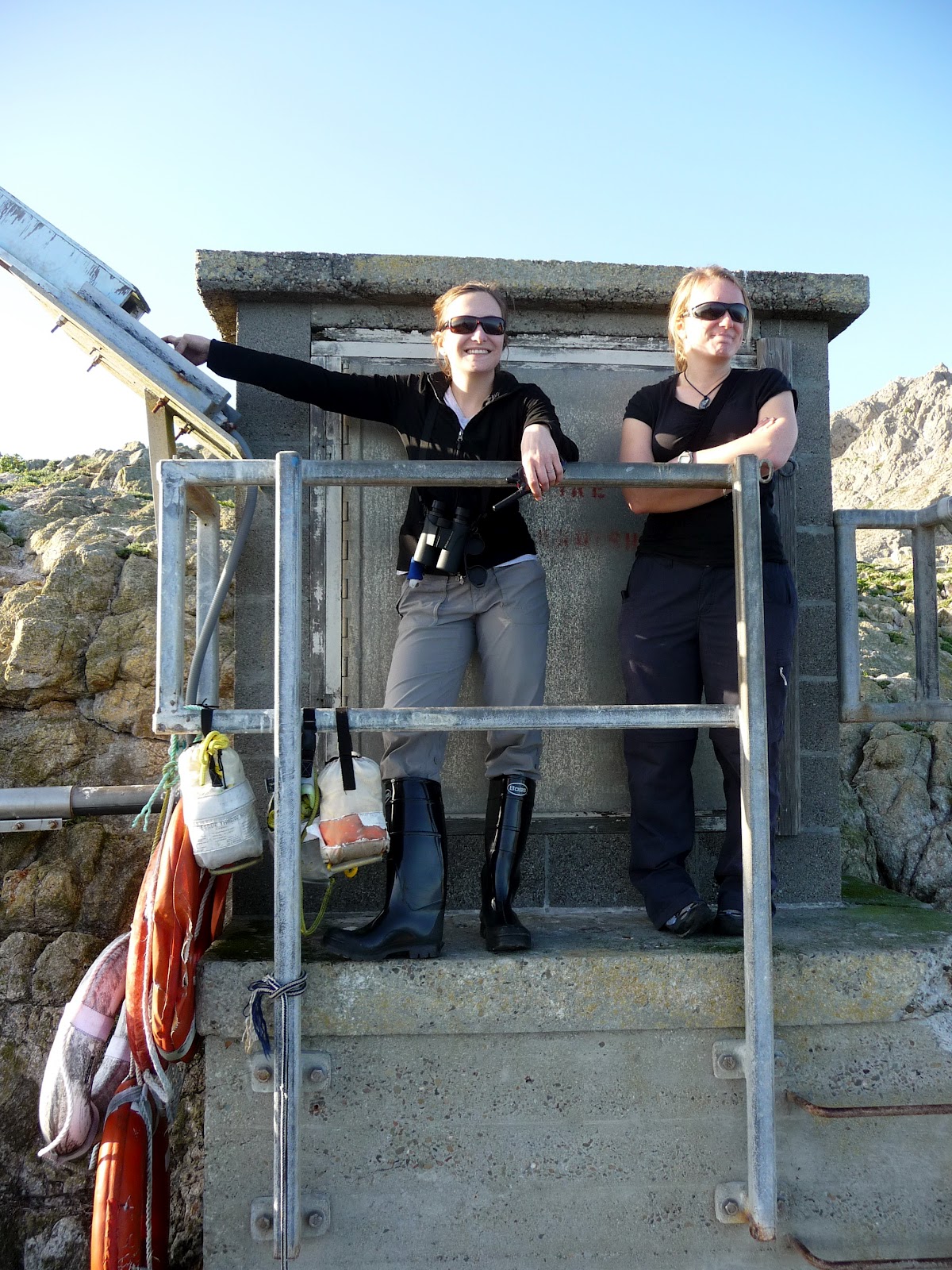
| Jane doing a little cetacean watching from the Light House. |
Jason A. Jones has come out for his first season as a winter intern on the Farallon Islands. Jason has been working as a field biologist for the last ten years, gaining experience with marine mammals, seabirds, and any other distractions along the way. He has researched tropical reef fauna including coral, sea turtles, and cone snails while pursuing university degrees. His marine mammal experience ranges from the Arctic to Australia, including working as a marine mammal observer on seismic vessels; population assessments of Hawaiian monk seals; monitoring Alaskan Steller sea lions; and anthropogenic effects on fur seals in Australia. In addition to becoming an avid birder while growing up in Corpus Christi, Texas, Jason's birding experience ranges greatly from offshore, wetland, and terrestrial surveys to animal rehabilitation; and living at remote field camps ... which are most often full of looney birds (camp mates). I think there might be a book out at some point that details the “Short stories and compilations from the life of Jason Jones”. He has had quite a few interesting experiences in his lifetime and the stories to go with them. Seriously Jason how many lives have you lived?
 |
| Cheers big ears. To another wonderful sunset. |
Last but certainly not least Ms Kerry Froud comes to us from Dorset, England. Kerry graduated from the University of Chichester with a BA (honours) degree in adventure education. It was during her university work placement year in Tonga where she was involved in humpback whale research that she decided to pursue a career in conservation science. Since then she has been gaining as much field experience as possible. She has volunteered for the Manx Wildlife Trusts’ basking shark, grey seal and cetacean projects on the Isle of Man, been an intern for the UK’s national cetacean sightings charity Sea Watch Foundation and has volunteered for various PhD students in New Zealand and Australia studying New Zealand fur seals, sperm whales and humpback whales. As an added bonus everything sounds so much fancier when it is spoken with a posh English accent and I am glad that she has a good sense of humor in regards to our bad attempts to speak like her. Bog standard, keen, Bob’s your uncle, Fannie’s your aunt, Cheers big ears are just a few new vocabulary phrases we have learned from Kerry.
 |
| Kerry trying to get an accurate measurement on a squirmy sally. |
It has certainly been fun getting to know one another over the past three weeks and I have a feeling this is going to be a fun season. Now that we have introductions sorted let’s move on to the science side of life. This post will simply touch the surface of all the different projects we have going on that fill up our minutes, hours, days and weeks out here on the island.
Every morning we are up at dawn to count the territorial and roosting gulls on the islands. One person heads up the hill to the Light House while the other starts at North Landing and all the gulls on the island are counted in groups of 10. Currently we are seeing over 10,000 gulls (mostly Western but also Glaucous-winged, Herring and California) which makes for quite the alarm clock at 0630 hrs. As we meander about the island we keep track of land birds that have come to greet us. Currently we are seeing Black Phoebes, Say’s Phoebe, Common Ravens, American Kestrel, Peregrin Falcons, sparrows, hummingbirds, shore birds, thrushes, warblers and the list goes on. With the fantastic weather we have been experiencing there is always the potential for new arrivals which makes each day exciting and eventful. So far some of our standouts this season include a juvenile Bald Eagle (first one since 1998 and 8th overall record for the islands) and a White-tailed Kite (seen one other time this year).
 |
| Jason captured this Common Raven chasing off the juvenile Bald Eagle with his fancy camera. |
 |
| Kerry snapped this photo of the White-tailed Kite through the branches of the pine. |
We also check the known roosts of 4-5 Burrowing Owls (BUOW) that are on the island. On warm sunny days these guys can be seen at the entrance to their burrow soaking up some of the sun’s rays. A comprehensive BUOW survey is conducted once a week where past roost are checked and pellet collections are made. Collecting owl pellets allows us to examine them in detail in order to follow prey items they consume throughout the year. Enough with the birds … on to the marine mammals!
 |
| Jason caught this BUOW sitting at its roost on Corm Blind Hill. |
If weather permits we conduct a cetacean (dolphin & whale) watch from the light house for three hours a day. At the moment we are consistently seeing 2-4 Gray whales. More recently we have seen a yearling diving and feeding in Mirounga Bay and a total of 25 whales on the 27th! Each day we also visit all of our elephant seal breeding sites in order to resight tags placed in hind flippers. These tags allow us to track individuals over time and in general assess the health of the population. While we are doing tag resights we also record daily counts of adult females (cows), pups and breeding males (SA1-4 and bulls). This allows us to calculate reproductive success and pup survival each season.
 |
| Gray whale as seen from the light house on a clear day. |
 |
| A group of immature elephant seals swimming during a high tide at the gulch. |
We have some of our usual suspects back from last season. Our much adored alpha male of Sand Flat, Rusty, is back once again this season. If he successfully “holds down the fort” this will be his 4th season in a row as alpha male of the most productive harem on the island. In areas that experience larger harems and more elephant seals an alpha male usually only acquires alpha status for one season. It is physically taxing to the males when they defend and mate with up to 100 cows in larger harems. Each season in a busy harem there are plenty of bigger, stronger and faster bulls waiting to challenge the alpha from the year before which means higher turnover for alpha status. Rusty may be able to continue his alpha male status because he expends less energy each season defending less than 50 cows. Because he seems to be a well tempered bull we wish Rusty continued success in displaying his dominance. On the other hand, last season’s alpha bull of Mirounga Beach Mc Hammer is back again. He seems to be an ill tempered animal as he killed a few of the weaned pups in his harem last season. This year Mc Hammer comes back to us with a blind left eye. Perhaps an indication of his aggressive interactions with other seals. Other returnees include Herzog, Guthrie, Tyler Xavier, Rumpelstiltskin and Bob.
 |
| Big bad MC Hammer with a bum left eye. |
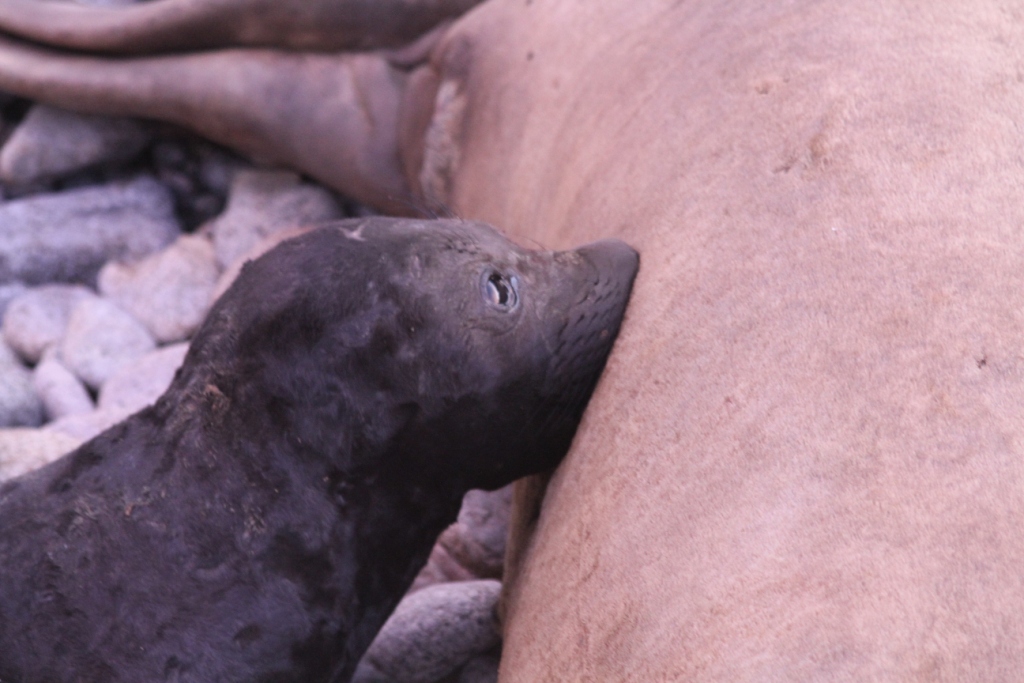
We have also positively identified five cows this season. They include Gertrude, Gruedy, Kyra, Prima and Alizabeth. An untagged cow that we have seasonally named Taha (number one in Tongan) produced the first pup of the season on the 21st of December! This is two days earlier than last year. We are happy to say that the pup has been seen nursing two days after birth and the outlook is good for the little male. Since then Alizabeth and Kyra have also produced male pups. With only six cows at the moment we realize the season is about to get very busy. Cows start showing up in droves from here on out. The difficulty we are experiencing this season centers around the presence of many California Sea Lions in areas that we have normally been able to census on foot in the elephant seal rookeries. However, because of the skittish nature of sea lions and the minimal impact we are trying to have on the wildlife at the Farallones we are conducting all of our elephant seal work from the blind. Which means mucho more patience is necessary!
 |
| Alizabeth with her male pup shortly after he was born on Sand Flat. |
Some of our other data collection responsibilities include the once a week pinniped census, the by-weekly elephant seal census, the by-monthly salamander surveys, bait degradation studies, population monitoring of the invasive Russian house mouse and invasive plant removal (a.k.a. weeding). And as usual chunks of time are spent fixing different supplies, equipment and facilities as there is a “Farallon Factor” on this island which translates to things breaking down much more quickly than normal.
 |
| The winter interns getting their salamander fix in. |
 |
| An adult Farallon arboreal salamander showing off its spots. |
Finally, Merry Christmas to everyone!
We had a cozy and quaint Christmas here on the island, equipped with presents, a small Christmas tree, animal themed ornaments and Christmas lights! The day started with gull counts, a full English breakfast, an elephant seal census, cheese platter and hors d’oeurves , some tag resighting from the blind and a massive Christmas dinner. Menu included orange glazed ham, stuffing, Raab broccoli and scallions, roastie potatoes and parsnip, chocolate mousse and of course ample amounts of mulled wine. We rounded out the evening with the board game Balderdash and slept like champs.
 |
| Christmas presents! |
 |
| Farallon Christmas tree with animal ornaments. |
 |
| Hand made cards that Kerry made fro each of us. |
 |
| Sitting down for Christmas dinner. |
 |
| Preparing the cheese plate. |
Spending time away from family and friends during the Holiday season demands a certain degree of self reflection. Why would we put ourselves in this situation? Sure there is a sense of feeling homesick while talking to loved ones on the phone while they are all gathered in one place enjoying the occasion. Sure there is the absence of catching up face to face with those you haven’t seen in a while. There are loads of things to miss about not being with family during the Holidays. But if we focused on missing those aspects of life we would miss out on the unique opportunity that greets us each morning as we step outside the front door. There is a special, peaceful easiness felt while spending these moments out here on the Farallones. No busy Christmas shopping, no long lines, no traffic jams, no materialistic ideals masking the true meaning of why we come together. Life gets boiled down to the basics out here. We work hard, we eat well, and we laugh often. We form tight friendships. We prefer quality over quantity. We become the family that we miss. And that is an important part to the culture here on the islands. If you can’t be with the ones you love then love the ones you are with.
 |
| Who really knows? |
 |
| This was all Kerry's idea & somehow didn't end up in the photo. |
By slowing our pace we fine tune our skills at noticing the small details in life. Each day holds something new, something slightly different than the one before. We aim to be minimal. We aim to be simple. And with these attempts life is filled with everything we need.
Merry Christmas and Happy New Year from the Winter Farallon Family.
 |
| Jason didn't get the memo - don't look at the camera amigo! |