Saturday, October 13, 2012

Farallonathon Results

With a promising weather forecast calling for light south winds, we eagerly anticipated the final two days of our Farallonathon - a week-long fundraiser that helps fund our study of the island's wildlife.

DAY 6 - The winds were perfectly southeast and light, but the visibility was too far, so the great landbird wave must have flown back to the mainland.  Still we managed to find a few new points.  A far from home House Wren was a nice addition to our list.  Although we normally see a few of these earlier during August and September, this was our first for the year.


One wave that did materialize was a Burrowing Owl wave.  While conducting our morning surveys, owls were flushing from everywhere.  It took quite an effort to avoid flushing them and to keep track of the ones we did flush.  By the end of the day, our Burrowing Owl intern, Maggie Spilatro, had tallied a very impressive island high count of 17.  Furthermore, the previous island high count of 11 was aided by telemetry, which obviously makes finding the owls much easier.  Here's one of the owls roosting in its preferred Farallon habitat - a rocky crevice.


Even though we saw Rock Wren on the first day of our Farallonathon, we were pretty excited to finally capture one.  Considering that most of this island we live on is rock, there is no habitat to concentrate them near our nets like the other birds, so capturing one is a very low probability event.  This bird was aged as a juvenile by its incompletely ossified skull and the molt limit that was present in its wing.


In addition to the point for the House Wren, we also found our first Western Sandpiper, Brewer's Sparrow, and White-throated Sparrows.  At the end of the day, another point showed up when a Greater White-fronted Goose took brief refuge on the island. This juvenile lacks the white around its bill that gave its species their name.


At around the same time that we found the goose, we also spotted a shark attack in Mirounga Bay to boost our daily total by an extra 5 points.  The five new migrant birds and the shark attack brought our 6-day total up to 150.


DAY 7 - With just 3 knots of wind out of the southeast and 10 miles of visibility, we really thought our final Farallonathon day had the potential to be epic.  Inexplicably, though, the wave did not materialize.  Instead, we just picked up a few new arrivals, albeit a few extra-stellar arrivals.  While conducting shark watch in the morning, Dan Maxwell spotted a nice Hermit Warbler bopping around on the rocks at the lighthouse.


He then got a fleeting glimpse of a bird that appeared similar, but even brighter.  Over our handheld radios, he announced that he might have seen a Black-throated Green Warbler.  After several hours of anguished searching, Maggie Spilatro relocated the bird on Pointy Cliff while searching for roosting Burrowing Owls.  This time Dan got excellent photos for undeniable proof of his sighting.  This is a species we normally only see once every other year.


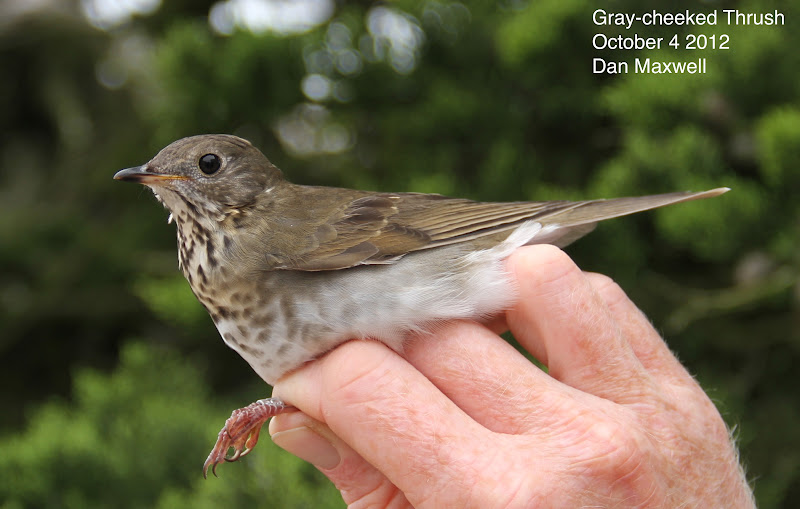
Even more exciting than the pretty warblers was when Dan pulled a drab, olive-colored thrush out of the PRBO house net that he had never seen before; a thrush that few people have ever seen in California.  The Farallon Islands, though, is the ideal place to find a reclusive species such as this, where the sparse vegetation concentrates skulkers around the island's four trees.  In fact, 12 of the previous 22 records in California have come from this local, including the state's first record on 3 October 1970.  Separating this species from other Catharus thrushes is fairly straightforward when one is seen well.  To differentiate this bird from the similar olive-backed Swainson's Thrush, note how its face is washed with gray and that it lacks the buffy spectacled appearance of a Swainson's Thrush.  Veeries from western Canada can be fairly dark as well, but they should still show more rufous to the upperparts, whiter flanks, and small, indistinct spots on the chest.  Because Gray-cheeked Thrushes are seen so infrequently in California, all records of this species need to be reviewed by the California Bird Records Committee to determine whether the sighting was supported with sufficient evidence rule out other similar species.


In addition to these birds, we found a distant Flesh-footed Shearwater, a Killdeer, and a flyby Cliff Swallow.  Thankfully we also saw two shark attacks (each worth 5 points) and a shark breaching out of the water (worth 1 point).  With the 5 points for the CBRC-worthy Gray-cheeked Thrush and 5 points for the other new migrant birds, we were sitting at the end of dinner with 171 points - a respectable finish.  But there was still one more animal that we had searched for a few nights previous without success.  With just 28 minutes remaining before midnight, and the end of Farallonathon, we succeeded in finding a juvenile Arboreal Salamander crawling around on the rocks to bring our total up to 172.

So how did our 21st Farallonathon rank against our previous attempts?  Using our current scoring system, 172 points is just 3 points below the average of 175.29.  Still we found some pretty exciting birds such as the Arctic Warbler and the Gray-cheeked Thrush, and we got to see six shark attacks!  While the Farallonathon is a lot of fun for us, the main reason we do it is to raise money so we can continue our research.  If you enjoy reading about the wildlife we study and would like to help us conserve the Farallon ecosystem, please visit the following website and make a donation:

http://prbo.kintera.org/faf/donorReg/donorPledge.asp?ievent=1035387&lis=1&kntae1035387=2D77273889284701A6B653247CA50095&supId=0&team=5260478

Thanks for following this year's Farallon-a-thon and see you next year!

Wednesday, October 03, 2012

The Farallonathon has Begun

On Sept 28th, we started our annual fundraiser that we call the Farallonathon!  Initiated in 1992, the Farallonathon was created to recognize the truly unique elements of the Farallones, while at the same time participating in PRBO’s Annual Bird-A-Thon.  The Farallonathon consists of a one week bio-blitz where we identify as many species of wildlife as possible. Instead of counting just species of birds on a single day, we count all of the animals we encounter including birds, fish, marine mammals, insects, and any other wildlife we find over an entire week.  We even assign points for rare and interesting wildlife events such as shark attacks and birds never before seen on the Farallones.

DAY 1 - We started out with light southeast winds, but dense fog limited visibility to just 1/4 mile. This meant that few birds would be able to find the island. However, we quickly spotted the Northern Gannet that was first found on April 25th. Since this was a first record for the Pacific Ocean, it was also a first island record, which means that it was worth ten points.

Thankfully, the fog lifted by 10 am, and the migrants that were flying around began to descend upon the island. We were immediately inundated in the banding lab with Red-breasted Nuthatches. Apparently their food supply crashed on their breeding grounds, and they are irrupting southward in huge numbers in search of food. On this day, we estimated a total of 54 individuals on the island, with 42 birds banded. This photo is of a nuthatch perched on the lichen-encrusted wall of the lighthouse. With high enough magnification, it is possible for us to see the microscopic insects that crawl over the walls. With their proportionately large eyes (compared to humans), the nuthatches and other birds are able to see and take advantage of this abundant food source


A huge surprise, though, was an Arctic Warbler that we found in the Coast Guard House mistnet. This is a species that breeds in the boreal forests of northeastern Europe, Asia, and Alaska. They mostly winter in southeast Asia, so they are extremely rare in North America outside of Alaska. In fact, prior to this bird, there were only eight records, 1 in Baja California and 7 in Alta California, which includes one previous record from the Farallones in 2005. Because this is a CBRC bird, we received five points for this wayward vagrant. The relatively short wing and bill, along with the yellow wash to the underparts and greenish upperparts, indicate that this was probably of the Alaskan subspecies, kennicotti.

 
Besides the two mega-vagrants (Arctic Warbler and Northern Gannet), we also found a mega rare bird for the island, a Ruddy Duck. Nearly all ducks are rare at the Farallones, with the exception of Northern Pintail and Surf Scoter, but it has been well over a decade since a Ruddy Duck was last seen on the island. The white cheek indicates that this is a male. In  eclipse plumage, males attain a drab appearance such as this duck, but in breeding plumage they have a bright rufous body; this bird had one rufous feather on its right side.


Several other species arrived this day as well including a Western Palm Warbler, a Chestnut-sided Warbler, and 8 Vaux's Swifts.


We also saw all 5 species of normally occurring pinnipeds on the island: Harbor Seal, Northern Elephant Seal, Northern Fur Seal, Steller Sea Lion, and California Sea Lion.  This Harbor Seal was swimming just off shore.


We also add Farallonathon points for butterflies and dragonflies.  Most of the species we see on the Farallones are highly migratory.  Variegated Meadowhawks, such as the one below, frequently make the over-water crossing to the island.


We finished this first day with a total of 96 points: 9 for the breeding birds (Black Oystercatcher, Western Gull, Pelagic Cormorant, Brandt's Cormorant, Common Murre, Pigeon Guillemot, Rhinoceros Auklet, Cassin's Auklet, Tufted Puffin); 61 for normal migrant birds; 5 for pinnipeds; 2 for cetaceans (1 for the resident gray whales and another for a Humpback Whale off Fisherman's Bay); 1 for a butterfly (Red Admiral); 3 for dragonflies (Green Darner, Black Saddlebags, and Variegated Meadowhawk); 5 for a species that needs to be reviewed by the California Bird Records Committee (Arctic Warbler); and 10 for a first island record (Northern Gannet).

DAY 2 - The winds in the morning were still light, but the fog was thicker and dropped our visibility to just a few miles for the entire day.  Still we managed to find 2 new butterflies (West Coast Lady and Painted Lady), and 15 new migrant bird species including a female Black-throated Blue Warbler,  a Magnolia Warbler, an Ovenbird, and a Tennessee Warbler. This increased our Farallonathon total to 113.


DAY 3 - Dense fog continued this morning, dropping visibility to just 1/8 of a mile.  Around noon, a strong northwest wind blew away the fog, and visibility increased to 30 miles, so we could easily see the San Francisco Peninsula.  Neither of these developments boded well for migrant birds to arrive on the island, as the strong northwest winds aided the birds that were over the ocean back to the mainland.  Although we could not find a single new Farallonathon point, we were able to get Peter Pyle, the founder of the Farallonathon, three new species for his Faralist.  He was on a pelagic trip with Shearwater Journeys, and we were able to get him on the Eurasian Collared-Doves, the Ruddy Duck, and the Northern Gannet.  His island list increased to 363, but our Farallonathon total remained at 113.

DAY 4 - More strong winds out of the north and northwest and high visibility (we could see Mt Diablo 60 miles away) meant that we would not see many new migrants.  With the morning winds coming off of Point Reyes, though, and news of big flights of Broad-winged Hawks in Marin, we were hoping that this species would cross the ocean and provide a first island record.  Unfortunately, this did not happen, but two White-tailed Kites did brave the crossing, and we saw them pass to our east.  Three other species of migrant birds were also new: Pacific Wren, Swainson's Thrush, and Spotted Towhee. We also found our second bat of the fall hanging in one of our three Monterey Cypresses.  We also added a point for the Farallon Cave Cricket, the only endemic species on the island. The only good news to the increased visibility was that we were able to spot a shark attack in Mirounga Bay, which is worth five points.  These points increased our total to 124.


DAY 5 - The northwest winds and high visibility continued to plague our Farallonathon, and we were only able to add 2 more migrant birds, a pair of European Starlings and a "heard only" Black-bellied Plover.  An Ashy Storm-Petrel survey revealed several active nests for another point.  Although the great visibility ruined our chances for a migrant bird wave, we were able to find a pod of 50 Short-beaked Common Dolphins swimming past the island.  Luckily they didn't come too close to the island as the sharks were busy in the afternoon, with two attacks in Mirounga Bay off Saddle Rock.  The first involved three sharks and lasted for nearly 30 minutes.  The second was closer to shore and ended fairly quickly.  The two attacks added 10 points and the two additional sharks at the attack added two more to increase our overall total to 140.

With only two more days to go, we'll need some good weather to come close to the record.  The forecast looks promising, with south winds and an increasing marine layer.  So long as we don't get fog, we may get a good wave.

So, what’s a typical ‘score’ for a Farallonathon?  During the last 20 years, scores have ranged from a low of 129 points to a high of 240 (a good year for shark attacks)!  The very first Farallonathon began auspiciously with a mega-rare Asian vagrant, the Northern Wheatear, but ended with only a modest 152 points due to very few shark attacks. 

Please consider supporting our research by pledging either a per-point amount or a flat donation for the event.  Money raised from this event goes directly to supporting Farallon research allowing us to purchase biological equipment, food and supplies for island personnel, and pay PRBO staff to analyze and publish the data we collect.  The information gathered from our research helps us and others protect the wildlife that use these unique islands and the marine environment that surrounds them.

To donate a flat amount online, simply go to the Farallonathon team webpage: http://prbo.kintera.org/faf/r.asp?t=4&i=1035387&u=1035387-366382138 and donate online. If you prefer to make a donation based on our point system or do not want to use the online method, please email Jim Tietz (jtietz@prbo.org),  Pete Warzybok (pwarzybok@prbo.org), or Russ Bradley (rbradley@prbo.org).  Your participation allows us to continue studying this unique and vital ecosystem on the California Coast.

Thank you,
Jim Tietz
PRBO Farallon Biologist

Monday, September 24, 2012

Lighthouses and Migrants

For the first few decades that PRBO worked on the Farallones, a powerful rotating light on the lighthouse acted as a beacon to lost ships, birds, and bats.  An analysis of 38 years of hoary bat arrivals on the island revealed that nights during the dark phases of the moon had a greater likelihood of bats being detected in the trees the following day than bright phases of the moon (Cryan & Brown, 2007, Biological Conservation).  The authors theorized that the darker nights increased the probability that these migrating bats would see and be attracted to the lighthouse.  And in fact, there are several accounts by previous biologists of bats circling the lighthouse during dark nights. At the time of the published paper, island biologists were finding bats on average >7 days per fall.  However, since the powerful rotating beam on the lighthouse was switched to a weaker, pulsating light, the number of hoary bat arrivals to the island has plummeted to approximately one per fall.  What effect, if any, this lighthouse switch has had on bird arrivals to the island is unknown, but it does seem that fewer birds are finding the island at night, with most birds arriving during the day.


The 16th through the 18th brought low winds and high overcast skies, which meant that good numbers of migrant birds descended upon the island. On the 16th we banded our first Yellow-rumped Warbler of the fall as well as our second Baltimore Oriole of the season; interestingly we have yet to record a Bullock's Oriole for the fall, which is normally our most common oriole. In addition, we had 11 species of warbler including a Black-and-white Warbler, 2 Chestnut-sided Warblers, a new Magnolia Warbler, and 3 Blackpoll Warblers. We also spotted a Vaux's Swift zipping past the lighthouse.


On the Farallones, we color-band six songbird species, including this Townsend's Warbler.  Each individual bird gets a unique color combination, which allows us to identify individual birds in the field without recapturing them, so that we can keep track of how many birds of our most common species are on the island each day.


The 17th brought us more migrants including a mixed flock of six teal, 3 Blue-winged Teal and 3 Cinnamon Teal. The Cinnamon were the first in over a decade, while the Blue-wings represented the 11th, 12th, and 13th records for the island and an island high count. Immatures and females of these two species are very similar in appearance, but lucky for us, they circled close to the island a few times, and we were able to get some good photos to aid in identifying them. The primary features to distinguish them are bill size (longer and spatulate in Cinnamon) and facial plumage (distinct white wrapping around the underside of the bill in Blue-winged). Can you figure out which are which?   The day continued with the first Vesper Sparrow of the Fall, a male Indigo Bunting, a male Dickcissel, and a Bobolink. We also added to the warbler count with 2 MacGillivray's Warblers, a Wilson's Warbler, and a Tennessee Warbler.


The 18th continued to be calm and cloudy and added several new migrants to the many birds still refueling from the previous two days. Notable arrivals for the day included a Willow Flycatcher, a Hammond's Flycatcher, the first Hermit Thrushes of the fall, a Painted Bunting, and 3 more species of Warbler including Blackburnian Warbler and Bay-Breasted Warbler - all and all a pretty nice little wave. We ended up seeing 17 species of Warbler over the 3-day wave. Although the last few days have been windy, with thick fog the past two days, we're hopeful that conditions will improve in the near future so we can catch another wave. 


In addition to studying the flying migrants, we conduct daily surveys from the lighthouse to document the occurrence of white sharks around the island as they fuel up each fall for their annual migration to the middle of the Pacific, where breeding is thought to occur.  The Farallones is the only places in California where white shark attacks can be routinely viewed. A recent analysis of shark genetics and transmitter data has revealed that the population in the northeastern Pacific (the ones we see in California) is genetically and geographically isolated from the other populations around the world (Jorgensen et al., 2009, Proc. Roy. Soc).  Furthermore, using underwater videography to identify individuals has led researchers to believe that this population is extremely low, possibly less than 400 adults (Chapple et al., 2011, Mar. Bio.).  For this reason, there is a push amongst conservation groups to get this population listed as federally threatened or endangered.  Over the past several years, the numbers of attacks at the Farallones has been steadily declining, so the seven attacks we have witnessed thus far during September have been a welcomed turn of events.


While looking for sharks, we also document the number of cetaceans within sight. For the first two weeks of September, we were seeing three resident Gray Whales that spend their time foraging around the island, but lately a fourth may have joined the group. After spending hours watching them cruise around during shark watch, we have become pretty familiar with each individual and have given them names so we can discuss which ones we are seeing. The two in this photo are affectionately known as Big Moby (in the back) and Lil' Moby (in the front). The third resident, Big Spot, is one that we have been seeing for at least the past three years. The fourth individual is also small and has quite a bit of red on its forehead. Its name is less settled, but has been referred to as Red Face or Lil' Red.


Tune in next week for more excitement.

Saturday, September 15, 2012

The Waves Keep Rolling In

 Migration usually happens in waves and is not just one steady phenomenon.  These waves tend to follow the weather patterns as high and low pressure systems slide past from west to east.  Interestingly, on the East Coast fall migration tends to pick up after a low pressure system passes because lows spin counter-clockwise, which create north winds in their wake that act as a tailwind.  This probably also happens on the West Coast, but on the Farallones, bird waves usually arrive just as a weak low passes to our north.  This tends to create the ideal weather pattern for us - light southeast winds and high overcast skies.  The theory is that the birds heading south along the coast are flying above the cloud deck and thus don't realize that they are getting blown slightly off course and out over the open ocean.  At dawn, when they fly down through the clouds for food and shelter, they then realize that they are over the open ocean.  If the the height of the cloud ceiling is low enough so that the mainland is not visible (where the birds would rather be), but high enough so that the birds within 10-15 miles can find the islands, a nice fallout can occur.

Since our last post on 3 September, the bird migration has picked up significantly.  The 4th started out with fog, light winds, and only a few miles of visibility.  The poor visibility kept many birds from finding the island, but we did find one arrival that was quite unexpected, a Red Crossbill.  Although there are 57 previous records, the last time that one was seen on the island was in 1998.  The reason for this long gap in occurrence is because they are an irruptive migrant, meaning that they are driven south in large numbers in some years due to a scarcity of food on their breeding grounds.  As you can see from the photo, the bird is not red, but yellow - only the males are red in this species. 


This bird lasted long enough for us all to run outside and photograph it.  As soon as we opened up the mistnets to attempt a capture, it flew off to the north, and we did not see it again that day.

The weather on the following day, the 5th, was nearly perfect for a fallout, with light winds out of the southwest, cloudy skies, and only 10 miles of visibility.  I walked up to the lighthouse to start my shark watch full of expectation, not for sharks though, but birds for the top of lighthouse hill is where most wayward migrants first touch down. As I headed up, I could see a few warblers sallying off the lighthouse for insects, a sure sign that a fallout was happening.  When I got to the top, I found six species of warbler: Yellow, Townsend's, Hermit, Black-throated Gray, Chestnut-sided, and Wilson's.


Shortly after my arrival on the lighthouse, I noticed that there was another female crossbill on the lighthouse.  Since we hadn't banded the one the day before, I was uncertain whether this was the same bird.


However, it sure seemed that the other bird had departed the island.  Without proof, though, we would have to consider it the same bird since there were no intervening days between the observations.  Several days later, I was looking at my photos and noticed that the primaries (outer most feathers on the wing) showed considerably different amounts of wear.  The crossbill on the first day had extremely frayed tips to its primaries,whereas the crossbill on the second day had intact primaries with just a few nicks.


In addition to the above birds, we also found a few sparrows in the genus Spizella, such as Chipping, Clay-colored, and Brewer's.  During the fall, these birds are notoriously difficult to separate from one another, and for some reason on the Farallones, we always seem to get birds that are on the fringe of what is considered "normal" for a species.  On this day we found a Chipping Sparrow, normally very easy to identify, that we initially mistook for a Clay-colored.  The Clay-colored features that it has are the mostly gray nape, relatively strong lines bordering the throat, and general buffy coloration to the mantle and throat.  The features in favor of Chipping, though, were more definitive, such as the blackish line bisecting the eyering and running through the lores, a poorly defined median crown stripe, long wing (2 mm longer than Clay-colored), and gray rump (not visible in this photo).  Could this be a hybrid Chipping x Clay-colored?  Probably not, but only its parents will ever know for sure.


We also found a tricky Brewer's Sparrow.  This species is usually fairly easy to distinguish from Chipping and Clay-colored Sparrows because Brewer's have a full white eyering.  This one, though, had a dingy grayish-brown eyering.  We identified this as a Brewer's through a process of elimination.  It could not be Chipping because it did not have black line through its lores and the rump was brown.  Separating it from Clay-colored was more difficult, but it did not have a distinct median crown stripe, the stripes bordering the throat were fairly weak, and the general coloration was cold, grayish-brown, not the warm, buffy brown usually associated with Clay-colored.  Unfortunately, all the measurements were intermediate between Clay-colored and Brewer's.  What species do you think this is?


The 6th of September was fairly calm, but unfortunately the mainland was clearly visible.  The highlight for the day was a Black-throated Sparrow.  Juveniles of this species are frequently misidentified as Sage Sparrows, but notice the full white supercilium.


September 7th was calm again, but the mainland was still clearly visible.  A few arrivals showed up, including an adult male Cape May Warbler.


The winds were blowing strongly out of the northwest on September 8th and the visibility was good enough for most birds that found themselves over the ocean to continue back to the mainland.  But a Painted Bunting decided the island was as good a place as any and cheered the islanders who saw it.


The 9th through the 11th were mostly clear, with strong to moderate northwest winds resulting in only a few arrivals.  This lull between the waves allows to birds to depart and continue south.  The only notable arrivals this period were a Yellow-headed Blackbird and a Baltimore Oriole.


The next wave began on the 12th, when we were greeted with overcast skies, 6 miles of visibility, and light southeast winds.  Warblers of eleven different species started filtering out of the sky about an hour after dawn, with a Bay-breasted, a Blackburnian, and an American Redstart leading the way and making quick friends. Multi-species flocks, with similar feeding styles, often band together during migration and on their winter grounds to help each other watch out for danger.


Several western migrants were present in the morning too including Wilson's and Hermit.


A few more eastern migrants arrived later in the morning to make for a great little wave.


While we all enjoying this bonanza of warblers, a posse of birders was bobbing around in Mirounga Bay off Saddle Rock hoping that the Northern Gannet would arrive.  Unfortunately for them, they arrived at noon, which was 3.5 hours before the bird arrived.  Thankfully they persevered, and we were able to get them on it as soon as it arrived.


The following day, September 13th, dawned foggy and calm, with few birds around, so we had a Waffle Morning.  The fog lifted after lunch and a few birds began arriving.  As Dan was walking to up to the lighthouse, he suddenly heard the distinctive "jip-jip" call of another Red Crossbill.  This one landed on Lighthouse Hill.  There are several "types" of Red Crossbills that breed in different regions, and each type has a unique sounding call.  We recorded this bird's calls in hopes of figuring out which type it is and where it came from.


The wave continued for one last day on the September  14th.  While eating my Trader Joe's O's, I received a phone call from ex-intern Matt Brady that there was a Yellow-throated Warbler on the lighthouse that he had seen with the webcam.  We all headed up the hill and sure enough, the island's 6th occurrence of a Yellow-throated Warbler was up there. This species breeds in the southeastern United States and is a very rare visitor to California.  In fact, the first record for California was only in 1969, and that record occurred right here on this very island.


When will the next wave happen?  Stay tuned to find out.