Thursday, October 02, 2008

September 30th

****FARALLONATHON DAY 2****

This was the 2nd day of the "Farallonathon", the annual fall fundraising event for all of PRBO's ongoing studies on Southeast Farallon Island. Yesterday, (29 Sept.) was a good day for us to start "Farallonathon", with the interesting arrivals noted in that day's blog. But today didn't continue that trend since the island experienced light west winds and clear skies. Only an Anna's Hummingbird and a Brown-headed Cowbird were new landbird arrivals. Wait...what is the Farallonathon, anyways? The Farallonathon is a week long event that would be similar to a week-long bird-a-thon except that all vertebrate species count for a point (e.g., cetaceans, pinnipeds, birds, fish, and the salamander), and butterflies and dragonflies count for a point. In addition, CBRC birds and shark attacks count for 5 points and every shark sighting counts for 1 point; it used to be even more shark-centric, but we recently toned it down from 5 points to only 1 point for shark sightings. So, today new points added (in parentheses) were 1 Gray Whale (1), 4 Blue Whales (1), 200 Pacific White-sided Dolphins (1), 1 Monarch butterfly (1), 1 White Shark sighting (1), 1 Short-tailed Shearwater (1), 1 South Polar Skua (1), 2 Pomarine Jaegers (1), and the aforementioned Anna's Hummingbird (1), and Brown-headed Cowbird (1) for 10 new points, equaling 78 points total for this years "Farallonathon". We need more birds and more shark attacks!

Also of note was the departure of a hatch-year male Rose-breasted Grosbeak that had been present on the island since 14 Sept.! We wish it well (how anthropromorphic!).

Rose-breasted Grosbeak
Photo © Matt Brady

Below is the ebird list from the day:


Location: Southeast Farallon Island
Observation date: 9/30/08
Number of species: 39

Pacific Loon 1
Eared Grebe 17
Western Grebe 1
Buller's Shearwater 6
Sooty Shearwater 10
Short-tailed Shearwater 1
Brown Pelican 1243
Peregrine Falcon 2
Wandering Tattler 2
Willet 1
Whimbrel 14
Black Turnstone 30
Pectoral Sandpiper 1
Heermann's Gull 20
California Gull 226
Elegant Tern 11
South Polar Skua 1
Pomarine Jaeger 2
Anna's Hummingbird 2
Black Phoebe 4
Say's Phoebe 2
House Wren 1
American Pipit 3
Tennessee Warbler 1
Yellow Warbler 3
Chestnut-sided Warbler 1
Magnolia Warbler 1
Cape May Warbler 1
Yellow-rumped Warbler 2
Yellow-rumped Warbler (Myrtle) 1
Yellow-rumped Warbler (Audubon's) 3
Townsend's Warbler 2
Palm Warbler (Western) 1
Ovenbird 1
Chipping Sparrow 5
Clay-colored Sparrow 1
Savannah Sparrow 7
Rose-breasted Grosbeak 1
Brown-headed Cowbird 1

This report was generated automatically by eBird v2(http://ebird.org)

Wednesday, October 01, 2008

September 29th

****FARALLONATHON DAY 1****

Today brought more new arrivals as the southerly winds continued. Visibility was a bit better than we would have liked, as many birds likely saw the mainland and headed there instead of the island. Later in the day as we started seeing reports from Point Reyes, it was obvious that's what had happened. While we had a good diversity of species we didn't get the rarer species like the Point (i.e. Prothonotary, Blackburnian, Virginia's and Black-throated Blue Warblers). We did see 12 species of warbler, with Cape May and Tennessee being the most uncommon. Some photos and a complete species list follow.


Chestnut-sided Warbler (M. Dettling)

Magnolia Warbler (M. Dettling)
Cape May Warbler (M. Brady)


Location: Southeast Farallon Island
Observation date: 9/29/08
Number of species: 49

Pacific Loon 1
Eared Grebe 6
Western Grebe 3
Pink-footed Shearwater 58
Buller's Shearwater 53
Sooty Shearwater 123
Brown Pelican 781
Peregrine Falcon 2
Wandering Tattler 3
Willet 1
Whimbrel 8
Ruddy Turnstone 1
Black Turnstone 56
Least Sandpiper 1
Pectoral Sandpiper 1
Heermann's Gull 12
California Gull 350
Elegant Tern 3
Parasitic Jaeger 3
Vaux's Swift 1
Black Phoebe 5
Say's Phoebe 2
House Wren 1
Blue-gray Gnatcatcher 1
Swainson's Thrush (Russet-backed) 5
Hermit Thrush 2
American Pipit 1
Tennessee Warbler 1
Yellow Warbler 2
Chestnut-sided Warbler 3
Magnolia Warbler 3
Cape May Warbler 1
Yellow-rumped Warbler 1
Yellow-rumped Warbler (Myrtle) 3
Yellow-rumped Warbler (Audubon's) 3
Black-throated Gray Warbler 1
Townsend's Warbler 2
Palm Warbler (Western) 2
American Redstart 2
Ovenbird 1
Common Yellowthroat 1
Western Tanager 1
Chipping Sparrow 6
Clay-colored Sparrow 1
Savannah Sparrow 7
Grasshopper Sparrow 1
Rose-breasted Grosbeak 1
Black-headed Grosbeak 1
Bobolink 1

September 28th

On the 28th we saw the arrival of some new birds with the overcast conditions and SSW winds. The complete list of birds seen on the island follows.

Location: Southeast Farallon Island
Observation date: 9/28/08
Number of species: 39

Eared Grebe 6
Pink-footed Shearwater 41
Buller's Shearwater 6
Sooty Shearwater 29
Brown Pelican 349
Peregrine Falcon 2
Wandering Tattler 10
Willet 1
Whimbrel 13
Ruddy Turnstone 1
Black Turnstone 54
Western Sandpiper 1
Least Sandpiper 2
Pectoral Sandpiper 1
Heermann's Gull 49
California Gull 605
Elegant Tern 4
Pomarine Jaeger 2
Parasitic Jaeger 4
Western Wood-Pewee 1
Black Phoebe 4
Say's Phoebe 1
Red-breasted Nuthatch 1
House Wren 1
Blue-gray Gnatcatcher 1
Hermit Thrush 1
Chestnut-sided Warbler 1
Yellow-rumped Warbler 1
Yellow-rumped Warbler (Myrtle) 1
Yellow-rumped Warbler (Audubon's) 4
Black-throated Gray Warbler 1
Palm Warbler (Western) 2
American Redstart 1
Common Yellowthroat 1
Chipping Sparrow 6
Savannah Sparrow 3
Rose-breasted Grosbeak 1
Indigo Bunting 1
Lesser Goldfinch 1

Sunday, September 28, 2008

Farallon Fall update -- 24 Aug to 27 Sept

The first two weeks of our stay were very slow with very few arrivals. The occasional mega-vagrant kept our spirits high. The weather finally gave us a big push of birds the following week. On the 9th, we banded a total of 30 birds, 10 of which were Yellow Warblers; we estimated that there were 14 on the island. For Townsend’s Warbler, though, we estimated there were 23 individuals, but didn’t catch a single bird because they were all up at the lighthouse. With so many individuals of a single species, it is impossible to keep track of them all so we try to color band the six most frequently-caught species with unique color-band combinations. These species are Yellow Warbler, Townsend’s Warbler, Yellow-rumped Warbler, White-crowned Sparrow, Golden-crowned Sparrow, and Dark-eyed Junco. On the 10th we put a net up at the lighthouse and banded 18 Townsend’s Warblers of an estimated 33 on the island. In total we banded 82 birds on the 10th and 68 on the 11th. We had a small lull on the 12th before another big wave hit on the 13th and 14th. The birds then tapered off a bit until the 20th when we had another small wave. The timing of this last wave occurred during the VIP trip that was awarded to Reese and Amory Willis at the Blue Ball last year. Boat days often occur during wave days; it might be statistically significant. This is probably because calm conditions that are good for landings also tend to bring birds. Over the last week, strong NW winds and/or fog have kept the birds and bats away from the island, but the weather appears to be changing for the better.

As far as bird vagrants go, this fall has been nothing short of spectacular. On 25-August, just a few days after our arrival, an intern stated that he had found and photographed a Gray-tailed Tattler in Sea Pigeon Gulch. We all got great looks at it a half hour later at East Landing when it flew up calling its diagnostic "chuweet-chuweet-chuweet" several times in the company of 2 Wanderings. This is a Siberian species with only a single previously accepted record for California that occurred in 1981. While this bird was in the company of the Wanderings, it was clearly paler gray with more restricted gray on the sides, and it had more conspicuous pale spots on its tertials. The nasal groove was about 2/3 the length of the bill, which is considered a better characteristic for Wandering Tattler. The nasal groove on a Gray-tailed Tattler should be less than half the length of the bill. The call has been stated by many to override the other features so it will be interesting to see how the California Bird Records Committee (CBRC) handles this bird. We also had a Semipalmated Sandpiper from Aug 23 to Aug 24.

During a migrant gull survey, we found a second year Laughing Gull mixed into the Western Gulls. This is only the 4th island record. On 16-Sept, we found a first-year Franklin's Gull during a gull count, another very rare bird on the island. In late summer, we mostly see California Gulls on this survey, but also a few Heermann’s and Ring-billed. Most of the juvenile California Gulls out here have an interesting peach phase plumage with varying amounts of pale peach color on their underparts and head and occasionally scattered on their back. For some reason, this plumage is far more common at sea than on the coast. The answer seems as though it should be due to wear or bleaching, but all the feathers look fresh. In October, gull diversity usually picks up when we get an influx of Herring, Glaucous-winged, and Thayer’s Gulls.


On Sept 3rd, we had poor looks at a bird on the Terrace he thought may have been a Baird’s Sparrow. We relocated it a few hours later under the Coast Guard Trees. One intern tried to flush it into the net, but it kept bouncing out. He eventually got photos of it perched in the trees (see attached photo). This species breeds in grasslands of the northern Great Plains and winters in grasslands from SE Arizona to Texas; there probably aren't many records of this species in trees. Because they are cryptic and skulky, they are very difficult to observe in their native winter/stopover habitat. On the Farallones where land and vegetation are limited, they are relatively easy to find and relocate. This was only the 4th record for the island and just the 5th for California.

We found and banded a Red-eyed x Philadelphia Vireo the next day; a first for the island and possibly the first west of the Rocky Mts. This was not an easy bird to identify and required an in-hand analysis of the length of its 10th primary feather (p10) relative to its primary coverts. Its p10 was >5 mm shorter than its primary coverts. The similar appearing eastern Warbling Vireo would have had a p10 that was longer than the primary coverts. In our opinion, the plumage and structure of this bird were halfway between a Red-eyed and Philadelphia Vireo. All the in-hand measurements were right in between these two species. The flat, sloping forehead met the bill at a relatively acute angle that reminded us a lot of a Red-eyed or a Yellow-green Vireo rather than a Philadelphia, and it had a dark eyeline and lateral crown stripe. None of these characteristics are good for Philadelphia, but the bird was too small for a Red-eyed or Yellow-green. We feel fairly confident in this bird’s ID, but would appreciate input from others.

The first of 3 Eastern Kingbirds showed up on the 8th. The first of 4 Blue-headed Vireos showed up on the 9th along with a Canada Warbler. A nice wave of eastern birds arrived on the 10th, but nothing too unusual except for a briefly seen Bay-breasted Warbler. The next day from the lighthouse, two of us got great looks at 3 Chimney Swifts flying below us. We also had the island high count of Ovenbirds with 5. On the 13th, we were lucky to catch and band a Merlin (a female taiga). A few minutes later we found a Yellow-billed Cuckoo in the cave on the back side of Corm Blind Hill. A crew change the next day brought a truly spectacular fallout with 103 species of migrants and at least 8 more resident species for a total of 111 species. Highlights for the day were Golden-winged and Virginia's Warbler at the lighthouse, another Baird's Sparrow on the Terrace, a Mourning Warbler in the Heligoland Tree, and 2 Black Swifts over the lighthouse. The highest species count for the island, set back in the 1980’s, was 117 during late October.


On the 15th, an intern was doing an area search at Sea Pigeon Point and had what appeared to be a dark-morph Wedge-tailed Shearwater (1st island record if accepted by CBRC) fly in off the ocean and fly several laps over his head. The bird flew with deep, languid wing strokes that were reminiscent of a frigatebird (a good characteristic for this species). It appeared long-billed and long-tailed, but its tail length was difficult to judge because it was molting its central rectrices. There are only seven records of this tropical species for California. There is some debate, though, as to the ID of this bird because its plumage looked very similar to that of a Sooty Shearwater.

On the 17th, we found the island's 2nd Blue-winged Warbler on Corm Blind Hill. It was a neat looking bird in that it probably has a bit of Golden-winged genes in its distant past. The mask extended back a little further than a typical BWWA with a little downward curl at the posterior end of the mask. Other than that, it looked just like an adult male BWWA. Amongst the small wave on the 20th was a Black-throated Sparrow and a Vesper Sparrow. We've also found a few other odd birds such as a hybrid Blue-winged Teal x something, and a Western Kingbird with a huge bill and strong face pattern.

In addition to birds, the calm conditions we experienced also brought migratory hoary bats out to the island. Calm conditions combined with a new moon often bring bats in September and we found 10 on the 10th.

Lately, we’ve been recording numerous whales around the island. From the 17th to the 20th there was a large feeding flock consisting of thousands of shearwaters and dozens of humpback whales. The humpbacks were frequently observed breaching and fin slapping. As if in response to this loud commotion, whales were frequently observed traveling towards the feeding flock. I wonder if the breaching and fin slapping whales are communicating the food news to others to help them cooperatively hunt their prey.

In the future, if the internet is working, we will try to provide daily updates of bird migration and other stuff we’re seeing. Yesterday was a foggy day that did not allow many birds to find their way to the island. The only arrivals were a Great Blue Heron, Western Wood-Pewee, Red-breasted Nuthatch, Townsend’s Warbler, Common Yellowthroat, and a Fox Sparrow.


Location: Southeast Farallon Island


Observation date: 9/27/08
Number of species: 27

Brown Pelican X
Brandt's Cormorant X
Pelagic Cormorant X
Great Blue Heron 1
Peregrine Falcon (Continental) 2
Wandering Tattler 7
Willet 1
Whimbrel 6
Black Turnstone 62
Western Sandpiper 2
Least Sandpiper 4
Heermann's Gull 47
California Gull 538
Western Wood-Pewee 1
Black Phoebe 7
Say's Phoebe 1
Red-breasted Nuthatch 3
House Wren 1
Blue-gray Gnatcatcher 1
Yellow-rumped Warbler (Myrtle) 1
Townsend's Warbler 2
Palm Warbler (Western) 1
Common Yellowthroat 1
Chipping Sparrow 10
Savannah Sparrow 3
Fox Sparrow (Sooty) 1
Rose-breasted Grosbeak 1

This report was generated automatically by eBird v2(http://ebird.org)

Monday, August 18, 2008

Class of the Farallones, c. 1953

One of the things I, as a first-season intern, love about the Farallones is the history that comes with them. Some of it has been rather bloody, wrought with seal hunting and egg harvesting. Over the last seventy years, however, the island has been run by first the Coast Guard, and then the U.S. Fish and Wildlife Service. Over the course of the summer, we’ve had several people come to the island who were here in the past, some from forty years ago and others from more recent times. It is a lovely tradition of the Farallones, and on Friday, August 8, we had visitors that lived on SEFI fifty-five years ago. In 1953, Del and Lucky Jackson lived on the island with their four-year-old daughter Linda.

Photo scanned from "The Farallon Islands: Sentinels of the Golden Gate" by Peter White. A fantastic history of the humans and wildlife that have called these islands home.

Naturally, a lot of things have changed. Lucky was an engineer with the Coast Guard and was stationed here for more than a year, so he brought his young family with him to this remote outpost. There were seventeen people on the island at the time and there were many more buildings than are here now. There were even streetlights along the cart path! With scarce communication, Del didn’t know what to expect when she first came to the island. So, she arrived in a dress and high heels, garments virtually non-existent in the SEFI wardrobe now. Lucky remembers his main job was to maintain and service the aids to navigation employed by the Coast Guard. He recalled a few stories of epic generator fixes and told us of how they were actually allowed to shoot gulls when they annoyed you. Now the islands are a refuge and the gulls and other animals that reside here are protected - though they still annoy you sometimes. Del remembers the kitchens, saying she spent a lot of time keeping up the houses and “cooking for the boys.” Nowadays it is definitely different, with the boys doing as much cooking as the girls (and just as good). Linda, coming back after living here as a small child, recalls feeding the western gulls extra pancake scraps and movie nights at the barracks. They all commented on how many gulls there are now and remembered that there weren’t very many in the areas where people lived. Apparently life was much different for Faralloners back in 1953.

Cleary for Del, Lucky and Linda, living on the Farallones was an important time in their lives and gave them an appreciation for teh wild beauty of the place they once lived. They were very excited to look around at all the changes and enjoyed learning about what our lives on the island are like now. Almost as much as we enjoyed hearing their stories. One thing that hasn't changed about the Farallones is their ability to shape the lives of the people that reside on them.

Posted by Marilyn

Saturday, July 26, 2008

An Unexpected Visitor

This is my first, and hopefully not last, summer as a seabird research assistant on the Farallones. Since I have been here, many of my loved ones have commented on how small the realm of existence is for my fellow researchers and me. A camera pan of a few seconds from the top of the lighthouse pretty much covers the areas into which we are allowed to venture. Not that there is a shortage of things to do, or that life is ever boring here; I, for one, have never felt boxed in or stir-crazy. However, when we see something on or near our isolated island that is out of the ordinary in any way, things tend to screech to a halt until that particular mystery has been solved.

Well, that is exactly what happened back in May when we sighted an unusual craft approaching the island. It was a slightly overcast but relatively calm afternoon near the end of May, just when the seabird breeding season is reaching peak activity. We had just finished a Cassin’s auklet check and everyone had split up to finish our respective tasks for the day. All of a sudden, a small boat was sighted from the east side of the island. This boat was not only tiny, but seems to be lacking motor and sail, and the crew apparently consists of one person. To top it off, the boat was inching, slowly but surely, to the northeast under the power of two oars. Near some islands of the world, this might be a natural occurrence, but Southeast Farallon Island (SEFI) is not one of these. This part of the California coast is known for having rough weather and supply runs on much larger and sturdier boats are often delayed or cancelled altogether. So, you can imagine what the conditions would be like for a boat small enough for someone to row.

Thus, someone rowing alone anywhere near SEFI must clearly be in trouble, suicidal, or just plain crazy. Since none of these conditions is ideal for anyone, we isolated biologists were faced with two choices:
1) Ignore this unusual boat, even though boats come to the island only once every two weeks, call the Coast Guard, and let them handle it.
2) Hop in our boat and go to see what in the world is going on.
As you can probably imagine, we chose the latter. SEFI biologists Russ and Pete launched the SAFE boat and whizzed after the vessel that was still ponderously gliding away from the island. Soon, it became clear for those of us waiting excitedly on the “mainland” that the woman rowing the boat was no crazier than the rest of us, but on a well-planned expedition to row across the Pacific Ocean, having already conquered the Atlantic.

Roz Savage is her name, and her vessel is the 23-foot long, 6-foot wide Brocade.
As daunting as her task was, Roz greeted Pete and Russ with a smile, turning down her audio book (Charles Dickens) to exchange pictures and contact information with our awestruck biologists. Although she declined an offered beer, Roz accepted some M&Ms, bananas, and trail mix that we rushed to take back out to her. I was actually able to go on that second ride out, and the Brocade was something to behold. Weighed down with about two tons of gear, equipped with various satellite dishes, weather indicators, and solar panels, and with two sealed cabins fore and aft, this boat is especially built for a difficult ocean voyage. As a member of the rowing team in college, I recognized the sliding seat and stationary shoes, also present in a regular racing shell, that allow a person to power a boat using mainly their quadriceps. I also remembered how horrendously grueling a 2000 meter rowing test was, and my respect for this intrepid woman who planned to row an almost incalculable amount more- without the support of teammates- increased.

As amazing as the logistics of Roz Savage’s journey are, the “why” of them is perhaps even more so. By doing something so unusually, mind-bogglingly strenuous, Roz hopes to raise awareness of the plight of the world’s oceans as well as take control of her own life. If she happens to inspire others to stretch themselves to the best of their ability in whatever they do, so much the better. In trying to set an example in her living on and off the water, her goals are not too different from ours here on the Farallones. Though our efforts lie in building a knowledge base rather than the outreach end of things, our way of life may seem as extreme as hers to some people. Brief though our contact was before she rowed off into the wild blue, I know everyone who saw her felt privileged at being able to meet such a unique individual.

The Roz encounter, though unusual, highlights a typical day on the island in some ways. As regimented as our lives out here are, there is always the chance for the unexpected, the unusual, or the just plain crazy to arrive out of the blue and remind us that anything can happen on the Farallones.

To find out more about Roz’s ongoing journey and her mission, go to her blog at http://www.rozsavage.com/. Look for us in the May 26th entry. Photos in this blog are courtesy of rozsavage.com.

Thursday, July 03, 2008

The Farallones, 40 years later.

In 1968, when PRBO first established the Farallon Island Research Station, the intent was to make this a long term project. Who could have imagined how successful it has been!


I (Ron LeValley) was fortunate to be a part of that first summer. At the end of the seabird season and the beginning of the land bird migration, I arrived on the island on August 21 with Dr. Richard Mewaldt to give Buddy Roberts, the first Farallon Biologist, his first break. It was a turning point in my career; and many of us seabird biologists can say that. The Farallones have possibly inspired more seabird biologist than any other location in North America and I feel fortunate to be one of them. I feel even more fortunate to be out here for a two week visit 40 years later! Of course, a lot of things have changed, and a lot of things have stayed the same.

What has changed? Well, for one thing I am typing this on a computer and will post this on the blog tonight via an internet connection. In 1968 we had one CB radio for mainland communication to the Palomarin headquarters. If the reception was poor, as it often was, we could sometimes go next door and use the Coast Guard radio. Our transportation was dependent on the Coast Guard -- when they transferred their Light Station personnel back and forth we were allowed to tag along. At first we got badges for our trip on the Buoy Tender that identified us as VIP (Very Important Passengers), but that didn’t last long!

There were hundreds, maybe thousands, of rabbits on the islands that summer. At any one time there were three or four in sight over much of the island. The removal of the rabbits in the late 1960’s probably led to the resurgence of the Rhinoceros Auklet population. In 1968 we pretty much did not see this species, and now as I walk around the island at night, it is everywhere. Common Murres, Western Gulls and Brandt’s Cormorants have also increased in great part to the increased protection of the island by PRBO and Fish and Wildlife Service staff. The Brown Pelican has also increased dramatically. In 1968, DDT and its related compounds were threatening the very existence of our west coast population. During August of 1968, I saw one individual on one day! Later in September we did see as many as 500 on Sugarloaf and West end. Now they are being taken off the endangered species list and are so numerous that they have almost taken over the California Gull colony (see blog of May 20) as they arrive after breeding down in southern California and Mexico. We counted over 800 the other day and their numbers will increase dramatically as the summer turns to fall. These are great success stories.
One species that seems less common is the Cassin’s Auklet. The Cassin’s population may still be depressed from the massive breeding failure of 2005 & 2006, but the resurgence of the Rhinoceros Auklet population may also have displaced some of the Cassin’s. Such is life on a crowded seabird colony.

The seals and sea lions have also dramatically increased in numbers. In August of 1968, Dick Mewaldt and I counted 183 California Sea Lions on Southeast Farallon. Later in September we saw 6-10 Steller’s Sea Lions and one Harbor Seal. Last week Pete and I counted over 2,500 California Sea Lions, 121 Steller’s Sea Lions, 60 Harbor Seals and 33 Northern Fur Seals. And of course, that doesn’t count the Elephant Seals, who are here in lower numbers at this time of year, but in 1968 we were excited to find 7 on what is now known as Mirounga Beach!


In 1976 and 1977 when I worked as a Farallon Biologist, the Coast Guard had removed their full time personnel from the island and left the daily maintenance to PRBO. I remember spending many days working on the generators and even changing the light bulb in the lighthouse. Now much of that is automated, and the equipment is much improved. The station is run almost entirely on solar energy, there is a gray water system for the toilets and there is even a telephone in the house! Oh, and the foghorn is gone. I don’t miss that!

What hasn’t changed is the dedication of the PRBO staff, volunteers, and interns. Incredible work is being done to unravel the mysteries of the seabirds, marine mammals and their ocean habitat, the California Current. We still count and band birds, we still watch to see what kind of fish and other prey the birds bring to their chicks, and this information still is a vital part of our interpretation of the California marine environment. I feel privileged to have been a part of the development of this station and to visit it again this year.

P.S. For more pictures of my trip out here this year, you can visit my web site at www.levalleyphoto.com/gallery and look at the months of June and July.


Tuesday, May 20, 2008

New Breeding Seabird on Southeast Farallon:
the California Gull

There is a new breeding seabird species on Southeast Farallon Island, bringing the total to 13! Though previously known to only breed on the mainland, often by lakes or brackish waters, a small group of California Gulls has begun to breed on the island. These gulls were seen in previous years on the island, roosting in intertidal areas, but appeared in greater numbers this year. After watching the California Gulls for weeks through a telescope (to minimize disturbance), their intent to breed was confirmed by the presence of eggs. We didn’t want to let the opportunity to study a new seabird species pass us by so we have already established a study plot with marked nests. We are very excited about beginning to study this species in its new breeding habitat.
Paid in Produce
Working on Southeast Farallon Island (SEFI) requires a large commitment of time and energy. Interns stay a minimum of 8 weeks, generally longer, and work every day. Though the island is a beautiful place, working “well beyond full time” in such an isolated and rugged environment can be challenging. Whereas most people are paid for their work, the interns on SEFI are volunteers whose main form of compensation comes in a different form: food, of good quality and quantity.

Anyone who has worked at a field station knows the positive impact that good food has on the morale of the workers. Here on the Farallones, we take our food seriously. As we spend our days conducting research in observation blinds or outside, resighting, counting, and banding birds etc.- we need good food on the table to keep us going through all kinds of weather. There aren’t too many workplaces where you need to fulfill your duties in 40 knot winds! Whereas the average person can purchase food at a grocery store or market, the nearest market to our house is about 27 miles of rough open ocean away. But fear not, us Fara-loners are far from starving.

Every two weeks (weather permitting), a boat from the Farallon Patrol, a volunteer organization of local Bay Area boat skippers, arrives with fresh food as well as any needed supplies, personal items and personnel. With 5-8 people on the island this means a lot of food is delivered. Between three refrigerators, a freezer and a walk-in pantry, we generally manage to store the food in its proper place until it is consumed.

From Monday to Saturday, each person makes their own breakfast and lunch and we have a rotating schedule for who cooks dinner, so everyone takes a hand to the spatula. Cooking for 8 hungry Faralloners is quite an undertaking and can be intimidating at first but the reward of having well-fed workmates (and someone else cook for you for the next 7 days) is very satisfying and builds a strong sense of community.

The food consumed at a typical Farallon dinner would put a high school football team at a buffet to shame. Recently, we’ve had calzones, fresh curry, pasta carbonara, cottage pie and eggplant parmesan. Sundays are made special by cooking a brunch together, celebrating the completion of one and the beginning of another fabulous week on SEFI. Though not a ‘required’ component of cooking, we are also known to have fresh banana bread, cakes and cookies around for those with a sweet tooth. Since the seabird season began, we have gone through about 30 pounds of flour, and 30 of sugar (15 white, 15 brown).

So if you are in Marin County and see a group of people loading or purchasing what appears to be an unreasonably large amount of groceries, check to see if one of them is wearing a PRBO hat or sweatshirt. If someone is, that food will be likely making a valiant voyage to the Farallones, providing the invaluable sustenance that is required by SEFI’s biologists and interns.


Loading up a truck with food for the island.

Saturday, May 03, 2008

It's Journal Time!
Out here on the island, there is a long standing tradition of recording all of our daily activities in the Farallon Island Journal. After our scrumptious dinner, we sit down to write in the journals and shout out whatever we have to add. PRBO biologists and interns have done this every day since June 7, 1967. At the end of the year the Journal is bound and becomes part of the island archives. This gives us the opportunity to look back at any given day and see who was here, what was happening on the island, or what birds were present.


Seabird Biologist and two interns complete the daily activity of journal entry.

There are a total of three journals which comprise the official Farallon Island Journal:
The first journal contains everything of relevance that happened that day, including weather, rare animal sightings, and common activities. This journal is very helpful if you are wondering about some event that occurred on one particular day. For instance, on April 7, 1999, there was a very interesting boat landing, and by interesting, I mean horrible. Here is a taste of that fateful day, “Near the entrance to the cove, Kelly gave the motor some gas and it flew off the back of the boat. The motor had been tightened down in the morning and there was a rope tying the motor to the boat. So we focused on rowing away from the cove thinking the motor was attached to the boat. But alas, the rope had broken and the motor had fallen into the abyss.” Everything that occurred in one given day is recorded and kept for future use. We also use this journal to keep track of who was on the island or who visited the island.

The second journal includes many different topics, from breeding birds to maintenance, butterflies to boats, or unusual events to dinner, not saying that the two are at all related. It has also become a tradition to record the dreams of island inhabitants if their dreams are related to the island, take place on the island, or if they involve some sort of dream bird. This tradition has been going on for seven or eight years, and that is a lot of time for a lot of people to have some pretty interesting dreams. Some dreams seem to be stress related, “Annie dreamt that the island vegetation was at least waist high and growing fast. She was worried that we would not be able to find our way around the island or locate study plots”. While others are just absurd, “Russ had a dream that wherever he went, jungle, city, Movie Theater, there were Murres milling about in large numbers being counted. Not just Russ was doing the counting either. Little old ladies were leaning out their apartment windows with clickers along with the rest of the populace”.

The last journal pertains to rare, non-breeding, live birds seen on the island. This journal contains a list (including # of individuals) of birds that have been seen on the Farallones this year. We get a variety of migratory birds, such as grebes, tubenoses, geese, falcons, shorebirds, kingfishers, kinglets, warblers, and sparrows. Sometimes we get large waves of land birds, such as Ruby Crowned Kinglets or Audubon Warblers, after strong winds. Occasionally, other uncommon species are seen in small numbers, such as Belted Kingfishers, a Eurasian Collared Dove, a Saw-whet Owl and Brown Boobies. In the beginning of the seabird season, daily shorebird walks provide the opportunity to survey particular areas of the island where non-breeding species often migrate to later in the season. Though breeding birds currently prevent us from doing the shorebird walk, we keep our eyes open and identify any other species we encounter during the day.

A Saw-whet Owl perched in the Monterey Cypress next to the PRBO house.

Thursday, April 10, 2008

The Importance of Individuals

Spring marks a switch in the focus of our research from marine mammals to seabirds. Within the last few weeks, the final bull (adult male) elephant seals left the island, but haulout areas are still filled with cows (adult females), immatures (sexually immature individuals) and weaners (pups from this year which have just been weaned). Elephant seals from as far away as Año Nuevo and San Miguel islands swam their way to Southeast Farallon and are currently basking on its shores.
An intern records the green
tag on this Elephant Seal,
allowing us to identify the
seal and where it came from


While we continue to re-sight tagged elephant seals, we are also working with a variety of seabird species. For the Common Murre, which number over 250,000 in the Farallones, we are re-sighting individuals (marked with a unique combination of colored/metal numbered bands on their legs) from blinds and identifying their territories before they begin nesting. We will continue our observations throughout the breeding season in order to collect data on egg laying, hatching and chick fledging success at three different locations through out the island.

Common Murres with
their individual color bands.

For Cassin’s Auklet, observations are more complex. This species breeds in burrows, as opposed to nests above ground. In order to collect data on the breeding success of these birds, we have specially constructed nest boxes which can be opened at the top, allowing the researcher to see the bird with minimal disturbance to itself or its ‘burrow’. Due to efforts in previous years,
the age of some of these auklets (identified by a numbered metal band) are known. Age specific data is rare and difficult to come by in many sea-going bird species which makes the information collected on these individuals unique and valuable.

Here, an intern checks nest
boxes for breeding auklets.


The information we are able to gather from individually marked animals allows us to track them over many years and determine mate fidelity, site fidelity, and lifetime reproductive success. With both of these species, as with most of the wildlife on Southeast Farallon Island, PRBO has decades of data and information on population sizes and breeding success. This means that the data collected this year can be compared to that of previous years. When this information is combined with our knowledge of past and current climactic and oceanic conditions, we can gain a better understanding of how environmental factors may influence the breeding success and population trends of marine birds.

Thursday, March 13, 2008

Jewel Cave Revealed

With ocean swells constantly pounding the island day and night, all year long, the intertidal zone on the Farallones is a harsh environment indeed. Nonetheless, a variety of tenacious plants and animals survive in this zone, and they are revealed during low tides. Only then can we observe the temporary pools left behind by the receeding waters on calm days. The stunning beauty of the tidepools is captured in names like "Jewel Cave" and "Pastel Cave."

Neon orange sponges, fuschia algaes, electric green anemones, and vivid purple sea urchins are part of the mindbogglingly colorful palette typically hidden deeper underwater. Pisasters patrol the pools feeding on mussels, and delicate hydroids filter plankton.

If we are lucky, we might spot a chitin clinging tightly to the wall of the pool.


Or a snail...


Or even a nudibranch.

The Farallon National Wildlife Refuge jurisdiction ends at the high-tide line. Therefore the inhabitants of the intertidal zone actually live in the Gulf of the Farallones National Marine Sanctuary. These hardy creatures are adapted to the turbulent natural environment of the intertidal region, but are vulnerable to an oil spill near the Farallones. As we learned from Cosco Busan, oil spills are still an unfortunate reality. Thousands of ships transit the area each year, and ship numbers are projected to double over the next decade.

Monday, March 10, 2008

Spring wildflowers on SEFI

Early spring is perhaps the most beautiful time of the year on Southeast Farallon Island as wildflowers burst into bloom, carpeting the island with lovely colors and sweet smells. The most abundant wildflower species here is the maritime goldfields (also known as Farallon weed) which covers a majority of the island. From the marine terrace to the top of Lighthouse Hill, the maritime goldfields form a thick carpet of vivid green and yellow. Purple and white sticky sand spurry blooms on rocky outcrops.


Other wildflowers found on SEFI include seaside daisy, marsh sand spurry, red maids, chickweed, miner's lettuce, pygmy stonecrop, and (non-native) fiddleneck.


\


Friday, March 07, 2008

Superweaner!

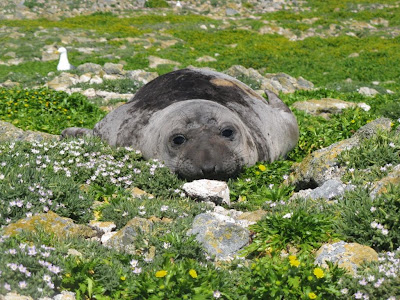
Once an elephant seal cow is done nursing her pup, she mates with one or more of the dominant males and heads back out to sea, leaving her pup behind. The weaned pups live off their blubber, sleeping and playing with each other for a few months before venturing into the water for the first time to find food.

Some pups are able to suckle successfully from two females. Sometimes a cow will share her pup with another cow, or a weaned pup is adopted by a foster mother after the real mom has departed. Usually the foster mother has lost her own pup. These shared pups are called "superweaners" or "double mother suckers," and they typically grow much fatter than other pups. We had three superweaners in our Mirounga Beach colony this year, all males.

Colleen shared her pup with another cow. The other cow's pup washed out to sea during one of the big winter storms. Below is a picture of Colleen's weaner hauling himself out of Mirounga Beach.
Grasshopper's pup was adopted by a another cow after Grasshopper departed. The foster mother nursed him for an additional 12 days. He is the biggest weaner on the Farallones. In the second picture, he is stuck in a pile of driftwood that washed into Mirounga Beach after one of the big storms. He eventually worked his way out after being stuck there for two days.