The Farallon Islands have been pummeled by a series of major storms over the past few days. The massive swells crashing into the island are awe-inspiring and the intermittent heavy rains are filling our cistern with much-needed drinking water to last PRBO biologists the rest of the year.
The huge waves - especially at high tide - wreaked havoc in our elephant seal breeding colony. Mirounga Beach and Log Channel filled completely with water. Just prior to the storms, Mirounga Beach had 16 cows and 5 pups. Once the storms hit, we thought all pups there were washed out. However, yesterday we spotted 2 tenacious pups still alive and attempting to move to higher ground! Many of the Mirounga Beach cows moved up to the protected Sand Flat, bumping up the population on the flat from 50 to 62 cows over just 2 days.
The storms are expected to last a few more days, with a break over the weekend and then more rain next week! Luckily the new blind on the hill overlooking Sand Flat not only hides us from the skittish California sea lions, but also provides us some shelter from the elements while we continue to monitor the elephant seals every day, rain or shine.
Wednesday, January 20, 2010
Wednesday, January 13, 2010
20 Orca seen today!
During this morning's lighthouse watch, I saw 20 Orca swimming west of the island, headed southeast.
5 big males were in the group and perhaps 4 juveniles.
Very exciting!
5 big males were in the group and perhaps 4 juveniles.
Very exciting!
Tuesday, January 05, 2010
The Battles Begin
Pink chest shield and large nose on Bubba.
Winter marks the season of bull battles as males compete to dominate the harems of females who have come ashore to give birth, nurse their pups, and breed. Rusty, our alpha bull last year, has returned and is holding the Sand Flat harem again, with 15 cows as of January 3, including Daniela, Kyra, Eone, and Lodi, and 7 pups. Kyra and Eone were both born on SEFI in 1999.
Kyra with her newborn pup on Sand Flat.
Flaccido Domingo is the beta bull on Sand Flat. Time will tell whether he challenges Rusty for the top spot.
Flaccido Domingo is second on Sand Flat, but wary of mighty Rusty.
Speaking of challenging for the top spot, the bull Bubba attempted to do so on December 31, leading to his demise. Rusty killed Bubba in a brutal, hour-long battle in which Bubba got stuck between two rocks in Log Channel Beach. This happened to Nero in 2007, when he was killed by Don Fransisco after getting wedged between the same two rocks.
Rusty and Bubba battle in Log Channel Beach.
Most elephant seal fights do not end in death, but occasionally when two bulls are closely matched, the winner will continue to batter the loser until he is permanently eliminated. The battle was a sobering reminder to PRBO biologists of the realities of nature and that life itself is at stake for these animals. You can view a part of the battle below, but be warned that it is not for the faint of heart.
The harem on the Marine Terrace of Sand Flat is small but growing. There are currently 3 cows and 2 pups, including new cow Shaye. McHammer, not quite a bull, is dominating this harem. He is 9 years old, born and tagged on the Farallons in 2001.
McHammer on the Marine Terrace.
Mirounga Beach has no pups yet, and cows so far have been just passing through. Felipe, nearly a bull, has been seen in Mirounga Beach. Similarly sized Mein Gott is biding his time on Lower Arch Terrace. McHammer, Felipe, and Mein Gott are known as "SA4" seals, or 4th-year subadults. The next step up is a bull.
Monday, December 21, 2009
It's big, it's blue, it's broken!
Living on a remote island wildlife refuge is a wonderful experience for the biologists and research assistants of PRBO. However, all food and personnel must come and go via boat, and the ocean is so rough at SEFI that no boat docks exist. Our main facility for getting things and people on and off the island for the last 40 years has been East Landing, which has a large, electric-powered crane that puts our SAFE boat skiff in the water. The SAFE boat then meets with the supply vessel and transfers material. The crane then lifts the skiff and supplies back up to the boat deck 30 feet above the sea.
A railroad cart that runs from the landing, past the powerhouse and ends at the SEFI house makes moving huge loads of supplies, generators, and fuel easy. This landing site has been used since the first human inhabitants of SEFI came to harvest skins and eggs because it lies in the protected lee of the island, sheltered from the prevailing winds and currents from the northwest. The latest incarnation of the East Landing crane was built in 1989 by Sheedy Drayage.
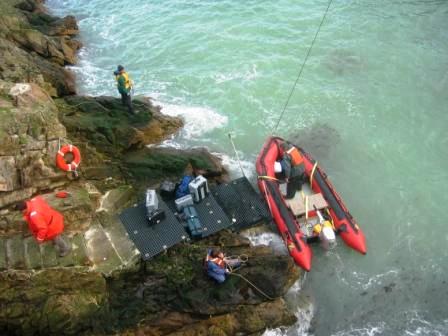
As is inevitable for machinery operating in an oceanic environment, the crane has suffered corrosion and decay and was suddenly condemned a few months ago. Since that time, we have been using our secondary landing on the north side of the island in Fisherman's Bay. North Landing has a hand-powered crane to raise and lower our Zodiac (a small, inflatable boat). Gear and supplies are transferred between the Zodiac and shore at a sea-level platform on the rocks. Large swells can (and often do) suddenly roll in, scouring the cove with roiling whitewater and tossing the Zodiac around like a cheap beach ball at a Phish concert. We then hump our supplies around the island in wheelbarrows.
We've begun the two week-long operation to dismantle the East Landing crane and remove it to the mainland for reconditioning and repair. Using HH-60 Pavehawk helicopters, our friends at the 129th Rescue Wing of the California Air National Guard at Moffett Field airlifted giant toolboxes loaded with the specialized, heavy-duty tools and equipment needed to work on the crane. Local 377 ironworkers from Sheedy Drayage tore down the crane over two days and prepared the parts for transport. Aris Helicopters then lifted each part of the crane and moved them to the helicopter pad, except for the boom, which was immediately flown to the mainland.
One of the crew from Sheedy was Al Pietrocelli, who worked on the original installation of the big blue crane 20 years ago. Al was happy the dismantling went smoothly and thought the damage was not too extensive. Hopefully we'll soon have East Landing back in operation, and the much more physically taxing North Landing will revert to its back-up role as a storm landing.
In a related (and nearly as important) story, early December bore brutishly down upon the island with a nasty cold snap. Not big news, except that our (in)famous Webasto boiler has been out of commission since April. We are wildlife biologists, who think of ourselves as a hardy species used to extreme weather, difficult geography, and of course, wild animals. But we were reduced to shivering, quavering wimps.
A handy-crafty species as well, the biologists out here at SEFI have been able to keep the Webasto (designed to heat the cabs and engines of semi trucks, buses and boats) going well past its service life. This time, however, the diagnosis was terminal. Its shiny new replacement is currently purring away under the back stairs, pumping hot water through the radiators, and happiness once again reigns at SEFI.
After two weeks, we barely remember the old one.
A railroad cart that runs from the landing, past the powerhouse and ends at the SEFI house makes moving huge loads of supplies, generators, and fuel easy. This landing site has been used since the first human inhabitants of SEFI came to harvest skins and eggs because it lies in the protected lee of the island, sheltered from the prevailing winds and currents from the northwest. The latest incarnation of the East Landing crane was built in 1989 by Sheedy Drayage.
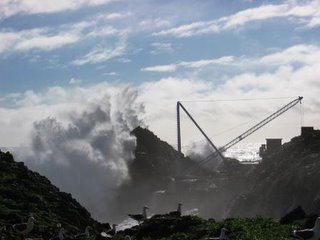
East Landing crane gets doused by a winter southerly storm swell.
As is inevitable for machinery operating in an oceanic environment, the crane has suffered corrosion and decay and was suddenly condemned a few months ago. Since that time, we have been using our secondary landing on the north side of the island in Fisherman's Bay. North Landing has a hand-powered crane to raise and lower our Zodiac (a small, inflatable boat). Gear and supplies are transferred between the Zodiac and shore at a sea-level platform on the rocks. Large swells can (and often do) suddenly roll in, scouring the cove with roiling whitewater and tossing the Zodiac around like a cheap beach ball at a Phish concert. We then hump our supplies around the island in wheelbarrows.
North Landing Zodiac at the steps where gear is unloaded.
We've begun the two week-long operation to dismantle the East Landing crane and remove it to the mainland for reconditioning and repair. Using HH-60 Pavehawk helicopters, our friends at the 129th Rescue Wing of the California Air National Guard at Moffett Field airlifted giant toolboxes loaded with the specialized, heavy-duty tools and equipment needed to work on the crane. Local 377 ironworkers from Sheedy Drayage tore down the crane over two days and prepared the parts for transport. Aris Helicopters then lifted each part of the crane and moved them to the helicopter pad, except for the boom, which was immediately flown to the mainland.
East Landing crane just before Sheedy and Aris pulled all the pieces and placed them on the helo pad.
One of the crew from Sheedy was Al Pietrocelli, who worked on the original installation of the big blue crane 20 years ago. Al was happy the dismantling went smoothly and thought the damage was not too extensive. Hopefully we'll soon have East Landing back in operation, and the much more physically taxing North Landing will revert to its back-up role as a storm landing.
In a related (and nearly as important) story, early December bore brutishly down upon the island with a nasty cold snap. Not big news, except that our (in)famous Webasto boiler has been out of commission since April. We are wildlife biologists, who think of ourselves as a hardy species used to extreme weather, difficult geography, and of course, wild animals. But we were reduced to shivering, quavering wimps.
A handy-crafty species as well, the biologists out here at SEFI have been able to keep the Webasto (designed to heat the cabs and engines of semi trucks, buses and boats) going well past its service life. This time, however, the diagnosis was terminal. Its shiny new replacement is currently purring away under the back stairs, pumping hot water through the radiators, and happiness once again reigns at SEFI.
After two weeks, we barely remember the old one.
Thursday, December 10, 2009
Winter Season Begins
Two California sea lions sleeping on the roof of the copper SLC blind.
Last year, sea lions took up residence on Sand Flat and Mirounga Beach and surrounding terraces, and have been there ever since. The sea lions on our main breeding beaches have changed the way we monitor elephant seal survival and reproduction. Because sea lions and fur seals are more skittish than elephant seals, we now read seal tags and count e-seal cows and pups by hiding behind rocks to avoid being seen by the sea lions.
Elephant seals and sea lions lounging at Upper Mirounga Beach.
This week, PRBO biologist Derek Lee and the rest of the winter crew began re-building a blind on the rocky outcrop overlooking Sand Flat. Using the blind, we can comfortably remain hidden while reading e-seal tags and monitoring the arrival and departure of cows and the births of pups. We also can keep tabs on the adult e-seal males battling for dominance.
We are grateful that the sea lions and fur seals are venturing back into places they may have abandoned many decades ago due to human disturbance. We are merely visitors to this world-renowned biologically rich haven for marine life.It is their island, after all.
Thursday, November 26, 2009
COUNTING BIRDS YOU CAN’T SEE?
Effective conservation of a species requires that you have some idea as to how many individuals there are in a population, whether the population is stable, growing, or declining, and what factors may influence those trends. The Farallon Islands are home to the largest seabird colony in the contiguous United States and currently have more than 300,000 birds breeding there each summer. That is a lot of birds, but this is really only a rough estimate because counting birds is a lot harder than it might seem.
The total number of sites counted was 21,044 including 10,525 medium sites (suitable for Cassin’s Auklets) and 4,681 large sites (suitable for Rhinoceros Auklets). There were also 501 collapsed burrows counted. These sites were likely former breeding sites that were unoccupied this season or had degraded by the time the census was conducted.

For some species that nest out in the open, like the gulls and cormorants, counting is relatively straightforward. We simply count the number of birds or nests that we can find on the island. However, for those species that breed underground, like the Cassin’s Auklet, Rhinoceros Auklet and Ashy Storm-petrel, it is not quite so easy.
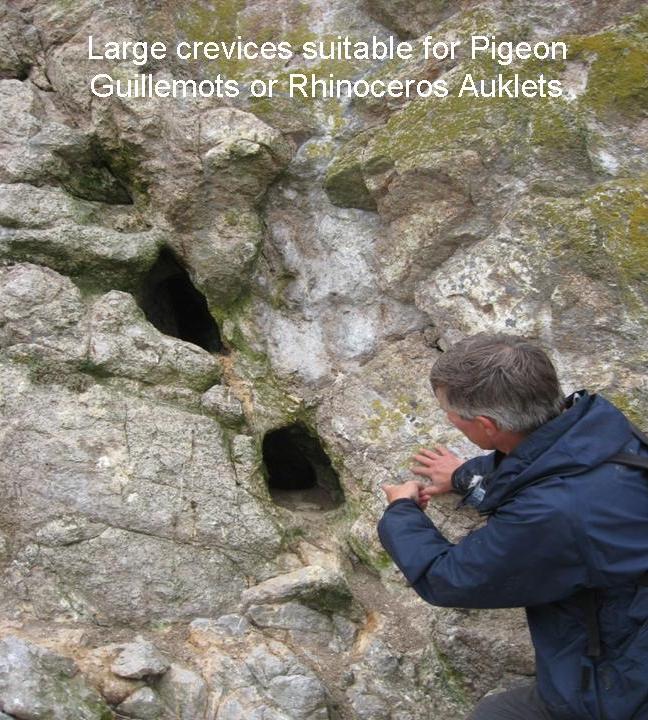
So how do you count birds that you can’t see? Well, one way to do this is to determine the amount of suitable nesting habitat that is available. Once we know that, we can then make corrections for how much of that habitat is actually used based on data from a small sample of followed breeding sites. For auklets, determining available habitat means going around the entire island and counting all burrows and crevices that are available as potential nest sites.
So this September, biologists and volunteers from both PRBO and the USFWS spent a week on the island repeating the 1989 census. It took 5-8 people five full days to complete, and it required scrambling up rocky slopes, crawling around in caves, and scaling the islets to be sure that we counted all the sites. This was exciting for us since we got a rare opportunity to go to some places on the island where we would normally never go.
But, it is also a lot of work, so it is not done very often. In fact, the last time the entire island was counted was in 1989. We assume that much of the habitat (particularly rock crevices) does not change very much from one year to the next but over the course of 20 years, small changes can add up. Old burrows collapse and new ones are excavated. Rockslides and erosion close off crevices and subtle changes to the habitat may make some areas more or less suitable for auklets.
The total number of sites counted was 21,044 including 10,525 medium sites (suitable for Cassin’s Auklets) and 4,681 large sites (suitable for Rhinoceros Auklets). There were also 501 collapsed burrows counted. These sites were likely former breeding sites that were unoccupied this season or had degraded by the time the census was conducted.

Now that we have these numbers, we can generate a new population estimate for Cassin’s and Rhinoceros Auklets and develop a better understanding of how these species are faring at the Farallones.
Sunday, November 08, 2009
Farallon Update - Nov 8
A crew transfer occurred on Oct 25th ushering in a shift from the early and mid season migration to the late season migration. During fall migration, the early migrants include the bulk of the shorebirds, flycatchers, and warblers which pass through mostly during late August and September. During October, these species begin tapering off rapidly while the sparrows and kinglets rapidly increase. This overlap of early and late migrants creates the greatest avian diversity on the island in early October when we hold the Farallonathon. During November, the late period, gulls, sparrows, and thrushes typically dominate.
After the big rain in mid October, northwest winds returned to the island and kept most of the migrants on the mainland. The crew transfer was a bit dicey as the East Landing crane, our normal mode of getting on and off the island, needs drastic repairs. This meant we needed to use North Landing which is less protected from the prevailing northwest swells and wind. Luckily, the swells were not too big on the day of the transfer and everything went smoothly. As we were transporting our food and gear from the landing to the houses, the winds really began ramping upwards. By the following day, the winds were a steady 25 knots gusting to 35. The one good thing about this wind at this time of year is that it occasionally brings us some long-winged goodies. On 27 October, a Snow Bunting was found by two interns conducting a standardized area search of the island.
Another exciting arrival was a Golden-crowned Sparrow that we first captured in 2006. We color-banded it with the combination S/OOY: silver on the left, and orange - orange over yellow on the right. This bird has overwintered on the island every year since then. It's fun to imagine this bird flying out to the tip of Pt Reyes and gazing longingly across the 20 miles of open ocean to its winter home of barren rock.
The following day the winds calmed down a bit more and we were rewarded with an even more unusual bird for the Farallones, a Western Bluebird. This was only the 3rd record for the island; the last two records occurred in the late 1980's. Although Western Bluebirds are regular along the coast, there are nearly 10x as many Mountain Bluebird records.
Not even a week later, a Mountain Bluebird showed up. Note how the rufous on the chest of the Mountain Bluebird is paler than on the Western, and that it has splotches of blue mixed into it. Also note how the pale rufous or buff color extends up into the throat whereas the pure, dark rufous chest of the Western is abruptly cutoff by the dark gray throat - the pattern on the Western is similar to that of the male.
We also spotted a Brown Booby which is becoming more regular to California and may even start breeding here if global warming continues unabated. We have recorded Brown Boobies on the Farallones annually over the last few years. On October 30th, we went out on the zodiac into Fisherman's Bay to photograph this bird while it was perched on Sugarloaf Islet with cormorants and pelicans.
On November 3rd, a Common Raven began croaking on the island. This was only the second fall record since PRBO began collecting data on the Farallones 42 years ago. Historically, these birds occurred on the island until the islanders shot and killed them over 100 years ago. There is still a place on West End called Raven's Cliff where it is believed that they bred. Since their extirpation, records on the island have been widely scattered with a record in April 1972 and then another on 4 October 1995 that rode out on the gusty east winds associated with the big Pt Reyes fire. However, a few years ago, they began arriving more frequently during the winter and spring. Last spring a pair spent a few months on the island and it seemed as though they might start breeding, but it appears they probably did not. Although it would be great to have ravens breeding on the island as they once did, they are also highly intelligent predators that were frequently seen digging Cassin's Auklets out of their burrows. The level of mortality that seabirds (or any species for that matter) can withstand is tied directly to their reproduction. When ocean conditions are good and productivity is high, then a native predator has little impact on a seabird colony, but when ocean conditions are poor, as they have been periodically this decade, the additional mortality can be devastating.
Sometimes the raven did a good deed such as eating the Siberian House Mice that were introduced in the 1800's by Russian sealers.
The only noteworthy insect for the period was a Brown Lacewing that was perched on the lighthouse. It is probably Hemerobius stigma which is considered the most common conifer-inhabiting Brown Lacewing in North America. We are currently uncertain as to whether this species has occurred on the Farallones before.
Thursday, October 22, 2009
Farallon Update - October 21
Well it’s been a quiet week on Southeast Farallon, our home island, out here on the edge of the continental shelf. With September being one of the slowest on record (we banded 90% fewer birds than average), the crew was a bit downtrodden. We had to take joy in the few birds that were showing up. On Oct. 1 a couple of White-tailed Kites made a lap around the lighthouse, and we discovered one of the Burrowing Owls that was banded in 2007. A5 (the number on its blue color band) has spent the past three winters on the island in the same auklet burrow. The next few days were pretty windy, leaving us with fairly low bird diversity, and even lower spirits.
On Oct. 5 we saw a ray of sunshine with a small increase in diversity, including a couple unusual species. Great Blue Heron, Northern Harrier, Black-bellied Plover, and Varied Thrush all made an appearance. The weather forecast was showing some favorable conditions over the next several days, so we decided to start the Farallonathon. This is an annual event each fall in which we attempt to score points by finding as many species as possible, including marine mammals, fish, salamanders, butterflies, dragonflies, as well as birds, over a seven day period. Farallonathon usually starts sometime in late September with one of the bigger waves that usually come that time of year. As this year is unusual, we waited until October to start.
The next day we garnered a few more points from Minke Whale, Monarch, Black Saddlebags, Mew Gull, Short-eared Owl, Barn Swallow, Hermit Warbler, Clay-colored Sparrow, and White-throated Sparrow, among others. We were literally scrounging for points on the 7th as the winds continued to come from the WNW with Mark looking around for Arboreal Salamanders (he found one). A rush of excitement came in the afternoon when Matt flushed a nightjar, which we then chased for an hour up and down Lighthouse Hill. This cryptically colored group of birds can be very difficult to identify when seen. The calls of these birds are the easiest way to identify them, which they usually give at night. After several fleeting glimpses of the bird and discussion of the features each of us had seen, we came to the conclusion that the bird was a Common Poorwill. With less than 10 records for the island, it's a rare bird for us even though they are relatively “common” along the mainland coast.
Light winds and high overcast greeted us on the morning of Oct. 8 and brought more birds to the island, though not the wave we were hoping for. The new species we saw were mainly migrants from the western US, which still give us Farallonathon points, but don't get us nearly as excited as the vagrants from the east. We added Black-vented Shearwater, Wilson's Snipe, Warbling Vireo, Nashville Warbler, Western Tanager, Grasshopper Sparrow, Lazuli Bunting, and Purple Finch. The one eastern bird we did see was a Rose-breasted Grosbeak. Farallonathon points that day also came from Harbor Porpoise, Hoary Bat, Green Darner, Variegated Meadowhawk, and a shark attack off of Saddle Rock (those are worth 5 points). So on day 4 of the Farallonathon, we were at 118 points. Last year we ended with 129 points which was the lowest ever. Could we get eleven more points in three days?
No problem when you get hit with a WAVE DAY! The long awaited wave of migrant birds appeared on Oct. 9. The biologists were feeling as light as the south winds and flying as high as the overcast skies. Birds were flitting about everywhere, from the marine terrace to the lighthouse. A flock of 20+ Hermit Thrushes was seen around the top of Lighthouse Hill early in the morning. Yellow-rumped Warblers (both Audubon's and Myrtle) seemed to be covering every square meter of the island. A flock of about 250 Violet-green Swallows was swirling around the island. After getting past the shear numbers of birds, we started to sift through the flocks and pick out some interesting birds. Early on we saw a Chestnut-collared Longspur that arrived at the lighthouse and then made its way down to the terrace, where we were able to get some great pictures. Then a Red-eyed Vireo was found in Twitville. As for warblers we added Tennessee, Blackburnian, Blackpoll, MacGillivray's, American Redstart, and Ovenbird. Bobolink, Least Flycatcher, and Lawrence's Goldfinch were also good finds. A Solitary Vireo was seen that suggested a Blue-headed. With a nice photo by Kristie, we were able to confirm that ID. The big find that day though was a Gray-cheeked Thrush. There have only been 21 records of this species in California, over half of which are from Southeast Farallon Island. This bird was found in a flock of Hermit Thrushes atop Lighthouse Hill and was accommodating enough to allow everyone to see it.
When it was all totaled up in the journal, we had seen 87 migrant bird species and 1332 individual landbirds. We set island high count records for Violet-green Swallow and Audubon's Warbler and saw 16 species of warbler and 16 species of sparrow. With all the new birds and a couple shark attacks, our Farallonathon total shot up to 158. Though our goal of “not being the worst” was pretty low, we crushed it with two days to spare.
With visions of vagrants in our dreams, we went to bed exhausted and elated. What would tomorrow bring? As we starting birding on the 10th it was obvious that there were fewer birds on the island, but there were different birds around. The numbers of Hermit Thrushes and Yellow-rumped Warblers were reduced by two-thirds, and Golden-crowned Kinglets doubled. We found Chestnut-sided, Magnolia, Black-throated Green, Palm, and Black-and-white Warblers. Long-billed Dowitcher, Band-tailed Pigeon, Hammond's Flycatcher, Northern Mockingbird, and Orchard Oriole were also nice additions. To add to the frantic pace of the day, we were also switching crew members and getting our food shipment. Jim, Matt, and Kristie were leaving, and Pete Warzybok and Andrew Greene were arriving.
About an hour before Jim was supposed to get on the boat and leave, he and Pete came across a bird that Jim didn't recognize. That's code for “it's probably not from North America.” He called out on the radio that he had just seen an “Asian bunting,” which sent us all running. Unfortunately, the two minutes it took for others to get to Jim were just long enough for the bird to disappear. It wasn't seen again. Jim consulted a field guide and identified the bird as a Yellow-breasted Bunting. The only records for this species in North America are from Alaska, and there are only a few. It has never been seen in the lower 48. Super mega, mega rarity. Then Jim left, and the bird was never refound. The other biologists were left in a state of shock. Such an amazing bird, that we didn't get to see, even on this tiny, barren island. What other birds have we missed? No sense in dwelling on it though. Ten Farallonathon points anyway.
Sunday, Oct. 11 was the last day of Farallonathon, and we were determined to squeeze out some more points. Diversity and numbers were down, but new species were still being found. A few of the highlights were Northern Shoveler, Tropical Kingbird, “Siberian” American Pipit, Black-throated Blue Warbler, Lark Bunting, and Yellow-headed Blackbird. Interesting fact for the day was that we saw all three Black-throated warbler species (Blue, Gray, and Green). Our Farallonathon point total was 193, which was the sixth highest total since it started in 1992. Hooray for wave days!
The following week saw a big change in the weather, as we were slammed by a storm on the 13th. We'll try to post some pictures of that soon. As would be expected, the numbers and diversity of birds are down. We had a flock of blackbirds that included Brewer's, Red-winged, Yellow-headed, and Tricolored Blackbirds with a few Brown-headed Cowbirds. That's a nice icterid flock. A Virginia Rail was found (and banded) on Oct. 12, followed by a Sora (also banded) on Oct. 16.
That's the news from Southeast Farallon Island, where all the biologists are strong, all the Elephant Seals are good looking, and all the vagrant birds are above average.
Subscribe to:
Posts (Atom)