Tuesday, October 04, 2011

A farewell tribute to the seabirds

When the fall crew arrives in late August, we just get a glimmer of the seabird colony that dominates life on the island during spring and summer.  Most birds are wrapping up their nesting priorities and preparing to head out to sea for several months to molt their feathers and find more abundant food to survive the cold, turbulent winter.

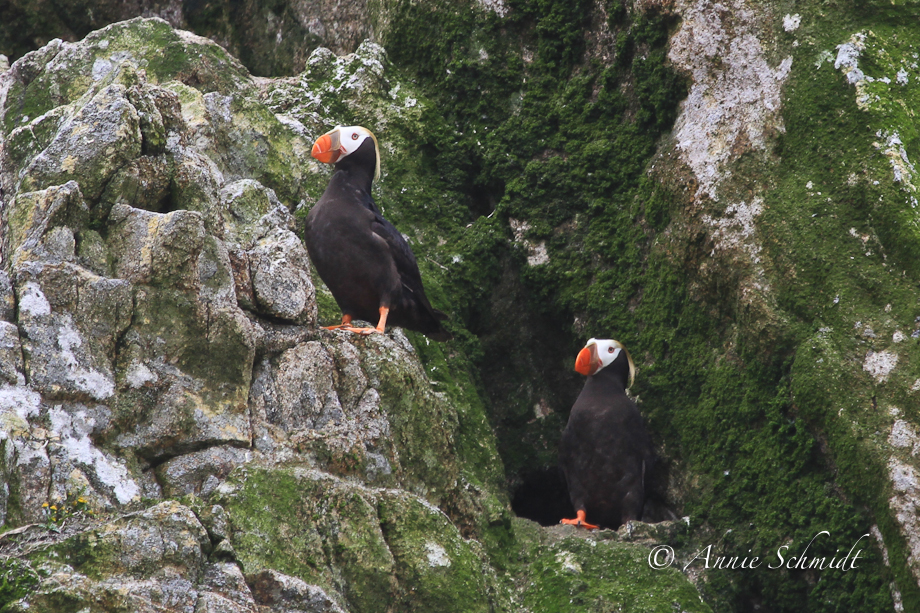
Everyone is excited to see the puffins, so we all take photos before they disappear in mid-September.  Here is one still in full breeding plumage.  While some still attend nests in late summer, many congregate in small groups to possibly prospect for mates or new nest sites.


Here's an individual that was foraging just off shore.


Pigeon Guillemots are later nesters, so we get to see them carrying food to their nests for the first couple weeks before all the chicks fledge.  Here you can see an adult taking off from the water with a fish.


Squid was a big part of the diet this year. Here's a different individual sitting outside its nest ready to feed its young a tasty little squid.  Yum!!!


A successfully fledged Pigeon Guillemot chick floating around the island.


Rhinoceros Auklets typically finish up right before we arrive and then they quicly leave the area, so we just get to see a few.  Here's an adult foraginng for a late nest.


Lately, the cormorants have been very late nesters, with many still feeding chicks at nests into late September.  Here's a nest with Brandt's Cormorant chicks that still have a long ways to go before fledging.  They won't be ready to fledge until they molt out all those downy feathers and replace them with sleek, oily feathers that can repel the frigid Farallon waters.


This Pelagic Cormorant chick, waiting to be fed from its parent, appears to be a little closer to fledging.


Western Gulls are usually still finishing up nesting when we arrive, with lots of chicks to defend and feed. This year was their worst reproductive year ever documented by PRBO, so there were very few around when we arrived.  Here's one adult that found a Rhinoceros Auklet chick that was attempting to walk to the ocean to find food and safety.  Unfortunately, many seabird chicks that leave their nests during the day need to walk a guantlet of hungry gulls that won't think twice about making a meal of these hapless birds.

The Western Gulls also need to defend their chicks from marauding neighbors, or perhaps just get out pent up aggression about the poor season.


Saturday, September 10, 2011

Transitions - A Fall Island Fashion Preview

Initially, I was excited and somewhat terrified at the notion of living for 6 weeks on the tip of what looks like a drowning mountain. The Farallones are defined by granite that has been morphed by wind and waves into steep arches, caves, peeks, and slippery flats.   The speckled cliff faces are coarse and fractured, and sprinkled with loose boulders or softball-sized rocks that are so dense and heavy that walking on them gives you the false impression of good footing!  A closer look reveals the result of 10,000 generations of nesting seabirds who have unknowingly turned sharp cracks into tiny, smooth (almost polished), guano-rimmed caves.  Here you are struck by the wonder and absurdity of habitat at its essence.

Arriving in early August and interning through mid-September on SEFI means witnessing fantastic changes.  On the ground, work involves wrapping  up the seabird breeding season projects, and initiating fall migratory passerine monitoring.  The density of breeding seabird, sea lion, and the serendipitous  waves of arriving song birds (sometimes from as far as Asia)  are astounding and give one a strong, uncanny sense of wonder.  But the story of the transitions doesn’t stop with the fantastic Farallon wildlife.  Indeed there is a cultural shift most poignantly in island fashion (who knew!) that is defined by the concepts of functionality, pattern, color, and style.
Seabirders work both day and night on their knees banding or monitoring nests and burrows on rocky cliff faces.  Protection  from the diving gulls and  the corrosive power of wind, rain, mud, and seabird guano is essential.  

In the fall however, biologists switch gears, searching constantly for elusive and fleeting land-bird arrivals, and attire becomes defined by freedom of movement and spontaneity.  Here are the fall findings. Functionality: Slim and trim.

Surveying 100m above the sea every day can be exhilarating, but if you should trip, you are almost guaranteed to suffer a bloody mark reminiscent of a childhood playground black top scrape.  For sure footing, flexibility, and light weight on cliffs, rubber boots are a must.  Here is Jim tying the fashion knot while crossing the Jordan Channel on his way to West End Island in a green wind breaker, cotton duck pants, and light weight rubber boots! CLASSIC


Color: Brown over bright
SEFI is austere to the extreme – a set of featureless mounds similar in color to a south Bronx new deal housing project; but within and atop each mound are hundreds of thousands of chirping, glossy eyed, feather balls, which fiercely radiate in all directions day and night, exploring and building, loving and eating.  
The walkways on the terrace are strewn with purple, green, and red pebbles swallowed and smoothed by the guts of prehistoric cormorants.  And the Lighthouse Hill Trail is littered with fragments of mainland pork and chicken bones lovingly regurgitated by Western Gull parents.  Inspiration abounds!  Here I am, looking die hard with a rifle-stock spotting scope dressed in cozy faux fur outer wear, and a bright green t-shirt (showcasing the color not on the island currently)


Patterns :  Bold, Structural Lines
Large dark patterns with wooly and cottony blends are big right now on island!
To avoid flushing wildlife, blending in is a lifestyle and is as important indoors as out.   Here is (steely) Dan ready for action with a tastefully structured plaid on plaid ensemble with tall coffee.


Style: The Tufted Look
A big factor when scouting for the rarest of rare birds (jungle nightjar -cross your fingers!!)  is to constantly be open to the impossible and the absurd.  For knowing where and when rare birds are arriving Matt (island fashion flare/bird-sticker guru) is on the cutting edge with his lightly quaffed mohawk and handy accessories.   This look really says "Hey guys relax, the bird is in the bag."


Accessorize!!!! : Neck Metal
Mr P with a fashion forward neck piece

Facial hair: Whiskers 
A must for fur seals and biologists (male) alike.


Knowing how to dress on island is important whatever the season. But whatever the dress, its about being outside, working hard and having fun.   I remember Biologist Pete Warzybok's comment as we stretched our way through a dark cave littered with dead fish, smeary guano, and fluffy rhino auklet chicks, ‘this is where I am most reminded of why I love science!’ 

Written by,
Adam Fox

Wednesday, August 03, 2011

The Wonderful WEGU


Spring and Summer on the Farallon Islands is abundant with breeding seabirds (13 species, to be exact), but Western Gulls are one of my favorites to observe.  One of my tasks on the island requires me to monitor a small plot of breeding Western Gulls.  There are four gull plots on the island, each of which is packed with birds whose age we know from their unique band combinations – as they were banded as chicks.   Each year has a new cohort combination (usually a color band on one leg and a numbered metal band on the other), so we can easily identify the year in which a particular bird was born.  Gulls are very territorial, and banding them allows us to follow their breeding attempts throughout their entire lives (up to 34 years!) as part of PRBO’s long term seabird research. 
This bird has a metal band on the left leg and a white band on the right leg, indicating is was banded in 2008.

In the beginning of the season, I was given a map of my gull plot and a list of birds that were known breeders in that plot.  Western Gulls usually return to the same nest site every year to breed.  Each site is marked with a stake that is painted with the year the bird was banded and the cohort number.


The bird that belongs to this stake was born in 2002 and was the second bird from that year to return to the study plot to breed.


One of the main tasks early in the season was resighting banded birds in each gull plot.  Resighting requires us not only to record the band combination of each bird, but to also read the numbers engraved on the metal bands.


An engraved metal gull band.


It sounds easy enough, but it gets tricky, as gulls can be pretty clever.  They are very aware of your watching them and every time you move to get a better look at the band numbers, the bird will also move so you only see numbers you’ve already seen.  Sometimes you have to get sneaky- pretend you’re looking at something else until you’re in a position to read the entire metal band and turn around quickly, before the bird has time to react.


Farallon biologist resighting Western Gulls.

In May, the gulls started laying eggs.  We number them so we know the order they were laid in, and later, the order in which they hatch.  This helps us keep track of the productivity of each known-age gull.

Numbered Western Gull eggs.


After the chicks hatch, they are given temporary color bands with the nest and chick number.  As they grow older and start to move around, the color bands help us differentiate between chicks from different nests sites.


Western Gull chick with a temporary band.
 
When the chicks get old enough, they get permanent bands.  This year, the cohort combination is metal on the left leg and red on the right.  This part of gull monitoring is probably the most fun since we were able to go into each followed plot and band all the chicks we could find.  We do this because the chicks that survive will come back to these sites in three years when it’s their turn to breed, and we can follow their reproductive success.


Gull chick banded this year.
 
At this point in the season, chicks are beginning to fledge.  A chick is considered fledged when it is seen flying.  Walking around the island, we often run into gull chicks that are trying to fly.  They hop up and down and flap their wings, trying to catch the wind.


This Western Gull study allows us not only to monitor the reproductive phenology and success of known-age birds, but also provides us with information on the health and function of the marine ecosystem.  Unfortunately this year, gull reproductive success was very low – while many eggs were laid and hatched, most chicks didn’t survive to fledge. With over 40 years of baseline data on Farallon seabirds, we know that this year’s breeding failure is the worst recorded for Western Gulls in PRBO’s history on the Farallones. This highlights the value of these long term studies to show that we are observing  changes in the ocean that are having strong effects on Farallon wildlife.

Text by Jen Aragon
Photos by Jen Aragon, Annie Schmidt, and Amy Blake

Sunday, July 17, 2011

Photo a Day Returns


Only a few weeks left for the seabird season. Keep up to date with your daily photo!
http://farallonphoto.blogspot.com/

Saturday, July 09, 2011

Sefi has shorebirds too!

On Southeast Farallon Island there are 12 different breeding species of seabirds, many of which have been profiled on this blog. However, there is one species that has not been showcased yet, the Black Oystercatcher. Oystercatchers are the only breeding shorebird on the Farallones, nesting primarily along the rocky margin of the island just above the reach of the surf.  One of my projects is to observe the birds in order to determine the number of active breeding sites and the total number of chicks produced on the island. A site is considered active based on different behaviors, including nest building, defending a territory, carrying prey items to the nest sites, or seeing a chick. However, finding the birds and their nest sites can be quite challenging and an exercise in patience. Oystercatchers are cryptic, build inconspicuous nests and are often hidden behind rocks or logs.  I spend many hours scanning the shoreline for signs of activity and attempting to locate territories, nests and chicks. There are roughly 26 active sites on the island this season. Here are some observations from one in particular but first let’s have a quiz!
Here is a photo of the site, can you find the Black Oystercatcher?


   We are not able to visit most of the areas where the Oystercatchers breed because it causes disturbance to other species, so most of my observations are done with a spotting scope from the top of Lighthouse Hill. This view is typically what I see through a telescope. To locate the bird I look for clues such as body shape, size, color (the orange bill and flesh toned legs) and movement. Sometimes I can observe a site for ten minutes before one magically appears!
    In the first two weeks of observations, I noted two birds were flying as a pair in the territory. Occasionally I witnessed the pair defending the area, flying aggressively towards any Western Gull that happened by. In the third week I found one preening but also alert for approaching threats. At one point the bird wandered in the area and a second oystercatcher stood up. Quickly, the first bird sat down in the same spot. Was this the nest site? I continued to observe the area hoping to see a nest or eggs. The bird sat still the entire time and I never saw the nest or eggs that day!


     Since they build a nest that is not always visible, I made a few notes in my notebook on how I could relocate the site. Black Oystercatchers do not build a typical nest. Instead they create a scrape. A scrape is formed when a bird presses their body against rocks or dirt. They may also use their feet to excavate extra dirt. They generally build their nest near the intertidal zone. This area is a great place to find food! On the Farallones oystercatchers enjoy eating limpets, chitons, California mussel, crabs, sea urchins, barnacles and various types of worms.

     I never saw any eggs at this site during my observations but that is normal for many sites. The eggs are difficult to see because they blend in with the environment. They tend to be cream colored with brownish black markings. The color and markings help hide the eggs from predators and from the research assistant. A clutch size can range from one to four eggs.


A few checks later I wondered if I would finally see any chicks. It had been about twenty-five days since I first saw the mate switch. The incubation period is about 26 to 32 days. I focused the scope and began my search.  I found one Black Oystercatcher sitting, so I waited and waited ……..and then…. an adult bird flew into the site! I noticed that the bill seemed longer and I realized it held a prey item. Out of nowhere a small downy black chick appeared and quickly ate the food! Just as quickly the chick disappeared behind a rock! I continued watching the sight and saw a total of three chicks.


      I only have a few weeks left on the island and I look forward to watching the chicks grow. The adults will continue to bring food to the chicks until they are able to forage for themselves. Around day two they are able to walk and by day forty they can fly. However the chicks will remain within the territory until the fall.

     Now back to the quiz. Could you find the oystercatcher? There are actually two birds in this photograph! One bird is standing guard and is looking for Western Gulls and Brandt’s Cormorants to scare off. The second bird is incubating the eggs.

                                    Incubating posture                                                       Standing guard


Text by Sarah Kebler
Photos by Annie Schmidt and Sarah Kebler 


Sunday, May 29, 2011

The Tufted Puffins of the Farallons

Imagine yourself as young tufted puffin. You have been on the open ocean since you first left the cozy crevice where you were born on the Farallon Islands. You’ve fished for food, diving and swimming underwater; slept on the ocean; and ridden out winter storms. Now it’s springtime and you’re looking good, you’ve grown long blond tufts on your black head. The tufts sweep back from your crisp white eye patch. Your beak has enlarged and turned bright orange, and your body has turned a dapper black. This is your first year to return to the island, the first time you will stand on land after three years in the rough North Pacific Ocean. This year you will find a lifetime mate and a home for your own family on the steep cliffs of Farallon Island.


In the beginning of April each year, the tufted puffins return to the Farallons. They’ve been at sea all year or as in the case of our first time breeder 3 years.The older birds that have been here before return with their mates to their prior breeding sites to attempt to raise a chick. These sites are all natural crevices in the rock, usually quite narrow and longer than the reach of the human arm.The puffins pull dry grass from the slopes and bring it into the nest site deep inside the tunnel. The male and female spend time outside their site renewing their bond - standing hunched over, facing each other with their bills together, flipping their heads back and fourth.

After billing they fly out to sea, where they will copulate and begin making that egg. The female lays a single large egg, and for the next 45 days the pair will take turns incubating. Once the egg hatches, the parents bring fish to the chick for another 45 days. So 90 days after the egg is laid, the chick fledges and flutters off the cliffs to the ocean. This is a very long incubation and nestling period for a Farallon seabird, an adaptation perhaps to variable food supply during a breeding season.


Young puffins coming to the island for the first time since fledgling fly around in groups of 5-10 birds. They compete for mates on rocky outcroppings and then investigate possible crevices with their new partners. The first year on the island the pair spends time loafing, sleeping and preening at their chosen site. Next year when they return they will come with their mate to the site they have found this year and begin the breeding cycle.


The Farallons, are the southernmost breeding colony for Tufted Puffins. It is a small tenacious group of 70-150 breeding birds that have been monitored for over 20 years. The puffins face challenges of variable food supply and warming sea surface temperatures. They have responded with boom and bust cycles, not breeding during poor food years, as well as breeding later than in the past.

Nonetheless, the puffins are a lively and joyful sight each spring and summer when they soar over the island and perch on the cliffs. They continue to return and maintain their life rituals on the Farallons, a unique and wonderful seabird we are lucky to have our offshore waters.


Text by Else Jensen
Photos by Annie Schmidt

Monday, May 23, 2011

Get your daily photo fix


After two weeks off, Farallon Photo a Day is back!

Friday, May 06, 2011

People Power

Farallon Seabird Crew 2007

On June 7th, 1967, C.J. Ralph and John Smail became the first PRBO biologists to overnight on the Farallones. They spent 4 nights on the island, as guests of the Coast Guard who were still permanently stationed here. I'm sure these biologists could not imagine the idea that PRBO would have a continuous presence on the Farallones from April 3rd 1968 to the present day.

We often focus on the research and conservation efforts of PRBO's 40 years on the Farallones, but we can never forget that lots of hardworking people have made this happen - be they PRBO Farallon Biologists, volunteers, USFWS staff, outside researchers, or contractors etc. From 1967 to April 30th 2011,  1405 people have been fortunate enough to spend at least one night on the Farallones, working with PRBO or USFWS activities. Most time has been spent by PRBO biologists and volunteers, who now spend at least 6 weeks at a time on island stints. Back in the late 1960's and early 1970s, Some PRBO biologists spent well over 200 days a year on the island.
Steve Morrell crossing Jordan Channel 1977

Though much has changed in the Farallon ecosystem over 4 decades, what has not changed is the role the Farallones has played in shaping multiple generations of biologists. The first photo below is of Farallon Biologist Ron LeValley with a Cassin's Auklet chick in 1977. Below him is volunteer Matt Barbour, also with an auklet chick, but in 2007.


Within a field season, many volunteers spend multiple months on the island, often with an occasional 2 week break. This long term staffing helps to create better scientific data, as well as excellent experience for up and coming scientists to learn from. In addition, many Farallon biologists have spent many years working on the island, as we all feel very strongly connected to our work, this incredible place, and the amazing passionate and committed people one finds out here.

Brandt's Cormorant Banding 2006

So the next time you ponder the Farallones, remember all the people whose hard work and dedication has made our unique program a reality. Below are the 22 men and 3 women of the the Farallon "Top 25", in terms of numbers of nights spent on the island during PRBO's tenure, as of April 30, 2011. ID# shows where an individual fits in in the PRBO Farallon timeline, as the first person in 1967 was #1.  

Friday, April 22, 2011

What is that MUSKY smell?

SEFI is bustling with many smells…


the fragrance of blooming weeds,


the fetid whiff of marine mammals,


the ambrosial scents of a Sunday brunch,


the putrid smells of seabird guano, the tantalizing aroma of Jen’s fresh baked chocolate chip cookies, and many more. But, of all the myriad smells we experience daily on this island, my favorite is a dirty musk that fills my nose when I enter the Habitat Sculpture, crouch down near a small rock crevice, or sweep the northeast corner of the Carpentry Shop. I like it because it reminds me of an Ashy Storm-petrel…

Ashy Storm-petrel
These aromatic seabirds are the size of a swallow but have the ecology of an Albatross. They spend most of their lives at sea, are strong fliers and are long lived. Storm-petrels are members of the order Procellariiformes and easily identified by the tube on top of their bill, which gives rise to the more common moniker for this group, “the tubenoses”. This tube aids storm-petrels in both olfaction and the ability to excrete excess salts.
Western Gulls amongst the grassy hillside
Ashy’s are found only between S. Oregon and N. Mexico and are a species of special conservation concern in California due to a small global population. In fact, half the world’s population of this diminutive seabird lives on the Farallones, making the Farallones a critical colony for monitoring and conserving this species. Unfortunately, the Ashy population significantly declined since the 1970’s when PRBO began monitoring them on SEFI and the future status of this species remains uncertain.  Like most seabirds, Ashy’s are vulnerable to the effects of a changing ocean climate which may affect the abundance and distribution of their primary food, mostly krill and other small zooplankton. Other major threats to Ashy’s on SEFI include predation by Burrowing Owls and Western Gulls and habitat change, specifically increases in non native grasses.

Ashy Storm-petrel at sea
Most of my work on SEFI is accomplished during the daylight hours, but, last week, for the first time this season, we also did night work. The crew worked until a grueling 2:00AM mist-netting for Ashy Storm-petrels. Because these birds are primarily nocturnal when they are at the colony, this is the only way that we can capture and band them. By banding Ashy Storm-petrels PRBO hopes to determine population size, status and survival of adult birds. To attract Storm-petrels to the mist net we played vocalization of adult birds, you can listen to an Ashy vocalization by clicking below:


Lying down on a bed of rocks beside the net we waited for the birds to fly in. Ashy’s can wriggle out of the net pretty quick so once in we rushed to extract them. My first Ashy extraction went smoothly. And while the Ashy’s bite did not leave a mark like the Cassin’s Auklet, the Ashy did regurgitate a highly concentrated oil that left my hands reeking of the remindful musky odor. This oil is an important nutrient rich food for their chicks. The night brought us a total of 28 Ashy Storm-petrels including one recapture.

Storm-petrel burrow

Later this season I will help study the breeding success of Ashy’s on SEFI. To do this I will suit up armed with a burrow camera, aka the SeeSnake, and traverse the island visiting known burrows. Ashy Storm-petrels nest in small cavities in rocks and crevice in some of the human created structures on the island. Each burrow is marked with a yellow stake and number. The holes are so tiny that we use the camera to peer in. We hope to find adult birds, eggs, or chicks.


Ashy Storm-petrels are amazing seabirds that travel over 300 kilometers each night garnering food to feed themselves and their chicks, but their population is declining. PRBO biologists on SEFI hope to learn more about this unique species to help conserve it. Even though the musk of an Ashy is not as sweet as the Egyptian Musk oil I sometimes wear when I am on the mainland, I will always flash a smile when I get a whiff, because it means an Ashy Storm Petrel is near.


Ashy Storm-petrel chick

Tuesday, April 12, 2011

Photo a Day project

New Farallon photo project by Annie Schmidt. Check it out!

Farallon Photo a Day: 2011