Friday, November 18, 2011

First Island Records and other fun birds

Southeast Farallon Island has one of the largest species lists for such a small area at this northerly latitude. With over 40 years of ornithological scrutiny and a list of 418 species, adding a new one to the list has gotten increasingly difficult.  Many of the species that are rare to California have been seen here already.  However there are numerous possibilities that have yet to make their debut in the state, and we ponder frequently which of these will show up here next.  Several other species, such as Western Scrub-Jay and American Dipper, are common in the state, but because of their more sedentary nature are unlikely to ever cross 20 miles of inhospitable ocean.  Although this latter group does not have the same exotic appeal as the former, long-time Faralisters are just as interested in this group. 

One group that many Faralisters struggle with are ducks.  Other than Surf Scoters, ducks seem to shun flying this far off shore.  Three merganser species are commonly seen California, but only one, the Red-breasted Merganser, had been seen by Faralisters prior to today.  Of the two remaining, Hooded and Common, Hooded seemed slightly more likely just because they are a longer distance migrant.  On November 18th, though, Oscar Johnson spotted a Common Merganser in basic plumage just offshore.  We all ran down to the East Landing to document this new species.  Sam Roberts managed to get a few decent photos that clearly distinguish this merganser from the similar Red-breasted, but unfortunately it flew just before we could get even better photos.  From Sam's photos, the clear white chin patch is cleanly demarcated from the dark throat, and the dark throat has a clean, straight demarcation below against the mostly white breast.  Furthermore, the bill is thick-based and is bright orange along the culmen (or top edge).  Red-breasted Merganser has a thin bill with a dark culmen and has a blurry throat with no clean-cut pattern.  The Faralist now stands at 419!


In addition to this first island record and the previously mentioned Short-tailed Albatross, we have seen several other interesting birds.  October 25th was a particularly nice day with light west winds and 5-10 miles of visibility.  A Summer Tanager and female Black-throated Blue Warbler were briefly seen at the lighthouse, but of greater interest were the island high count of eleven White-throated Sparrows and the long-returning Say's Phoebe, who we now refer to as Simon.  This phoebe was first banded in 2007 and has returned to spend its fifth winter on the island.
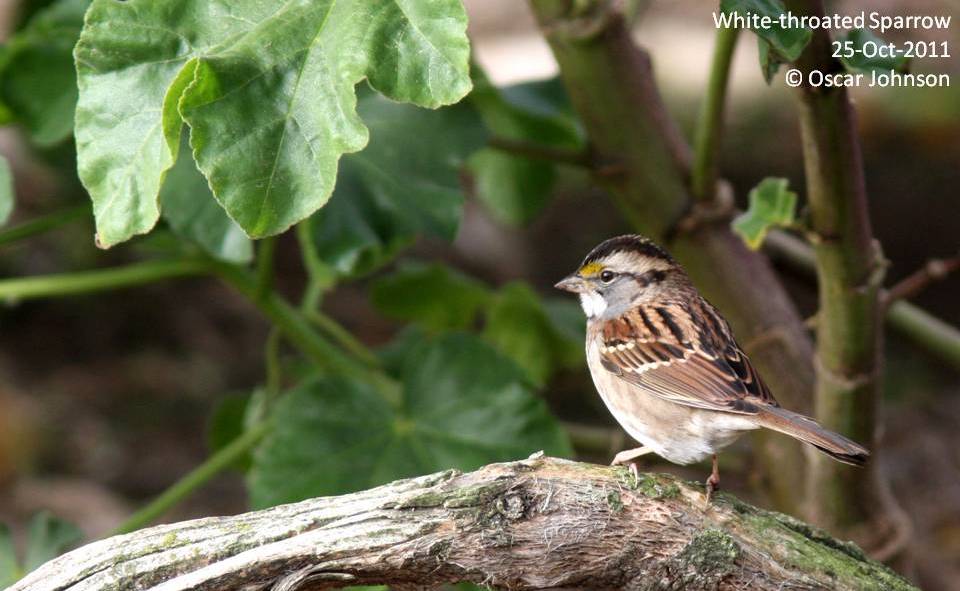


In addition to the above mentioned species, we also enjoyed two Swamp Sparrows and a rarely captured Rock Wren.  A few of these wrens typically over-winter every year, but they rarely come near our nets since they are not attracted to the few trees where the nets are located.


On November 1st, we were graced with a second Yellow Palm Warbler in just two years.  Western Palm Warblers are fairly common here during the fall, but the more easterly Yellow Palm is a very scarce migrant to California.  As the common name implies, Yellow Palms have more yellow than Westerns, in particular on the throat and the supercilium (or eye brow).  Prior to last year's Yellow Palm, this subspecies had not been adequately documented from the Farallones.


Here are two images of Western Palm Warblers for comparison:


November 3rd proved to be another good day for migrants with an Eastern Phoebe, a male Black-throated Blue Warbler, and a record late Pectoral Sandpiper; the previous late date was 23-Oct. A second Eastern Phoebe made an appearance the next day.


Also of interest were a few odd birds that had some of us scratching our heads such as this Herring Gull.  American Herring Gulls (smithsonianus) typically have more solidly dark back feathers and wing coverts.  The anchor patterns on the back feathers, checkered wing coverts, and tail pattern (not visible in this photo) are suggestive of the Asian Vega Gull, but the pale bill base, heavily barred undertail coverts, smudgy head streaking, and anchor patterns this early are not typical of Vega.


Another gull that caused some excitement was this bird, which looks to us like a Slaty-backed Gull, a largely Asian species which is as-yet unrecorded on the Farallones. Some aspects of the plumage gave us pause as to whether it was a pure Slaty-backed, including the limited streaking around the eye, the apparently rather pale mantle, and the limited "string-of-pearls" in the primaries (not shown in the photo below). Communication with birders in Japan, where this species is regular, furthered our belief that this bird is within the range of a pure Slaty-backed Gull. We will submit this record to the California Bird Records Committee to see if they endorse the identification.


A Yellow-rumped Warbler intergrade between Audubon's and Myrtle spiced up our day.  This individual shows the eye arcs and lack of a supercilium typical of Audubon's, but the white throat wrapping up and around the back of the auriculars (or ear coverts) is more like Myrtle.


Two Horned Larks of different subspecies hobbled about on the gravelly area of the Marine Terrace.  One was quite pale, while the other was more richly colored.


Brown Creepers rarely show up on the island, but when they do, they frequently are found hanging around the cypress trees.


On 8 November, a Xantus's Murrelet turned up in Fisherman's Bay.  This species is in the same taxonomic family as the several species of alcid that breed on the Farallones (Pigeon Guillemot, Common Murre, Rhinoceros Auklet, etc.), only this one breeds on the Channel Islands off southern California.  There are only about 25 records of this species for the Farallones, and they usually show up during warm water El Nino years.  Why one would show up in these frigid waters during November will just have to remain a Farallon mystery.


Just as impressive was the return of a Golden-crowned Sparrow with the color-band combination silver on the left and orange over orange over yellow on the right.  We abbreviate this combination as S/OOY, which has become this bird's name.  We first banded this bird in 2005 and have seen it every year since!  Look at that crown!  Go S/OOY!


A lovely male American Kestrel also showed up on this calm day.  It has remained on the island for the past week to help rid the island of the introduced House Mouse.


Lastly, a juvenile Indigo Bunting showed up the following day.  Juveniles of this species can be distinguished from the more common Lazuli Bunting by the more uniformly dark rufous-brown upperparts, less contrasting wingbars, and more uniform buff wash below with blurry streaking.


Monday, November 07, 2011

First Short-tailed Albatross in 124 years!


On 6 November, 2011, PRBO biologists documented the first Short-tailed Albatross from the Farallon Islands in 124 years. This species used to be the most common albatross seen along California’s shoreline. Historical accounts mention that it was “numerous” in nearshore waters, including around the Farallon Islands. Short-tailed Albatrosses, however, did not breed on the Farallones or anywhere near the California Coast. In fact, its primary breeding grounds were located on islands scattered across the western Pacific Ocean south of Japan and in the East China Sea.

Short-tailed Albatrosses make an amazing 2,500 mile migration from their breeding grounds off Japan to the California Current and the Gulf of Alaska to take advantage of the nutrient-rich upwellings in these regions.  They feed largely on squid and fish on the surface of the ocean, and are often found feeding on the offal discharged by fishing boats. They are truly impressive birds, with a wingspan of seven and a half feet, making it the largest albatross regularly occurring in the northern hemisphere. Juvenile Short-tailed Albatrosses are solidly dark brown and take an estimated six years to attain the largely white plumage and golden head of a breeding adult. 
Short-tailed Albatross mated pair, probably at Torishima Island.
Juvenile at Cordell Bank, Marin Co., 16 Sep 2009 (Photo by Tom Blackman)
There are two other species of albatrosses that occur in California waters to find food, the smaller Black-footed and Laysan Albatrosses. Both of these species, though, are relatively common in California waters, and in fact, the Black-footed Albatross is seen regularly from Southeast Farallon Island.

During the second half of the 19th century, feather hunters killed an estimated 10 million Short-tailed Albatrosses on the breeding islands. Due to this intense hunting pressure as well as two volcanic eruptions at its primary breeding colony on Torishima, the species was thought to be extinct by 1949. Thankfully, a few dozen immature birds survived at sea away from the breeding islands, and with a hunting ban in place, the species returned to Torishima and began breeding again in 1954. Coordinated conservation efforts by the Japanese, Canadian, and US governments have allowed the species to undergo an amazing recovery, so that the population estimate as of 2007 has increased to approximately 2,500 individuals. 

Breeding colony of Short-tailed Albatross at Torishima Island 
The majority of these birds breed on the Torishima and Mukojima islands off Japan, but in the last ten years a few individuals have shown signs of breeding on Kure and Midway Atolls in the Northwestern Hawaiian Islands, and just last year a pair successfully fledged a chick on Midway. Despite these successes, Short-tailed Albatrosses are particularly susceptible to becoming by-catch in the long-line fishing industry and consuming plastics that they mistake for food, which can directly kill them or cause them to die from malnutrition. Both of these threats are hampering efforts by conservationists to recover this species.

As a result of the population increase over the last 60 years, Short-tailed Albatross has slowly started to reappear in California waters, with the first record since about 1900 being a bird seen 40 miles west of San Clemente Island on 28 August 1977. Since that date there have been a total of 33 records in California waters, 15 of which have occurred since 2007, and two of which were seen in San Francisco County waters. However, the last time that a Short-tailed Albatross was seen at Southeast Farallon Island was when one individual was collected by an ornithologist on 20 March 1887.

So, you can imagine the excitement when Oscar Johnson spotted a large, dark brown albatross with a huge, pink bill flying behind a fishing boat that was offloading offal about two miles west of the island. After a few moments of disbelief, he yelled into the radio to notify the rest of the island’s residents (Jim, Liz, Sam, and Megan), who ran up to the lighthouse to witness a species that barely escaped the maw of extinction.  With high-fives all around, we watched an immature Short-tailed Albatross fly to within a mile of the island before turning around and heading back west to the deep water zone where albatrosses are normally found.

Immediately after seeing the bird, Oscar sat down and sketched it in his notebook and wrote down some details on how it was identified. Here is a scan of that drawing.


Tuesday, October 18, 2011

Farallonathon - The Final Score

The score:

Yesterday's Total: 139
Migrant bird: 5 points
Shark sightings: 2 points
Cetaceans: 1 point

2011 Farallon Grand Total points: 147

The final day of Farallonathon was a busy one. It was media day on the Farallones as we were visited by a group of reporters from a variety of local and national media outlets. Between the boat landings and all the media commotion, we didn't have a lot of time to look for migrants, but we still managed to come up with a few. The highlight was a pair of black-throated warblers, one gray and one blue, which dropped in on the island for a brief rest. In addition, a small group of Northern Pintail was observed flying past the island in the morning and two species of migrant gull (Herring Gull and Black-legged Kittiwake) were also seen flying by.
There were no shark attacks observed today, guess they weren't hungry. But there were two sharks seen at the surface to give us two points. Finally, one Blue Whale was spotted cruising past the island in the morning. The massive spout of this majestic species is unmistakable and brought us our final point for this year's Farallonathon.

Even though the Farallonathon is officially done, you can still donate to help support the Farallones. To support our research, you can donate a flat amount or you can make a pledge based on the Farallonathon point system. To donate a flat amount online, simply go to the Farallonathon team webpage, and click on the DONATE button. Now that you know the total number of points achieved you can easily calculate your per point donate and submit that amount online Or, if you prefer not to use the online method, please email Jim Tietz (jtietz@prbo.org) for details on how to submit your pledge.
(All photos copyright Dan Maxwell)

Biologist Pete Warzybok being interviewed by the crew from KGO-TV channel 7 while Mark dilligently searches for migrants. See the story here.


Black-throated Blue Warbler in it's native habitat - granite outcrops on remote islands.


Cedar Waxwing flying over the house in the early morning.

Farallonathon - Bonus Days!

The Farallonathon runs for seven straight days and we rack up as many points as we can during this time period to help raise funds for Farallon research. So, day 7 was the last official day and we got a grand total of 147 points. This is the fourth lowest total ever for a Farallonathon. Weather conditions just didn't cooperate to bring in the birds this season and two days in particular were very poor weather days with dense fog, rain and no birds.This is the luck of the draw and the difference between a couple of nice days and a couple of poor days can be quite dramatic for Farallonathon. For example if we had dropped the two rainy, foggy days from the Farallonathon where we weren't able to see the ocean and where migrant birds were unable to find the island and replaced them with the next couple of days at the end (Days 8 and 9) we would have had a total of 174 points this year.

Here are a few of the highlights from those bonus days:

Day 8: 24 points! Three shark attacks, 1 new butterfly (Common Buckeye), 1 new dragonfly (Black Saddlebags) and 7 new migrant birds (Red-shafted Flicker, Red-breasted Nuthatch, European Starling, Tennessee Warbler, Nashville Warbler, Pine Siskin and Dickcissel).


Dickcissel spotted on Lighthouse Hill

Nashville, Tennessee - a tribute to the Volunteer State
Day 9: 10 points. One shark attack, 1 butterfly (Orange Sulfur), 4 migrant birds (American Wigeon, Northern Shoveler, Vaux's Swift and Lapland Longspur).

Unfortunately we don't have any good photos of these species since the ducks and swifts were just flying by and the Longspur was in and out of the grasses being generally photo resistant.

However, this just goes to show you how much luck and weather factor into the Farallonathon. Tune in again next fall to see how we do. Maybe we will get good weather for all 7 days next year and break the record! And please, donate if you are able. You may donate a flat amount or a per point amount for either the official total (147) or the bonus total (174) or any amount you choose. Every dollar raised helps to support research and conservation on the Farallon Islands.

Friday, October 14, 2011

Farallonathon Day 6

The score:

Yesterday's Total: 126
Dragonfly: 10 points
Fish: 2 points
Migrant bird: 1 point

Total points: 139

The weather just keeps improving, and our dispositions with it. Day six of the Farallonathon was a reflection on this slight upturn, the addition of some new arrivals added much needed points on the penultimate day. Our only migrant bird addition was a Flicker Intergrade (Red-shafted x Yellow-shafted), a common occurance where the two races overlap, but an uncommon bird for the Farallones. The big winner for the day was our first island record of a single Twelve-spotted Skimmer, confirmed from atop Lighthouse Hill, which added a whopping 10 points! The sun brought forth a Mola mola from the cold ocean depths, and was observed soaking in the much appreciated rays in Fisherman's Bay. Our final point for the day required a little extra work, combing the exposed tidal pools around East Landing in order to find a Calico Sculpin. Hopefully this warming trend will continue into tomorrow, to give us a final pulse of points for the 2011 Farallonathon.

(All photos copyright Dan Maxwell)

 The Flicker Intergrade perched upon a rather foreign substrate for a woodpecker.

 A Calico Sculpin, in its temporary holding container for identification purposes. It was returned to its pool unharmed.


The Mola mola, or Sunfish, surfaces to take in some rays.

Thursday, October 13, 2011

Farallonathon Day 5


The Score:

Yesterday's total: 124
Salamander: 1 point

Fish: 1 point

Total Points: 126 Points


Well, the weather got better but only slightly. The fog stuck around but the rain went away. Try as we might we were not able to get a single bird Farallonathon point. As dedicated Farallonathoners we did not give up and instead turned our attention to other taxa. The rains yesterday actually helped us out, making Arboreal Salamander easy to find. Fish species also count for the Farallonathon, but usually are pretty difficult for us to locate and identify. Lucky for us there was a nice low tide this evening which allowed us to get down to Jewel Cave and do some tide pooling. We were able to find Red Irish Lord Sculpin for our second and last point for the day. We are still optomistic that the fog will break tomorrow and bring some more birds and points.


Arboreal Salamander, the only native terrestrial animal on the island.


Juvenile Red Irish Lord Sculpin found in Jewel Cave.


Wednesday, October 12, 2011

Farallonathon Day 4


The Score:

Yesterday's total: 118 
Migrant Birds: 1 
Shark Attacks: 1 (5 points)

Total Points: 124 Points

Day four of Farallonathon was enveloped in heavy, soupy fog with periods of rain. Needless to say, it was a challenge to find any Farallonathon points today. Our first and only migrant bird point of the day was a Northern Saw-whet Owl found in the Coast Guard tree. It was looking quite wet and unhappy, though we were relieved to get at least one point for the day. Later in the morning we were extremely lucky to see a shark attack off East Landing, as the fog prevented the Lighthouse shark watch. Hoping for better weather and more points tomorrow!


This Northern Saw-whet Owl found in the Coast Guard tree was new for the Farallonathon, but could be a bird that was banded earlier this fall. We were unable to see its legs to check for a band.


PHOTO NOT AVAILABLE
Shark attack off of East Landing, giving us a much needed 5 Farallonathon points.

Monday, October 10, 2011

Farallonathon Day 3


The Score:

Yesterday's total: 102 
Migrant Birds: 10
Dragonfly: 1 
Shark Attacks: 1 (5 points)

Total Points: 118 Points


The third day of Farallonathon was marked by a surprise Nano-Wave. We had a whopping ten new migrant bird species including a Magnolia Warbler, that arrived late in the afternoon.  The Nano-Wave also produced the first of the Fall American Goldfinch, Bonaparte's Gull, and Band-tailed pigeon. 

The Island was shrouded in fog for most of the late morning and early afternoon which halted Shark watch and reduced our chances of observing a Shark attack.  We were, however, still able to observe a Shark attack off Sea Pigeon Point late in the afternoon once the fog receded.


This advanced plumage HY White-crowned Sparrow didn't count as a Farallonaton point yesterday.  It was counted on Day 1, but it was one of the 18 birds that we banded.

One of the two Clay-colored Sparrows on the island, this HY was also one of the birds banded yesterday. 


Another Farallonathon point, courtesy of this Band-tailed Pigeon.

A Variegated Meadowhawk munching on a fly counted as a Farallonathon point. 


This AHY Male Magnolia Warbler was an exciting addition to our growing Farallonathon list.


Sunday, October 09, 2011

Farallonathon: Day 2


The Score:

Yesterday's total:  85
Migrant Birds:  5
Breeding Birds:  2
Shark Attacks:  2 (10 points)

Total Points: 102 Points

The second day of Farallonathon coincided with a major boat day. Jim Tietz, the Fall Season Biologist went on a two week break, while Seabird Season Biologist Pete Warzybok joined the SEFI crew. Kristie Nelson also departed the Island, but Mark Dettling and Megan Elrod came on; this is Megan's first stint on the Island, while Mark has been here for several previous Fall Seasons.

There were fewer birds around the Island yesterday, as clear skies and Northwest winds overnight allowed birds to continue their southward journeys. However, we did have a few new migrant birds arrive, including an American Kestrel, a Red-necked Phalarope (on the later side of their migration), and the first House Finch of the year.

In addition, two breeding species that were missed yesterday were observed: one Rhinoceros Auklet and several Cassin's Auklets. Though both species are resident in the California Current, adults leave the vicinity of the Island after the end of the breeding season; the birds we saw were likely young birds.

The bulk of our points for the day were due to two close, particularly spectacular Shark attacks. One off Sea Pigeon Point and Saddle Rock in the morning was quick, but the other, off Blow Hole Peninsula in the evening, lasted for more than half an hour. At times, the sharks were within 100 meters of the Island, allowing for some great photo opportunities.

We also saw several US Navy ships steam past the Island, on their way to Fleet Week in San Francisco.

 All photos are copyright Dan Maxwell, and were taken on October 8th.

This adult male Lesser Goldfinch was one of two on the Island; not worth a point (we saw three the day before), but still a nice addition to the Island's avifauna.
 
An immature Northern Elephant Seal killed by a Great White Shark floats belly-up off Blow Hole Peninsula.

Shark attacks are almost always spectacular and Adrenaline-inducing, but they're not often as close to the Island as this one was.

This Shark was about 14 feet long - that's a big fish!
Although all Farallon Biologists love Seals, predator-pray interactions like this are an integral aspect of life on and around the Island.

The USS Carl Vincent, on her way to San Francisco for Fleet Week.

Saturday, October 08, 2011

Farallonathon: Day 1


The Score

Breeding Birds:  8 points
Migrant Birds:  53 points
Pinnipeds:  5 points
Cetaceans:  3 points
Butterflies:  3 points
Dragonflies:  3 points
Shark Attacks: 2 (10 points)

Total: 85 points

Opening day of Farallonathon was a strong beginning to what will hopefully become a record setting year.  We had decent numbers of the more common fall migrants. There were good butterfly/dragonfly totals, three species of Cetaceans (Northern Right-whale Dolphin, Pacific White-sided Dolphin, and California Gray Whale), and most importantly- two shark attacks!

Yesterday was the first time this fall that we saw good numbers of Golden-crowned and White-crowned Sparrows.  The first White-throated Sparrows of the fall were also seen.  Other notable birds included Pectoral Sandpiper, Merlin, Chimney Swift, and Palm Warbler.  

 Here are a few photos of things we saw yesterday.

This hatch-year male Anna's Hummingbird was one of two individuals seen buzzing around the island.


Here you can see the oil slick and swarming gulls that are a telltale sign of a shark attack in progress.


This Burrowing Owl on Lighthouse Hill was worth a Farallonathon point.


We have been seeing this guy out on the Marine Terrace for the last few days now.


One of our only warblers so far for Farallonathon.  Hopefully there are many more to come.

 Stay tuned for days 2 through 7 of Farallonathon 2011!