Thursday, November 26, 2009

COUNTING BIRDS YOU CAN’T SEE?

Effective conservation of a species requires that you have some idea as to how many individuals there are in a population, whether the population is stable, growing, or declining, and what factors may influence those trends. The Farallon Islands are home to the largest seabird colony in the contiguous United States and currently have more than 300,000 birds breeding there each summer. That is a lot of birds, but this is really only a rough estimate because counting birds is a lot harder than it might seem.

For some species that nest out in the open, like the gulls and cormorants, counting is relatively straightforward. We simply count the number of birds or nests that we can find on the island. However, for those species that breed underground, like the Cassin’s Auklet, Rhinoceros Auklet and Ashy Storm-petrel, it is not quite so easy.


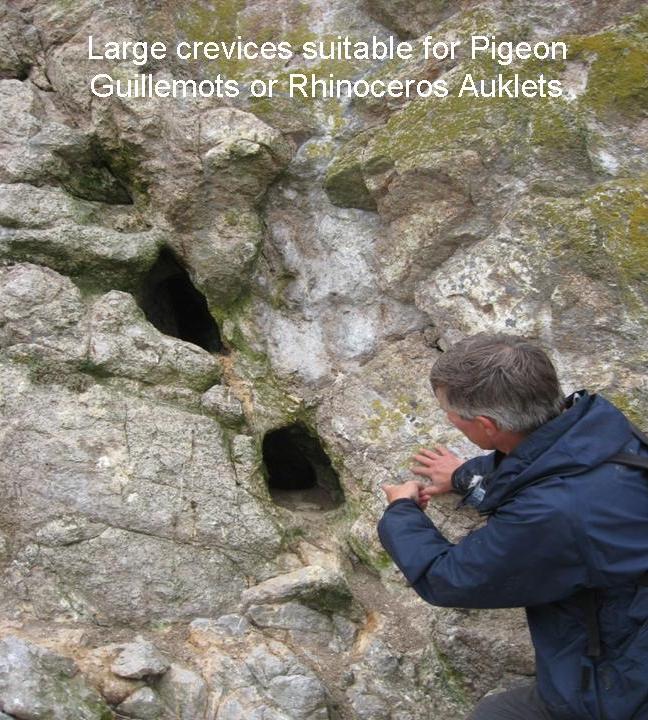
So how do you count birds that you can’t see? Well, one way to do this is to determine the amount of suitable nesting habitat that is available. Once we know that, we can then make corrections for how much of that habitat is actually used based on data from a small sample of followed breeding sites. For auklets, determining available habitat means going around the entire island and counting all burrows and crevices that are available as potential nest sites.


So this September, biologists and volunteers from both PRBO and the USFWS spent a week on the island repeating the 1989 census. It took 5-8 people five full days to complete, and it required scrambling up rocky slopes, crawling around in caves, and scaling the islets to be sure that we counted all the sites. This was exciting for us since we got a rare opportunity to go to some places on the island where we would normally never go.


But, it is also a lot of work, so it is not done very often. In fact, the last time the entire island was counted was in 1989. We assume that much of the habitat (particularly rock crevices) does not change very much from one year to the next but over the course of 20 years, small changes can add up. Old burrows collapse and new ones are excavated. Rockslides and erosion close off crevices and subtle changes to the habitat may make some areas more or less suitable for auklets.


The total number of sites counted was 21,044 including 10,525 medium sites (suitable for Cassin’s Auklets) and 4,681 large sites (suitable for Rhinoceros Auklets). There were also 501 collapsed burrows counted. These sites were likely former breeding sites that were unoccupied this season or had degraded by the time the census was conducted.

Now that we have these numbers, we can generate a new population estimate for Cassin’s and Rhinoceros Auklets and develop a better understanding of how these species are faring at the Farallones.


Sunday, November 08, 2009

Farallon Update - Nov 8

A crew transfer occurred on Oct 25th ushering in a shift from the early and mid season migration to the late season migration. During fall migration, the early migrants include the bulk of the shorebirds, flycatchers, and warblers which pass through mostly during late August and September. During October, these species begin tapering off rapidly while the sparrows and kinglets rapidly increase. This overlap of early and late migrants creates the greatest avian diversity on the island in early October when we hold the Farallonathon. During November, the late period, gulls, sparrows, and thrushes typically dominate.

After the big rain in mid October, northwest winds returned to the island and kept most of the migrants on the mainland. The crew transfer was a bit dicey as the East Landing crane, our normal mode of getting on and off the island, needs drastic repairs. This meant we needed to use North Landing which is less protected from the prevailing northwest swells and wind. Luckily, the swells were not too big on the day of the transfer and everything went smoothly. As we were transporting our food and gear from the landing to the houses, the winds really began ramping upwards. By the following day, the winds were a steady 25 knots gusting to 35. The one good thing about this wind at this time of year is that it occasionally brings us some long-winged goodies. On 27 October, a Snow Bunting was found by two interns conducting a standardized area search of the island.


Another exciting arrival was a Golden-crowned Sparrow that we first captured in 2006. We color-banded it with the combination S/OOY: silver on the left, and orange - orange over yellow on the right. This bird has overwintered on the island every year since then. It's fun to imagine this bird flying out to the tip of Pt Reyes and gazing longingly across the 20 miles of open ocean to its winter home of barren rock.


The following day the winds calmed down a bit more and we were rewarded with an even more unusual bird for the Farallones, a Western Bluebird. This was only the 3rd record for the island; the last two records occurred in the late 1980's. Although Western Bluebirds are regular along the coast, there are nearly 10x as many Mountain Bluebird records.


Not even a week later, a Mountain Bluebird showed up. Note how the rufous on the chest of the Mountain Bluebird is paler than on the Western, and that it has splotches of blue mixed into it. Also note how the pale rufous or buff color extends up into the throat whereas the pure, dark rufous chest of the Western is abruptly cutoff by the dark gray throat - the pattern on the Western is similar to that of the male.


We also spotted a Brown Booby which is becoming more regular to California and may even start breeding here if global warming continues unabated. We have recorded Brown Boobies on the Farallones annually over the last few years. On October 30th, we went out on the zodiac into Fisherman's Bay to photograph this bird while it was perched on Sugarloaf Islet with cormorants and pelicans.


On November 3rd, a Common Raven began croaking on the island. This was only the second fall record since PRBO began collecting data on the Farallones 42 years ago. Historically, these birds occurred on the island until the islanders shot and killed them over 100 years ago. There is still a place on West End called Raven's Cliff where it is believed that they bred. Since their extirpation, records on the island have been widely scattered with a record in April 1972 and then another on 4 October 1995 that rode out on the gusty east winds associated with the big Pt Reyes fire. However, a few years ago, they began arriving more frequently during the winter and spring. Last spring a pair spent a few months on the island and it seemed as though they might start breeding, but it appears they probably did not. Although it would be great to have ravens breeding on the island as they once did, they are also highly intelligent predators that were frequently seen digging Cassin's Auklets out of their burrows. The level of mortality that seabirds (or any species for that matter) can withstand is tied directly to their reproduction. When ocean conditions are good and productivity is high, then a native predator has little impact on a seabird colony, but when ocean conditions are poor, as they have been periodically this decade, the additional mortality can be devastating.


Sometimes the raven did a good deed such as eating the Siberian House Mice that were introduced in the 1800's by Russian sealers.


The only noteworthy insect for the period was a Brown Lacewing that was perched on the lighthouse. It is probably Hemerobius stigma which is considered the most common conifer-inhabiting Brown Lacewing in North America. We are currently uncertain as to whether this species has occurred on the Farallones before.


Thursday, October 22, 2009

Farallon Update - October 21

Well it’s been a quiet week on Southeast Farallon, our home island, out here on the edge of the continental shelf. With September being one of the slowest on record (we banded 90% fewer birds than average), the crew was a bit downtrodden. We had to take joy in the few birds that were showing up. On Oct. 1 a couple of White-tailed Kites made a lap around the lighthouse, and we discovered one of the Burrowing Owls that was banded in 2007. A5 (the number on its blue color band) has spent the past three winters on the island in the same auklet burrow. The next few days were pretty windy, leaving us with fairly low bird diversity, and even lower spirits.

On Oct. 5 we saw a ray of sunshine with a small increase in diversity, including a couple unusual species. Great Blue Heron, Northern Harrier, Black-bellied Plover, and Varied Thrush all made an appearance. The weather forecast was showing some favorable conditions over the next several days, so we decided to start the Farallonathon. This is an annual event each fall in which we attempt to score points by finding as many species as possible, including marine mammals, fish, salamanders, butterflies, dragonflies, as well as birds, over a seven day period. Farallonathon usually starts sometime in late September with one of the bigger waves that usually come that time of year. As this year is unusual, we waited until October to start.

The next day we garnered a few more points from Minke Whale, Monarch, Black Saddlebags, Mew Gull, Short-eared Owl, Barn Swallow, Hermit Warbler, Clay-colored Sparrow, and White-throated Sparrow, among others. We were literally scrounging for points on the 7th as the winds continued to come from the WNW with Mark looking around for Arboreal Salamanders (he found one). A rush of excitement came in the afternoon when Matt flushed a nightjar, which we then chased for an hour up and down Lighthouse Hill. This cryptically colored group of birds can be very difficult to identify when seen. The calls of these birds are the easiest way to identify them, which they usually give at night. After several fleeting glimpses of the bird and discussion of the features each of us had seen, we came to the conclusion that the bird was a Common Poorwill. With less than 10 records for the island, it's a rare bird for us even though they are relatively “common” along the mainland coast.


Light winds and high overcast greeted us on the morning of Oct. 8 and brought more birds to the island, though not the wave we were hoping for. The new species we saw were mainly migrants from the western US, which still give us Farallonathon points, but don't get us nearly as excited as the vagrants from the east. We added Black-vented Shearwater, Wilson's Snipe, Warbling Vireo, Nashville Warbler, Western Tanager, Grasshopper Sparrow, Lazuli Bunting, and Purple Finch. The one eastern bird we did see was a Rose-breasted Grosbeak. Farallonathon points that day also came from Harbor Porpoise, Hoary Bat, Green Darner, Variegated Meadowhawk, and a shark attack off of Saddle Rock (those are worth 5 points). So on day 4 of the Farallonathon, we were at 118 points. Last year we ended with 129 points which was the lowest ever. Could we get eleven more points in three days?

No problem when you get hit with a WAVE DAY! The long awaited wave of migrant birds appeared on Oct. 9. The biologists were feeling as light as the south winds and flying as high as the overcast skies. Birds were flitting about everywhere, from the marine terrace to the lighthouse. A flock of 20+ Hermit Thrushes was seen around the top of Lighthouse Hill early in the morning. Yellow-rumped Warblers (both Audubon's and Myrtle) seemed to be covering every square meter of the island. A flock of about 250 Violet-green Swallows was swirling around the island. After getting past the shear numbers of birds, we started to sift through the flocks and pick out some interesting birds. Early on we saw a Chestnut-collared Longspur that arrived at the lighthouse and then made its way down to the terrace, where we were able to get some great pictures. Then a Red-eyed Vireo was found in Twitville. As for warblers we added Tennessee, Blackburnian, Blackpoll, MacGillivray's, American Redstart, and Ovenbird. Bobolink, Least Flycatcher, and Lawrence's Goldfinch were also good finds. A Solitary Vireo was seen that suggested a Blue-headed. With a nice photo by Kristie, we were able to confirm that ID. The big find that day though was a Gray-cheeked Thrush. There have only been 21 records of this species in California, over half of which are from Southeast Farallon Island. This bird was found in a flock of Hermit Thrushes atop Lighthouse Hill and was accommodating enough to allow everyone to see it.


When it was all totaled up in the journal, we had seen 87 migrant bird species and 1332 individual landbirds. We set island high count records for Violet-green Swallow and Audubon's Warbler and saw 16 species of warbler and 16 species of sparrow. With all the new birds and a couple shark attacks, our Farallonathon total shot up to 158. Though our goal of “not being the worst” was pretty low, we crushed it with two days to spare.

With visions of vagrants in our dreams, we went to bed exhausted and elated. What would tomorrow bring? As we starting birding on the 10th it was obvious that there were fewer birds on the island, but there were different birds around. The numbers of Hermit Thrushes and Yellow-rumped Warblers were reduced by two-thirds, and Golden-crowned Kinglets doubled. We found Chestnut-sided, Magnolia, Black-throated Green, Palm, and Black-and-white Warblers. Long-billed Dowitcher, Band-tailed Pigeon, Hammond's Flycatcher, Northern Mockingbird, and Orchard Oriole were also nice additions. To add to the frantic pace of the day, we were also switching crew members and getting our food shipment. Jim, Matt, and Kristie were leaving, and Pete Warzybok and Andrew Greene were arriving.


About an hour before Jim was supposed to get on the boat and leave, he and Pete came across a bird that Jim didn't recognize. That's code for “it's probably not from North America.” He called out on the radio that he had just seen an “Asian bunting,” which sent us all running. Unfortunately, the two minutes it took for others to get to Jim were just long enough for the bird to disappear. It wasn't seen again. Jim consulted a field guide and identified the bird as a Yellow-breasted Bunting. The only records for this species in North America are from Alaska, and there are only a few. It has never been seen in the lower 48. Super mega, mega rarity. Then Jim left, and the bird was never refound. The other biologists were left in a state of shock. Such an amazing bird, that we didn't get to see, even on this tiny, barren island. What other birds have we missed? No sense in dwelling on it though. Ten Farallonathon points anyway.

Sunday, Oct. 11 was the last day of Farallonathon, and we were determined to squeeze out some more points. Diversity and numbers were down, but new species were still being found. A few of the highlights were Northern Shoveler, Tropical Kingbird, “Siberian” American Pipit, Black-throated Blue Warbler, Lark Bunting, and Yellow-headed Blackbird. Interesting fact for the day was that we saw all three Black-throated warbler species (Blue, Gray, and Green). Our Farallonathon point total was 193, which was the sixth highest total since it started in 1992. Hooray for wave days!


The following week saw a big change in the weather, as we were slammed by a storm on the 13th. We'll try to post some pictures of that soon. As would be expected, the numbers and diversity of birds are down. We had a flock of blackbirds that included Brewer's, Red-winged, Yellow-headed, and Tricolored Blackbirds with a few Brown-headed Cowbirds. That's a nice icterid flock. A Virginia Rail was found (and banded) on Oct. 12, followed by a Sora (also banded) on Oct. 16.


That's the news from Southeast Farallon Island, where all the biologists are strong, all the Elephant Seals are good looking, and all the vagrant birds are above average.

Saturday, October 03, 2009

It's October....Where Are The Birds??

It has been about two weeks since our last update from the Farallones, and although a few birds have come and gone, we are still awaiting (hotly anticipating) a Fall fallout. Strong Northwesterly winds and dense fog have conspired to keep birds away from our Island, but we remain hopeful that things will pick up as September ends and October begins.

In the two weeks since our last update, a few birds have managed to find the Island, despite the strong wind and dense fog, but in far lower numbers than are expected from this time of year. For example, while we expect to see greater than 100 Yellow Warblers in a given Fall season, we have only recorded ten individual Yellow Warblers so far in the 2009 Fall Season! The same is true for most of our other typical Fall migrants: 'Western' Flycatchers, Willow Flycatchers, Warbling Vireos, Black-headed Grosbeaks, Orange-crowned Warblers, Townsend's Warblers, Wilson's Warblers and Common Yellowthroats are all way, way down from their usually abundant numbers. It's still too early to be sure if later Fall arrivals, species like Hermit Thrush, Red-breasted Nuthatch, Ruby-crowned Kinglet, and Fox, Lincoln's, White-crowned , Golden-crowned and Savannah Sparrows will make a decent showing, but we still await our first Hermit Thrush, Red-breasted Nuthatch and Lincoln's Sparrow of the Fall.


As is usual for the Fall Season, a few rare vagrants have shown up this year. Some, such as Blackpoll Warbler, Tennessee Warbler and Clay-colored Sparrow show up every fall, generally in small numbers. This Fall has also been slow for these "usual vagrants", but representatives of many of them have made an appearance. Every year we also expect a few rarer birds to show up. This year some of the highlights have included a Connecticut Warbler (the first on the Island since five appeared in 2006) on September 18th , a Brown Booby observed on seawatch on the 19th, a dark-lored White-crowned Sparrow, of either the mountain race oriantha or the eastern subspecies leucophrys was observed, and on September 27th, a minor day of arrivals, a Prairie Warbler (the first since 2005), a Bay-breasted Warbler, and a Painted Bunting, one of fewer than 15 records for the Island, were all discovered. The Painted Bunting was a very disheveled-looking individual, that when caught and banded, was aged as a second-year bird. Painted Buntings are one of the very few species of North American birds that can be aged as second-year in the fall.


However, even such exciting birds as the Connecticut Warbler and Brown Booby pale in comparison to the star of the Fall (so far!), a Brown Shrike, discovered by interns Matt Brady and Ryan Terrill on September 24th. It was eventually captured and banded. This species, a very rare stray to North America from Asia, has only occurred two times before in California, and fewer than a dozen times for North America as a whole - mostly from western Alaska, but also one record from Nova Scotia. The two prior records from California were both from the mid 1980s: the first record was of a juvenile bird, caught and banded right here on Southeast Farallon Island in late September, 1984, almost exactly 25 years ago; the second record was of a juvenile bird discovered by Oregonian birders visiting Pt Reyes in late October, 1986. That bird spent the winter at Olema Marsh, near the town of Pt Reyes Station, and was last seen in March, 1987. Unlike both of those older records, this year's bird was determined to be an adult female. Although juvenile Brown Shrikes can be confused with juvenile Northern Shrikes, adults are unmistakable. This one, with a bright rufous tail and cap, and slightly darker back, was deemed to be of the nominate subspecies, which is what all other records from North America have been attributed to.


In addition to the birds, we have had some interesting insects as well. It seemed that even in the dense fog, a few Odonates and Butterflies were able to find the Island, and on most days a few were found and identified. Although both Painted and West Coast Ladies were seen most days, the big insect highlight of the fall occurred on September 22nd, when two Western Pygmy Blue butterflies were photographed. These were the first identified on SEFI since 1998! We have also had our first Monarch of the year, as well as good numbers of Familiar Bluets, and a few Variegated Meadowhawks and Black Saddlebags. Only one Green Darner has been seen, which is normally one of the more common Dragonflies for the Island


Continuing their strong showing from the Summer, Whales have maintained a constant presence around the Island. While Humpbacks have been the most abundant species, with up to 25 individuals on some days, a few Blues have been around, too. Our resident Gray, whom we have nicknamed Dorian, has been seen just about every day. Sometimes it will come so close to the Island that we can almost imagine reaching out and touching it!


On September 19th, Jordan Casey, our Seabird Season holdover, departed the Island. After she left the Island, she visited the Monterey Bay Aquarium, where she finally got to see a Great White Shark, then headed back to the East Coast. She'll be spending the winter doing seabird work on another set of rocky islands: the Galapagos! Cassin's Auklets are cool, but can they compare with Nazca Boobies? Jordan will have to keep us posted! We were joined by Mark Dettling and Kristie Nelson, two SEFI Fall Season veterans, on September 26th. With six birders on the Island, what astounding rarities will be found?? Stay tuned to find out!

Tuesday, September 15, 2009

Farallon Bird and Insect Update_15-Sept-09

The weather this fall has not cooperated much to bring migrants to Southeast Farallon Island. Typically in the fall, nocturnal migrants land on the island when there is a light east to southeast wind that pushes the birds offshore. If there is cloud cover over the coast (usually a marine layer or fog), then the birds do not realize that they are over the ocean until they descend through the clouds in the morning to find food. If the ceiling is high enough so that the visibility is 5-15 miles (Pt. Reyes is the nearest shoreline at 20 miles), then the birds can see the island, but not the coast. If the ceiling is too high, then birds with sufficient energy will fly back to the coast. If the ceiling is too low, then the birds cannot find the island. The weather this fall has alternated between dense fog and gusting northwest wind. Neither allows many birds to find the island.

Although many migrant songbirds probably flew right past the island without even knowing we exist, a few hours of good weather on 9 Sept brought some nice surprises such as the Canada Warbler that we eventually caught in the Heligoland mistnet. Other interesting birds seen this day were a pair of Purple Martins flying over the lighthouse, a Baltimore Oriole seen in a cave during an area search, and a Clay-colored Sparrow in Twitville.


The fog briefly dissipated today and brought a few more birds like this juvenile Orchard Oriole.


Thankfully, some birds that arrived earlier lingered in the bad weather while others that remained may decide to overwinter. While the Farallones has had many species of shorebirds migrate to the islands, only a few species of shorebirds overwinter. The ones that do overwinter usually are ones that can utilize the extensive rocky shoreline such as Whimbrel and Wandering Tattler. During high tide, PRBO biologists conduct a shorebird survey that attempts to locate high tide roosts where large numbers of these "rocky" shorebirds congregate. Other species such as Long-billed Dowitcher turn up at the few small ponds along the water's edge or on the Marine Terrace where there is soil for foraging.


One group of birds whose numbers do not seem to be too adversely affected by the poor weather are migrant gulls. During the early part of the fall, large numbers of California Gulls migrate away from their inland breeding locations to overwinter along the Pacific Coastline or out on the open ocean. Hundreds of these gulls roost on the island each night. We have suspected that a large number of these birds originate from the relatively close Mono Lake or the burgeoning colony in South San Francisco Bay. On 8 Sept, we photographed a 2nd-year California Gull roosting on the Marine Terrace that was wearing a band. Three of the digits on the band (575) were legible. I contacted Kristie Nelson, a PRBO biologist who bands California Gulls at Mono Lake, and asked her whether it could be one of her bands. She said that they finished banding in 2008 with band number 945-57575. So it likely that the band I read was one of the 75 birds that had 945-575XX.


Frequently when we have even semi-decent weather, we see a few migrant insects such as butterflies and dragonflies. These two "ladies" are superficially similar, but if you look closely at the outer part of a forewing you'll notice that Painted Lady has two white spots along the leading edge while West Coast Lady only has one white spot. Over the last few years, Painted Ladies have been far more abundant than West Coast Lady. Although we're seeing a typical number of Painteds (n = 9) over the past 3 weeks, we've had >6 times as many West Coast Ladies as Painteds. Clearly this is a good year for West Coast Ladies!