Wednesday, August 25, 2010

Delving into the Gull JuJu Archives…


Here on the Island, we’ve noticed that the Western Gulls have a particularly unique and fascinating taste for edible-looking things and nest decorations. When walking through gull territories, one will often notice a collection of rib bones, regurgitated bits of plastic trash and other such goodies, brought back lovingly from the mainland, some 30 miles away.

Over the years, we’ve collected our favorite findings and stowed them away into the Gull JuJu Archives. Here is a peek into the various juju tastes….


By far, the most common juju items found are decrepit plastic figures. A variety of army men, Winnie-the-Poohs, Lego characters, rubber duckies and many more have found their way into gull’s bills and stomachs. Two of our particular favorites are the Beanie Baby fish with bulging eyes (top left) and the slightly terrifying plastic baby doll leg.


Gulls seem to display an affinity for small round things as well, in addition to particularly colorful items such as cocktail picks. The distances that gull juju travel also differ. On the left are pinniped tags from Antarctica, along with bits of sealion fur, and a mermaid pouch likely from a nearby beach.
 
 
Remember thinking that cutting up your credit cards and disposing of them in the trash will make them safely disappear forever? Wrong. Pocket contents are also a gull favorite, be it your keys, rolling papers or iPod slips. We find it all here.
 

Unfortunately, the odd fishing hooks, lures and squid lights are also found. Although the birds who brought them onto the island avoided the potentially fatal repercussions of these objects, many birds often don’t. Due to poor by-catch monitoring, little is known about how many seabirds are entangled in fishing nets and hooks every year, and what the impacts are on their populations. However, while these lucky birds evaded death, many with similar tastes do not.


And last, but certainly not least, the oddball egg is a rare find. Is this proof of a mysterious 14th breeding species, or merely just another bit of Western Gull JuJu?

Monday, August 02, 2010

Whale Town

Last week the clouds lifted for a few days allowing us a glimpse of life off the island. Not only could we see civilization on the mainland, but other marine life was suddenly visible. The most prominant visitors we had were the Humpback Whales.
Two Humpbacks near the Farallones

These whales are well known for their acrobatic aerial displays (breaching) where they jump, and often spin, out of the water. Although the function of this behavior is not known, it is thought to possibly be involved in communication and/or ectoparisite removal. In any case, it's always incredible to watch. From the island, we have seen numerous whales breaching, tail slapping and flipper slapping. Our high count of Humpbacks last week was 91 in a single day! The number of Humpbacks observed from the island varies significantly from year to year but in the last two years we have seen very high numbers here in the late summer and fall. The high count last year was 107 on Oct 8, the second most seen in a single day (highest count was 125 on November 8 1998). It is definitely unusual to see numbers this high already in August so we may still break the record.

Humpback Whale showing how it got its name

 
Humpbacks weren't the only cetacean species spotted from the island last week. We also saw Risso's dolphins, Northern Right Whale Dolphins, Gray Whales and Blue Whales.
Risso's Dolphins near the Farallones
Blue Whales are the largest animal to have ever lived on this earth and were once extensively harvested. PRBO began recording recording cetacean sightings from the Farallones in 1973, only a few years after whales became protected in the US. The first Blue Whale was not seen from the island until 1978 and our counts since then have documented an increasing number of whales present in this area. Our high count last week was 7 in one day!

Blue Whale back. It's hard to get a feel for how big there are from this.

Although its always a treat to see whales, seeing them in these numbers is especially thrilling. Humpbacks were hunted extensively in the early part of last century, down to perhaps as few as 1400 animals in the North Pacific. Once whales became protected, Humpbacks and other species began to recover. Currently, the North Pacific population is estimated to be closer to 20,000 with around 1200 of those in the California/Oregon/Washington Stock (http://www.nmfs.noaa.gov/pr/species/mammals/cetaceans/humpbackwhale.htm). Counts recorded from the Farallones have helped to document the increase in the Humpback population as well as other species of cetaceans.


Cassin's Auklet chicks are fed krill by their parents
The presence of this many whales is yet another indication that there is a lot of krill around. Humpbacks and Blue Whales are baleen whales which means they filter large amounts of water to gather up their small prey. Humpbacks tend to eat a variety of small prey including krill and small fish, but Blue Whales feed almost exclusively on krill. They are the Cassin's Auklet of whales. The only difference is they are about 3000 times the size of a Cassin's Auklet! The presence of Blue whales, and the fact that Cassin's Auklets are producing lots of fat, healthy chicks, indicates the high abundance of krill in the vicinity of the island.


Happy as the whale recovery stories are, significant threats to whales remain. We witnessed one of the most serious last week when we found a dead Humpback floating near the island that appeared to have been struck by a ship. There were numerous deep lacerations on the whales left side. As this incident demonstrates, ship strikes are still all too common and remain a serious concern and cause of mortality to many whales.

Dead humpback spotted near the islands
Lacerations on the left side of the whale likely from a ship propeller

Saturday, July 24, 2010

Baby Chicks = Diet Watch/Collection

There is nothing more exciting than cute little baby chicks! Right?!? Right!!!!


Three species that have already fledged some chicks are the Common Murre, the Cassin's Auklet, and the Pigeon Guillemot.  The Rhinocerous Auklets haven't fledged their chicks quite yet, but are getting close!

adult Common Murre in breeding (summer) plumage

adult Pigeon Guillemots in breeding (summer) plumage
When chicks first hatch, they're covered in down, which is really really soft and makes them look like little puffballs of happiness!
The Pigeon Guillemot downy-feathered chick is jet black and weighs about 35 grams when we first weigh them.  They also have a lot of attitude, so like to scream a lot. Finger-wagging them doesnt improve their behavior; usually they'll just bite.


The Cassin's Auklet downy-feathered chicks is grayer than the Pigeon Guillemot, and their sites are monitored in the boxes with removable lids.


The Common Murre downy-feathered chick looks like it has that sweet '90's frosted hairdo that only the coolest guys in town could pull off.


The Rhinocerous Auklet chicks are really puffy and also black.


Soon after the chicks hatch, we try to figure out what the adults are bringing back to feed their young. This helps us to understand what is going on with fish populations in the area, and how they affect breeding seabirds.How do we do this? In different ways for each species of course!
For the Pigeon Guillemots, we sit at Garbage Gulch and Lighthouse Hill (alternately), and watch the whole fish that the adults bring back for their young, and record 1) the site they went to, 2) the type of fish they brought in, 3) the size of the fish (approx), and 4) the adult's band combination. Here is Russ, Annie, Jessie, and Michelle in the middle of a shift change at Garbage Gulch.


We monitor Common Murre diet from the Murre Blind above the Upper Shubrick Point study plot.


This is an adult murre bringing back a rockfish, the fish of choice of 2010!


Netting for Rhinocerous Auklets at dusk is a two-fold effort. First of all, it is a mark-recapture, and secondly, it allows us to see what fish the adults are bringing back for their chicks since they drop the fish when they are captured in the mistnet. We collect their fish and process them after we close the net.


Cassin's Auklet diet is a little different, since it doesn't bring back whole fish like the other three species do. In fact, they don't feed on fish at all! They eat krill! They regurge it back up for their young when they return to their colony at night, and we collect 100 samples of this regurge every year for lab analysis.


Cassin's Auklet diet is especially important because they pretty much only eat two species of krill (= their diet is extremely limited), which makes them a good indicator species. It's reasonable to suggest some ideas about the productivity of the ocean based on the productivity of the Cassin's Auklet.

We continue diet watches and diet collections until the chicks fledge and can forage for themselves.

Most of the murre chicks have fledged or are about to fledge.


The transformation that chicks go through is astounding. After just 25 days, the Pigeon Guillemots have grown from 35 grams to 500 grams! Monitoring the growth of chicks is another indicator of how well their parents are provisioning them. These feisty, poopy suckers sure love to eat.


This is a fully-feathered Pigeon Guillemot chick.  Look at its bulge of fat! It must be getting fed a lot!


We've just started banding a few of the Rhinocerous Auklet chicks, as they're approaching their mostly to fully feathered stages.

Rhinocerous Auklet chick, partly to mostly feathered but still has quite a bit of down


The Cassins Auklet seem to be having a wildly productive year - the majority of them have fledged their first brood of chicks and are currently sitting on their second broods!


This is a fully feathered CAAU chick the day before it fledged


Birds obviously undergo a wild transformation in the few weeks that it takes for their parents to raise them to a point where they can either fly or take them to sea, and it takes an enormous amount of energy and risk on both parents' part to feed their chicks to their nesting site, yet they spend this energy and take these risks to raise their offspring to fledge. Let's hear it for mama and papa birds!

Thursday, June 17, 2010

Island Dreams

The Farallones is a very intense place. When you first arrive out here, you are surrounded by sights, sounds, and some choice smells that most people have never experienced. After a hard day of fieldwork, people tend to have some pretty elaborate dreams, most of them about the island in some fashion. For the past 20 years, we have been recording these dreams in our nightly Farallon Journal.

While the stuff of these dreams is ample material for a whole PhD on the psychology of field biologists, I have found during my 10 seasons out here that most dreams fall into one of two major categories – Invasion Dreams and Anxiety Dreams.

The Farallon National Wildlife Refuge is closed to public access. This is done to protect the sensitive wildlife populations that call this special place home. While trespassing violations are extremely rare, the threat of them has made for many exciting “Invasion Dreams” had by biologists over the decades. These dreams are often hilarious; a quick scan of the journal reveals dreams of island attack by aliens or a band of pirates led by Uma Thurman. I specialize in these sorts of dreams, and tend to have a few choice ones every year. Here is a sampling from my own personal invasion dreams- the Russ Bradley collection

- I had to prevent tourists from feeding popcorn to Common Murres
- Everyone I ever knew showed up on the island, disturbing wildlife
- A 2 story house full of people washed up on the beach
- A Super Villain joined our volunteer Farallon Patrol and tried to take over the island
- Hundreds of people showed up at the “Farallon Cruise Ship Terminal”
- A Harrier Jet landed on West End Island - a completely closed Wilderness Area - and dropped off a huge group of rock climbers
- I found 2 palm trees and had to cut them down and remove them (a plant invasion dream...)
- There were small children and dogs running everywhere on the island, crushing seabird burrows and causing mayhem. I have this one all the time.

While these invasion dreams may seem absolutely ridiculous, they do remind us of how special and sensitive the Farallon Islands are.


Now for the anxiety dreams. These often involve interns thinking they have conducted a study wrong, and will soon face the wrath of us supervising biologists. One intern dreamt he had forgotten to check half of the Ashy Storm Petrel breeding sites all season. Another walked out to her gull plot to find it full of chicks, and she had missed the laying and hatching of eggs entirely. Another dreamt she accidentally left the island early on the wrong boat, and that I was furious with her for missing out on cormorant banding. Here is a scan of a dream sent to us by one of our former interns, a year after she had left the island. She talks about improper banding of Pigeon Guillemots, and how potential interns were forced to swim in shark infested waters to prove their worthiness to work on the island.

Again, just a tad extreme, but there is a moral here. Despite the sometimes mad world of dreams, everyone takes their work out here very seriously, and want to make sure they do their best to ensure good science and conservation are being done.

Wednesday, June 16, 2010

The darker side...

Common Murre with a fresh egg
Not too long ago, it felt like Easter. Eggs were popping up all over the place - Western Gulls, Pigeon Guillemots, Ashy Storm Petrels, Common Murres, Brandt's Cormorants, Cassin's Auklets, and Rhinoceros Auklets - just about all the birds on the island. It's so contagious that even the Farallon Weed has started resprouting. While most of these birds are still laying eggs, some have started to hatch.


Cassin's Auklet chick
Cassin's Auklets were the first with their little gray fuzz balls. As of the first of this month, we got our first Pigeon Guillemot chick, a little black fuzz ball. Others, Rhinoceros Auklets and Common Murres, have started hatching within the last week. Even to hardened biologists, hatchlings are very cute and always bring out a collective "Aww." They are small soft balls of fluff that fit in your hand and are so sweet because they don't know how to defend themselves yet.


But, no matter how adorable, one of the recent additions to our hatchlings also brings a sense of dread.
Newly hatched Western Gull Chicks
How can these innocent little creatures inspire such feelings? Let me explain.

When I arrived in April, I was a clean, relatively innocent intern arriving to a rather quiet island. Birds were calling, but all were nice. They weren't breeding yet, so they didn't have anything to defend. If they happened to be in your path, they just moved out of the way as you approached. Once "Easter" arrived, the noise level of the island started to increase exponentially (to a volume and pitch that I am certain will contribute to future hearing loss) and birds no longer moved out of your way. Instead, they attack you for coming into their territory.
Western Gull in attack mode

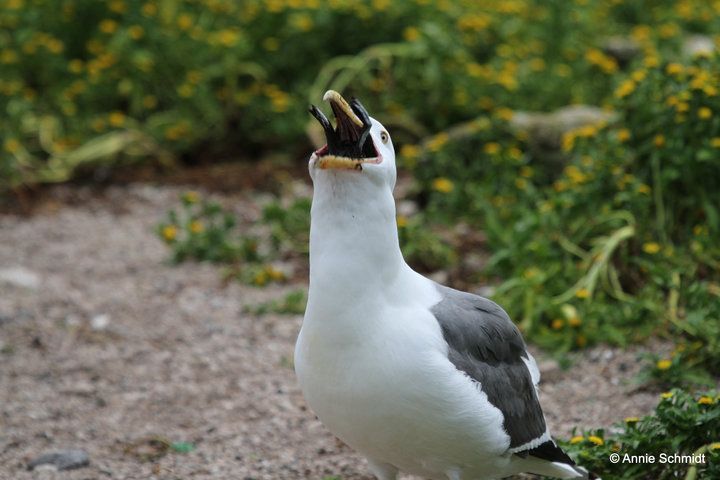
Western gulls are by far the most aggressive defenders of their nests. They have a very distinctive call that they scream at you as you approach their nest. If that isn’t enough to make you go away, they try to nip at you (and sometimes succeed), or they swoop back and forth over you in a U-shape, making a terrorizing call mere seconds before depositing a generous helping of stinky guano on your person. If none of these attempts have chased you to leave their territory, they will resort to the full aerial assault. They will fly down at your face or head, attempting to hit you with their feet or their bill. Often adding more guano to the arsenal.  I have been hit in the head by a gull’s bill and whacked on the shoulder by their feet and it hurts a lot more than you would expect. It's amazing the force and power that those Western Gulls have. And this just gets worse as time goes on. Imagine getting hit repeatedly in the head with no respite, wearing clothes without an inch of clean space and that is what life here on the island is soon to become.

Field jacket afert checking gull nests
My patchwork duct tape pants and slowly degrading jacket (already severely worn from climbing, sliding, shimmying around on the granite slopes) are being tortured further by getting covered in various colors, and smells, of Western Gull excretions. While my head is gradually being bashed in by these callous, cold-hearted birds. I am no longer the innocent intern. No longer do I go outside without something covering my head. I know which birds require the extra adornment of a hard hat. Earplugs are permanently stored in my pockets for easy use.


So it is important to remember that while chicks are cute, they bring vicious, merciless adults with them, which they will later become if they fledge. Inside those delightful downy balls beats a cold, cold heart.


Tuesday, May 25, 2010

Walk this Way – for Storm Petrel Wings

Every five days on Southeast Farallon, an overworked and windblown (but well fed) intern has to undertake the burden of what is euphemistically named the “Ashy Wing Walk.” This falsely conjures up images of a casual stroll while marveling at the flutter of wings as storm petrels dance like fairies around your head. If only. This walk is a survey for predated storm petrels – eaten by overwintering Burrowing Owls or nesting Western Gulls who take their territories very seriously. Usually all that is left are the bird’s wings. This task may seem a bit morbid, but it’s crucial to our studies of the Ashy Storm Petrel. This is a bird the size of a swallow that’s more like a miniature albatross. They are endemic to the California Current, can live well over 35 years and sometimes take until December to finish fledging their chicks. This species of Special Concern in California has shown dramatic population decreases over the past several decades, especially here at the Farallones – their largest colony in the world.

I call it the “Walk of Death.” I think of myself as the metaphorical cop walking her beat. It’s the same route every five days. I pace and rhythmically tap my mechanical pencil against my thigh and look for anything suspicious. My beat takes me across the Rubble Pile where Pigeon Guillemots breed, along the Helicopter Pad, up Lighthouse Hill and finally concludes at the old Egger’s House, the remains of the storage cache for murre eggs on their way to San Francisco during the Gold Rush. For the most part, it remains uneventful except for finding one or two slimy regurgitated wings, courtesy of a peckish gull. Good for the petrels, yawns for the intern.


Once in that rare while, my discoveries are a little more sinister. The first thing that clues me in, is an odor. No, it is not the smell of rotting flesh that pervades - I couldn’t say the same for the dead elephant seals, but a musty overpowering scent commonly secreted by tubenoses (Seabirds of the order Procellariidae - which all have large external nostrils). On high alert now, I look around nearby crevices until I find its source. Soon enough, when I peer into a gap in stone wall, I encounter what at first appears to be a pillow fight gone very very wrong. Further examination reveals a grim scene.


Inadvertently, a chill run downs my spine, it’s the Farallon version of an episode of CSI . After the collective gasps of horror, comes the gruesome task of reaching in among the carnage and hand picking out the individual wings. This allows us obtain an accurate estimate of the number of storm petrels killed. The largest collection we’ve found this year is twenty wings in one roost.
The next question you ask, who is the culprit? A Peregrine Falcon? A Raven? An extra hungry gull that isn’t satiated by a diet of anything and everything? No, my fellow sleuths, the perpetrator lies hidden within this photo:


While they rate very high on the cuteness quotient, overwintering Burrowing Owls are major predators of storm petrels during the spring, after abundant house mice have their seasonal population crash. Western Gulls also take many storm petrels throughout a breeding season. Predation is a part of life for all the Farallon seabirds, and studies like the wing walk are key to our understanding of these important populations. Death is just a part of everyday experience out here.


Wednesday, May 12, 2010

Another new breeding species on the Farallones!

California Gull on the nest
Over the last few seasons we have seen an influx of new breeding species on the island (or at least a return of some species that had not bred here in a very long time). First were California Gulls, which suddenly started breeding on SEFI during 2008. This was not only a first for the island, but also a first record of this species breeding in the marine environment.

Then last year Peregrines nested for the first time in 100 years. Earlier this season we saw evidence that Common Ravens were nest building on Arch Rock. They last bred here in 1911. Though we haven't been able to get around to where we think the nest is, we are fairly certain that they are at least attempting to breed (we will post an update on that once we confirm the nest).

On May 7th, we found a new species that was somewhat unexpected. It is a species that has never before bred on the Farallones and would not typically be thought of as a species you find on an offshore island.

Now, before we tell you what it is (and no fair scrolling down!) we thought we would tell you about a little experiment first. You see, the biologists that work at PRBO are a pretty savvy bunch and certainly have a great wealth of knowledge about avian breeding biology. So we decided that we would let them weigh in on what species they thought could conceivably start breeding on the Farallones. This would not only be a fun test of their ability to predict species distributions (well fun for a geeky bunch of biologists like us anyway), but would also help us to generate a list of other species which are likely to breed on the island at some point in the future. Just to make it a little more interesting, the first person to name the new species wins a prize.

We received many entries from biologists across PRBO and had many good suggestions, often accompanied by detailed accounts of why that species might be found on the Farallones. From these we have generated this list of the top 10 theoretical breeders (listed in order of most votes received).

There were also two species – Rock Wren and European Starling – mentioned by several folks as likely breeders. These species have bred on the island in the past, so we will consider them the most likely to do so again.

These are all good guesses and there are a variety of reasons why each of these species might be expected to breed on SEFI. But none of them were correct. In fact only one person guessed the correct answer.


The Canada Goose!
Canada Goose sitting on its nest on the Marine Terrace

Canada Goose often pass over the island in the spring and fall as part of their annual migration and it is not unusual to see a pair hang around for a short while in the spring. But, they generally prefer marshes and open grasslands (or lawns at your local golf course) to rocky offshore islands. However, these geese have been spreading rapidly along the coast in the past decade and have been found breeding at several locations where they would not normally be expected. Although there are still abundant grasses this time of the year, they will dry out and disappear by mid-June, leaving the geese without a reliable food source when their chicks hatch.

Then again, it is likely that their chicks will just be gobbled up by the ravenous Western Gulls – as has happened for every California Gull chick hatched thus far on the island. But Canada Geese are big and can be very aggressive when defending their young. So maybe they will have a chance. We will keep you posted on their success as well as the next new species to breed on the Farallones. Will it be one of the species on the list above or will it be something totally unexpected? On the Farallones, anything is possible.


Oh, yeah. The winner? Tom Gardali – associate director of the Terrestrial Ecology Division. Congratulations Tom!