Sunday, May 21, 2006

Following Nesting Brandt's Cormorants


Like many of the seabird species, Brandt's Cormorants are well into their nesting season. These large foot propelled diving birds feed on a variety of fishes and nest in dense colonies in some of the island's flat areas. Breeding populations are up this year in many areas, and most birds are currently incubating eggs. Male cormorants gather nesting material from native vegetation and then display for females, showing off their bright blue gular pouches.
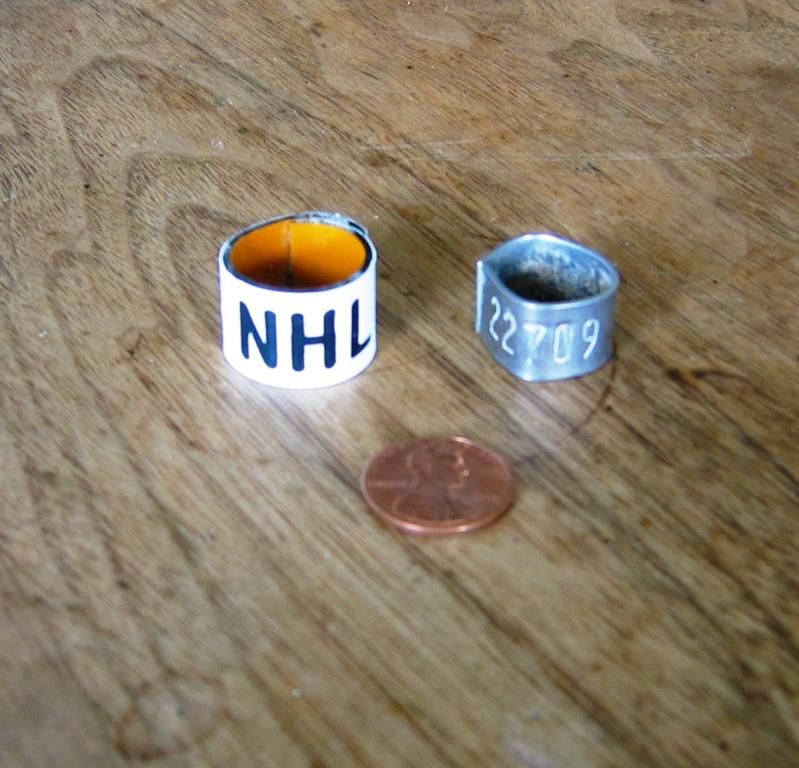

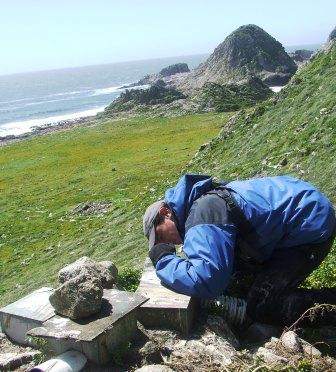
Our Brandt's Cormorant studies, like much of our seabird research, involve following how individuals survive and reproduce throughout their lives. We do this by banding birds as chicks with metal and color bands like the ones shown here. The numbers and letters provide a "name tag" we can use to follow the same cormorants every year throughout their lives, which can last over 20 years. To do this we resight bands and birds at their nest sites through a telescope from an observation blind above our main study colony. This can be challenging, imagine reading the numbers on the metal band above on a bird 200 feet away through a telescope. It is a task that requires a lot of patience!
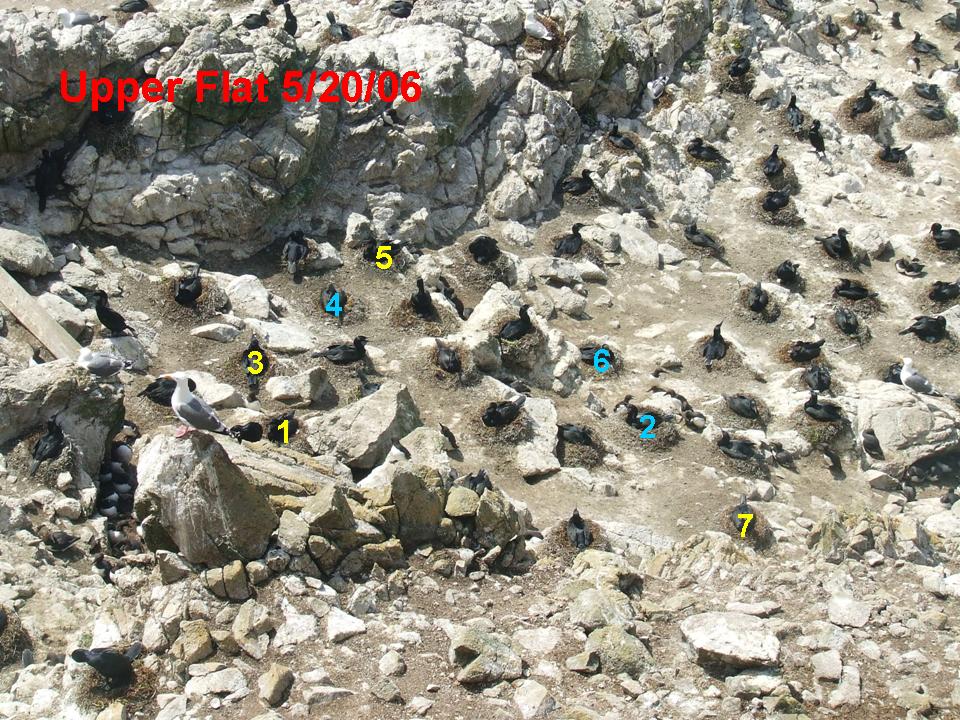

Currently, we are following over 100 nests of breeding banded birds in our main study colony. Here is a map of one of the areas. The numbers mark nest sites of followed birds. While we will obtain breeding success information on all nests, the blue numbers mark nests we are sure to check at least every 5 days, to gain valuable information on the timing of egg laying and chick hatching. This is long tedious work, that requires many hours spent watching cormorants on their nests, often waiting long periods to see into their nests and confirm their bands. However, the rewards are great, as the information gathered from individual birds allows us to assess the variation in survival and reproduction between birds of known age and experience. This additional layer of data helps to improve our ability to examine how the breeding activities of seabirds can reflect changes in the ocean environment. Its definitely something to think about as you're sitting in a cold blind on a hilltop, waiting for your cormorants to stand up....

Tuesday, April 25, 2006

Tristram's Storm-petrel visits the Farallones!

*Update: Note that this original report refers to this bird as a Black Storm-Petrel, it was eventually confirmed as a Tristram's Storm-Petrel, a Hawaii/central pacific species which was the 1st North American Record!*
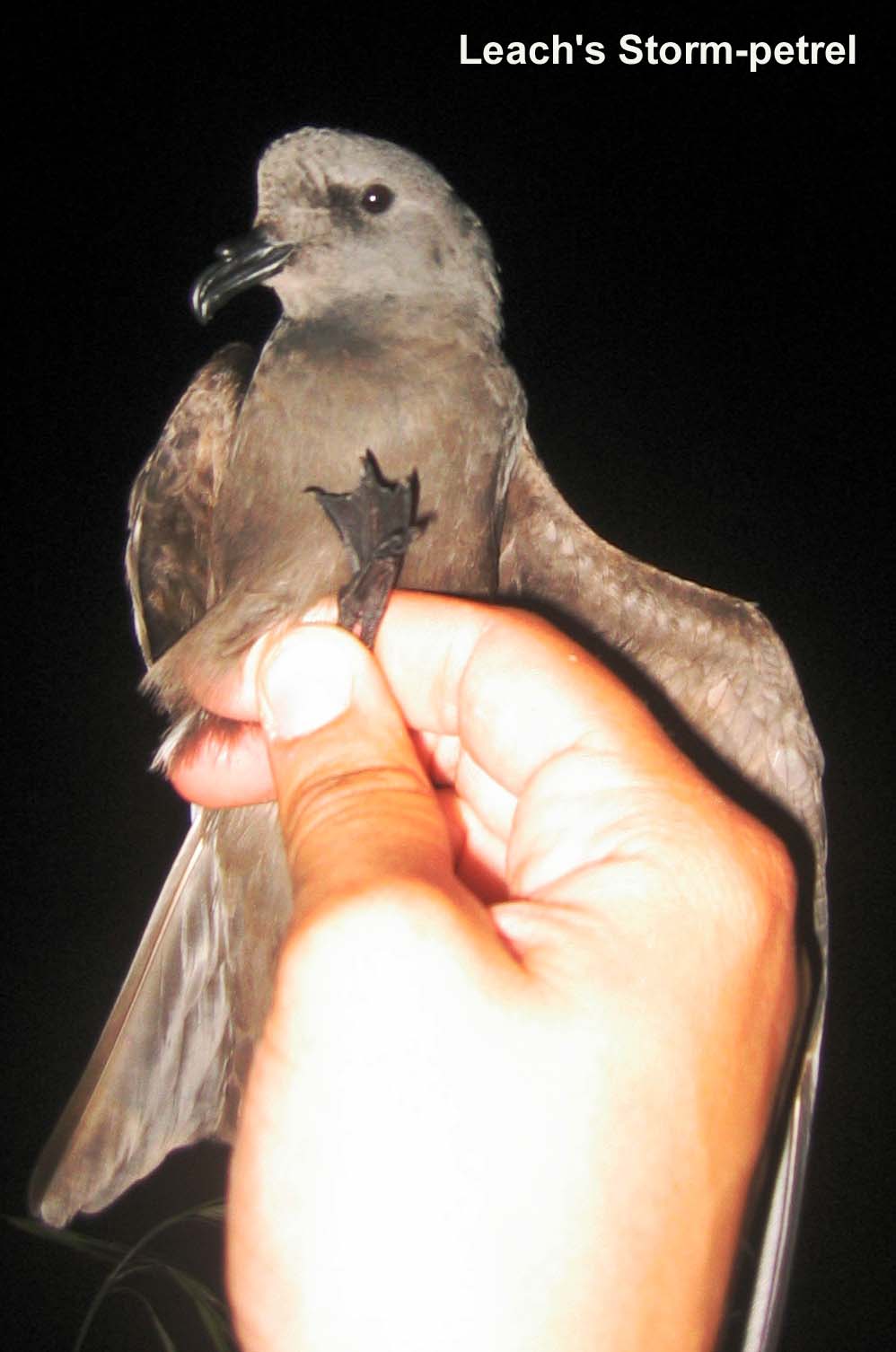
Storm-petrels are diminutive little seabirds usually only glimpsed for a moment as they flutter over the surface of the ocean. They are part of an order of birds know as Procellarids, more commonly called the "tubenoses" for the presence of a specialized structure that encases the nasal openings on the top of the bill. They are long lived, with records of individuals in excess of 35 years old, lay a single egg each season which they will rear over the course of several months, and are the most pelagic of all seabirds which breed on the Farallones. Storm-petrels travel great distances from their breeding colonies in search of food, sometimes up to 250 km in a single foraging trip, and spend most of their lives in the open ocean. They are primarily nocturnal at the colony, returning only after full dark in order to take their turn incubating the egg or to feed waiting chicks. Approximately half of the world's population of Ashy Storm-petrel breeds at the Farallones along with a small population of Leach's Storm-petrel.

Twice a month, we go out in the middle of the night to mist net these incredible birds as they return to the colony. This work is part of a long-term mark/recapture study to assess population status and trends and to estimate survival. But on April 22, we had an unexpected visitor to our colony, the Black Storm-petrel.
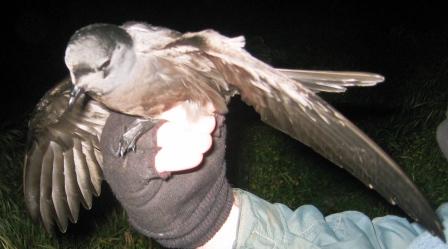
Black Storm-petrels are the largest of the storm-petrel species commonly seen along the west coast of North America, and are considerably larger than both Ashy and Leach's, as can be seen in the photo below. The bird on the left is an Ashy while the bird on the right is the Black. It also has a much stockier build, longer wings, larger bill, and stronger bite than the Ashy (as the person in this photo discovered just prior to releasing the bird). Black Storm-petrels breed on offshore islands from Baja California, Mexico north to the Channel Islands and in the Gulf of California, but the majority of the world's population breeds on San Benito Island in southern Mexico. They are typically seen off the coast of southern California, but may also be seen in Monterey Bay and the Gulf of the Farallones during the winter. However, it is rare for this species to be observed this far north during the breeding season and is the first spring record for the Farallones as well as the only one ever caught on the island. The occurrence of this Black Storm-petrel on the Farallones, in addition to being exciting for those of us living here, illustrates the impressive foraging range of these birds and the unpredictable nature of life on this island.

Seabird breeding begins on the Farallones

The seabird breeding season has officially begun with the first eggs laid by Cassin’s Auklets on April 11th. This is the true start of the seabird research season. We will now begin monitoring the success of seabirds by determining the number of birds that breed, the number of eggs that are laid, the number that hatch, and the number of chicks which fledge. Cassin’s Auklets are one of the many species that breed on the island and we have studied their populations and reproductive success here since 1972. They are small seabirds (about the size of a robin) that spend most of their lives at sea, feed on zooplankton and nest underground in burrows, rocky crevices, or in nest boxes.

Biologists from PRBO check nest boxes every five days beginning on March 2nd each year. We monitor these boxes throughout the season looking for birds with their eggs and eventually chicks. When we find a bird in a box, we capture the adults, determine their band number or place a band on them, and take a variety of measurements (wing length, weight, bill size) which help us to determine the sex of the bird and give us an index of their overall health. Banding birds allows us to keep track of individuals through time and to examine survival, fidelity to nest locations and mates, and the overall reproductive success of individual birds throughout their lives. These boxes create additional nesting habitat and allow us to collect valuable breeding information with a minimum of disturbance to the birds.

Cassin’s Auklets are usually the first birds to breed on the island and the timing of their reproduction can often indicate if it will be a productive year for seabirds at the Farallones. Auklets tend to initiate breeding earlier when the ocean is cold and conditions are favorable for the production of their favorite food, krill. In warmer years, there is less food available and they will delay breeding until conditions improve. So, this species serves as an "early warning" system for overall seabird productivity. For example, last year the ocean was warm, food was scarce and the first eggs were not observed until May 1st, a full three weeks later than this year. As a result the auklets (and other seabirds at the Farallones) were able to rear few chicks. Hopefully, the earlier breeding observed this season is a sign of more favorable conditions and higher productivity for auklets.

While Cassin's Auklets are the first to lay their eggs, the other seabird species are getting ready. Western Gulls, Brandt's, Pelagic and Double-crested Cormorants are all establishing their territories and building nests. Common Murres have been at their breeding sites every day and have been practicing by incubating rocks or small bits of vegetation. Puffins have returned to the colony and the Rhinoceros Auklets and Ashy Storm-petrels have been in at night. Soon these species will have eggs too and things will get very busy for the next few months.

Friday, March 24, 2006

Return of "The Birds"


After a complete change with the winter crew, we seabird biologists have returned to the Farallones for another season. PRBO has been studying seabirds here for over 35 years. Our research focuses on using information from the birds, like how well they reproduce and what they eat, to learn about changes in the ocean environment.

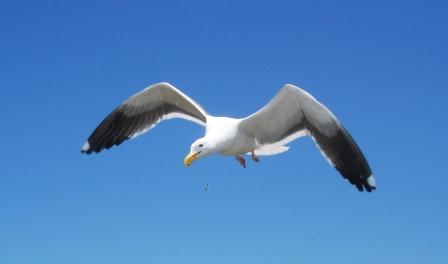
When you step on the island at this time of year - it becomes quickly apparent that it's a "gull's world". The island supports the world's largest breeding colony of Western Gulls, almost 20,000 strong. These are the birds from the Hitchcock movie"The Birds"! Or at least their descendants - the film was shot in Bodega where some Farallon gulls spend their winter. Right now gulls are reconnecting with mates and fighting for breeding territories. As you can see in this recent video - life isn't easy for a gull on the Farallones. Every year I return to the island I am more amazed by the resilience and pure toughness of the gulls. From our banding studies we know that Western Gulls can live more than 30 years! So I sing the gulls' praises - but wait a few months when they are dive bombing us nonstop - maybe I'll change my tune...

Saturday, March 11, 2006

Risso's Dolphins

We finally had a nice calm day here, so I went up to the light for some whale-watching. In 2.5 hours, I saw 1 gray whale and a huge herd of ~200 Risso's Dolphins. It was amazing to watch as the Grampus surfed down the faces of the huge ocean swells that are running today. Tomorrow, if the seas calm down, the seabird biologists will take over the island. Winter season is over, and I'm going back to the mainland, but the work here goes on with a new focus on the seabirds that breed here. Elephant seal season is over, but we had a great year. The population grew again this year, with big jumps in numbers for Pastel Cave Highlands and Marine terrace harems. Reproductive success (number of weaners per cow) was about average, and altogether we had 132 weaners. Another year of elephant seal data added to the long-term ecological dataset for the Farallones that adds to our understanding of this amazing, constantly changing, incredibly productive portion of the world ocean.

Tuesday, February 14, 2006

Molly

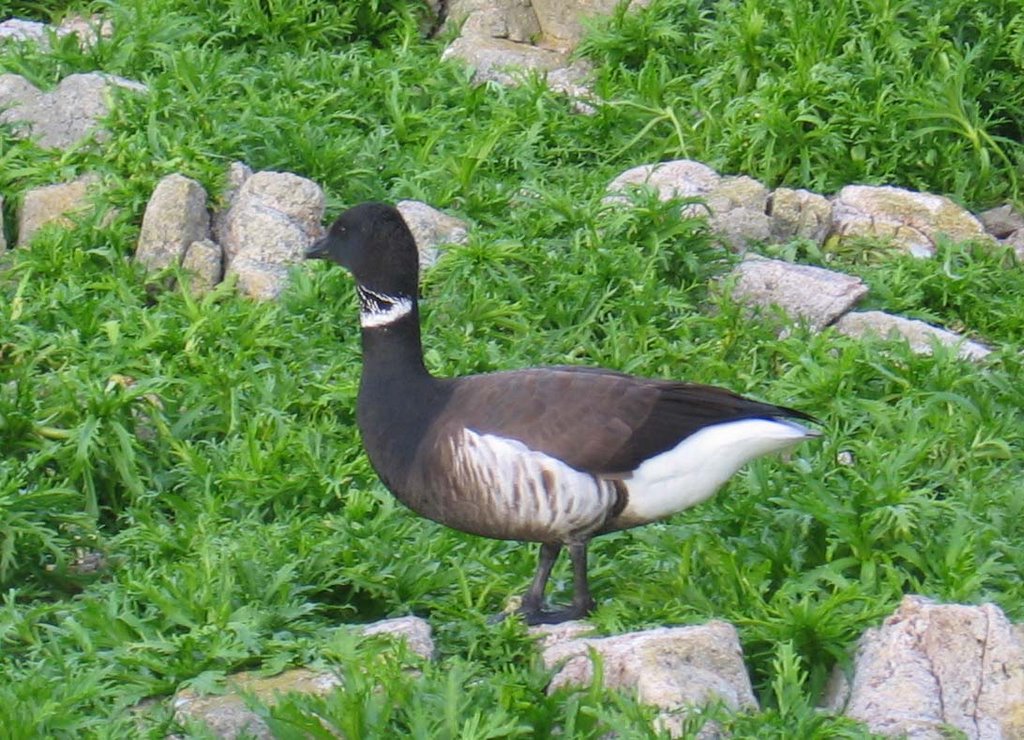
Saturday, November 27th 1993. The Farallon journal (our island diary) lists "Black Brant: 1". One Black Brant seen on the island that day. Unbeknownst to the biologists, with this simple entry they recorded the starting of a Farallon era, the era of Molly.

Who is Molly ?

At first glance Molly appears to be a common specimen of the species Branta bernicla nigricans (Brant goose or Black Brant). A species that is described as “small and dark with bright white around tail, about 25 inches in length, weighing about 3 pounds. An almost exclusively coastal goose, found in flocks on shallow bays and marshes, feeding on eelgrass.”

But Molly is more than your average Brant. As time went on, it became apparent that this Brant was not just some flyby migrant, she was here to stay! Not only does she not seem to care about the company of her own kind (during migrations many Brant stop on the island for a day or so), she apparently prefers the company of Western Gulls. Gulls are not very fond of other birds tresspassing on their territories and any other bird is chased away. But Molly (or “La Molly” as some Farallon biologists call her) taught them that she is no pushover, coming at them with her head low and her neck stretched out, hissing. The gulls never stood a chance.

So now, the gulls accept Molly as one of them, nothing to be surprised about and just the way it has always has been. She is sometimes seen foraging on algae in the intertidal, but mostly she stays among the gulls, nibbling at Farallon weed or spurry. Everyday between fall and early summer Molly can be seen at her preferred hangouts, by the old foghorn system or on the Marine Terrace next to Sandflat. We will know she has gone completely gull when she starts scavenging on the dead elephant seal pups.


Several years back Molly seems to have had an accident of some kind while she was away, because she came back sporting a little limp that has persisted to this day. Then, 2 years ago Molly was believed dead because she was not seen for several months. There was even a “Molly Memorial” picture posted in the living room. Then, like nothing had happened, she was seen again waddling along with the other gulls – and our 10 year anniversary party was saved!

So now, for over 12 years, Molly has made every day out here more special, seeing her makes our day. Like overprotective parents not seeing the Farallon mascot in 24 hours makes us nervous. Her long coexistence with the gulls is a model to us all on sharing this special, fragile habitat with the seabirds, seals, and sea lions that call the Farallones home.

Friday, February 10, 2006

Hot Winter Days- Seals hit the beaches

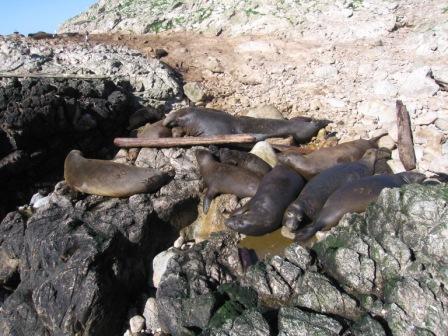
While we biologists have been enjoying the beautiful, sunny, warm (mid 60's) weather this week, the seals have not. Elephant seals are built for swimming in 40-degree water, not sun bathing on the beach. The calm, sunny, warm conditions don't just make the seals uncomfortable, it can kill them from overheating.
In the afternoon heat, the seals move to any source of water or shade. They splash water or sand or rocks over their backs to cool themselves. Some of the weaners on the Marine Terrace have been tossing Farallon weed, the most abundant vegetation on the island, onto their backs.

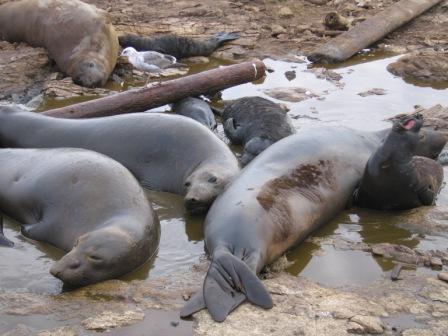
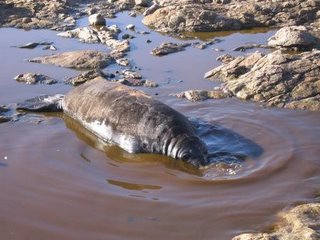
A few cows have found small puddles or tide pools of their own, but most try to cram into a few overcrowded spots with all the others. This results in chaos as the seals crowd into the puddle on Sand Flat (above, on a slightly cooler day, not quite as crowded as it has been this week) and down by the water's edge at Log Channel Beach (below). On these hot days, all the cows are grouchy and many fights erupt.
Unfortunately this chaos is bad news for the pups. Several pups have managed to get themselves stuck in Log Channel, requiring a long struggle to crawl back up. Others have fallen off ledges into the water below- a pretty terrifying first swimming lesson! A few have even been crushed or drowned as bigger seals pile on top of them while trying to get to the cooling water.

The hot weather has also resulted in a lot of new weaners this week. Many of the cows on Marine Terrace had been pups that were quite fat and able to be on their own. The first hot day of the week, these moms headed out to enjoy the cool waters at sea and to find their first meal in over a month. Now the Terrace is home to clusters of weaners who have stopped searching for mom and begun getting to know each other.

Tuesday, January 31, 2006

Resurgence of the third major breeding site on SEFI

In recent years, the two major breeding sites on SEFI have been Mirounga Beach and Sandflat. Mirounga Beach is a small cobblestone beach with space for about 30 cows, and is also the seal's main point of access to the island. Sandflat is uphill from Mirounga Beach, situated on a rocky plateau about 3 meters above sea level. When the Farallon elephant seal colony reached its peak in numbers of breeding animals during the early 1980s, it was not uncommon to have cows also breed on the Marine Terrace above Mirounga Beach and Sandflat, an area covered in soil and plants. However, when the Farallon colony diminished in later years, cows only bred at Mirounga Beach and Sandflat (apart from some stray animals that tried raising their pups on tide-washed pocket beaches in gulches).


Now, for the last two breeding seasons cows have resumed breeding on the Marine Terrace in numbers (picture above), choosing this roomy, plant covered area that requires a longer trip overland from the sea. This year the Marine Terrace breeding site has almost doubled the number of breeding animals over last year as ever more cows are attracted to this site.

Click on the picture below to watch a full length video of an e-seal birth on the Marine Terrace.

And this change has well paid off for those animals. The pup mortality rate is 0 % so far (compared to 56% at Mirounga Beach, and 23% at Sandflat), and the Marine Terrace has produced some of the fattest and healthiest pups on SEFI. Every cow has enough space to raise her pup in peace, so the often-observed inter-female territorial fights of Sandflat rarely occur. No pup was bitten by another cow because it trespassed on its neighbor (a bite to the head is the most frequent cause of pup mortality), and the Marine Terrace alpha male, Don, has kept disturbances by subadult males to a minimum so the mothers have ample time to concentrate on feeding their pups.


So, every pup on the Marine Terrace has gained an enormous amount of weight in a surprisingly short amount of time. Here is a picture of our biggest pup on the terrace, 28 days old today, which means he is about to get weaned, and he's now bigger around than his mother.

It seems like such a good situation, zero mortality, fat pups, you may wonder why haven't cows moved up to the Terrace earlier? It may be that there was a shortage of bulls. Cows depend on the beachmaster to keep inferior quality males from harassing and mating with them, so if no large, quality bulls are available to rule the Terrace, cows will likely stay under the aegis of an established beachmaster. As populations wax and wane, the demography and age-structure of the populations change, and this can affect the population as a kind of feedback. PRBO Conservation Science is a leader in wildlife population biology, making use of our long-term data to understand the factors that cause an animal population to increase or decrease. This is crucial information for managers and policy-makers, because conservation dollars are scarce, so our efforts must be directed towards the most influential segment of the population at risk.

Monday, January 23, 2006

Meet the Weaners

Weaner is the term we use for a weaned pup. When a pup is born it is small and wrinkly, weighing about 80 pounds. Like human infants, elephant seal pups spend most of their time eating, sleeping, and crying. Pups nurse for about 28 days before being weaned. During this time the mothers eat nothing; they metabolize blubber to survive and to produce rich milk for their pups. As a pup grows fatter and fatter, its mother becomes ever skinnier. Finally the cow mates with the alpha bull and returns to the sea to find food, leaving her pup behind to fend for itself. A chubby, healthy weaner weighs about 200 to 250 pounds at this point. Currently we have five weaners on our beach.

First, there is Weaner 01 (she won't receive a real name until she returns as a cow ready to have her own pups). Weaner 01 was born on December 8th, 7 days earlier than any pup previously born on the Farallones, and 8 days earlier than the second pup born this season. As she was the first weaner, she suddenly found herself all alone after her mother left. She handled her abandonment quite well. She quickly found a nice spot on the outskirts of the colony, far enough away that she wasn't getting harassed by other mothers, but near enough that she could still watch what was going on in the colony.
Recently, all the weaners have begun to move around and explore the areas around the beach.

Weaner 01 is beginning to molt her black lanugo fur in exchange for a nice new silver one. Notice the bald patches on her head and sides where the old fur has been lost. With her old coat, she will also lose the number, which was stamped on her fur with Clairol blonde hair bleach when she was a pup so that she could be identified as the pup of Cow 01, named Giovanna. Clairol generously donates this product each year so we can harmlessly mark the seals to keep track of them all . The numbers are molted off with the fur.

Weaner 17 is the biggest and chubbiest of our weaners. His mother did a great job of fattening him up- and she did it in only 21 days! That's a full week less than average. Recently, he has been hanging around the tripod we use to weigh pups, as if challenging us to to get him on the scale. We've already determined that this year's pups are 10% heavier than last year's indicating that the cows fed very well while gestating these pups. Last year's pups were smaller because feeding conditions for cows were not so good. Cow elephant seals feed in very deep waters beyond the continental shelf, primarily on squid. The cows may be in such good condition due in part to the unusual numbers of deepwater Humboldt squid in the area last year. Here is another example of how our marine wildlife studies tell us about parts of the ocean otherwise inaccessible to us.


Weaner 20 has recently discovered a puddle along the edge of Sand Flat and seems to enjoy playing in it- at least until somone bigger comes along. Weaners often get pushed around by bigger seals, which is just about everybody else on the beach. When Weaner 20 gets chased out of the puddle, you can hear him letting the whole beach know how unhappy he is. Pup tantrums are not uncommon as the weaners learn to cope with the hardships of life without Mom. The weaners must learn to swim and eat before their blubber reserves are depleted, so a fat pup produced by a fat cow might have a better chance of surviving these early months. Your donations to the Farallones Science Program of PRBO will help us better understand these amazing animals, and the oceans we all depend on for survival. The ocean dominates this planet, and is the primary engine of global climate, so knowledge of the ocean is crucial in these days of accellerating global climate change.


Weaner 21 is the smallest of our weaners. Here you can see him with Weaner 17 behind him. Click on the photo to watch them playing. Weaner 21 was abandoned by his mother, Schnitzel when he was two days old. He was lucky though and quickly adopted himself a new mom, First Cow, and brother, Pup/Weaner 20. Cows whose pups have died or been stolen may adopt a new pup later on, but most cows do not adopt a new pup when they already have one to raise. First Cow, however, allowed Pup 21 to hang out with her pup and after a few days even began to nurse him. She has done a great job of raising both pups, further evidence of the great condition these cows are in this year!

Weaner 28, the daughter of Drip and granddaughter of Faucet -if she comes back as a cow, we are considering naming her Splash- is the youngest of our weaners. She is also the second largest- almost as fat as Weaner 17. She spent her first few days of weanerhood all by herself, far from the other weaners. It looked almost like it was too much trouble for her to drag her big body around on her small flippers, but recently she too has begun to explore and meet the other weaners.

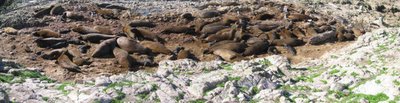
These early weaners were lucky. They were born before the beach became crowded and had plenty of space and time to sleep and nurse in peace. Now Sand Flat, our main pupping beach, is much more crowded and chaotic. The photo below shows Sand Flat on January 22nd. The pups there now are frequently interrupted by their mothers squabbling with other cows and are often squished between other seals in the cramped conditions. These interruptions mean less time suckling each day, and slower development, but mom has to defend her pup or it could be killed by another seal. We have many pups now on Sand Flat and five other colonies around the island so there are many more weaners to come!


Thursday, January 19, 2006

The Farallon Factor strikes again!

Sea and weather conditions out here are always unpredictable and can change rapidly. Supply boats often have to be rescheduled because of storms, high seas or simply the wrong wind direction to do a safe landing. This unpredictable Farallon Factor always has to be taken into account when planning anything in a place that is still ruled by nature's forces. So, when this morning's boat was cancelled because the conditions for a North landing were too rough and the SAFE boat outboard motor was still non-functional, this was nothing out of the ordinary. The Farallon Factor had stranded the film crew and Refuge manager Joelle Buffa on the island for a day longer than planned. As you can see from the pictures below, the Ocean Futures Society crew was not idle, but used the extra day to get more gorgeous footage of the island's wildlife. Even the interns had their 10 seconds of fame. Keep your eyes open for the Farallon segment in the show "America's Underwater Treasures" on KQED sometime in October.
Fabien Cousteau and the camera team, down at the elephant seal beach.

Some extra footage in the kitchen of PRBO house, setting for Farallon Iron Chef .

We hope that Fabien, Chuck and Rick enjoyed their prolonged stay on The Farallones!

Tuesday, January 17, 2006

Cousteau arrives..... via North Landing


Today was an extraordinary day, first, because Fabien Cousteau of the Ocean Futures Society and his film crew came on the island to film part of a special on National Marine Sancuaries, and second because they did not arrive as is usual via East Landing.
As we told you in an earlier entry, Farallon equipment only functions properly in the marine environment for so long before the Farallon Factor renders it unusable. So it came as no great surprise when our previously trustworthy Honda 50 outboard motor on the SAFE boat quit working yesterday. We were unable to fix it on such short notice, so without a functioning SAFE boat we could not use the East Landing.


Because of the importance of always having functioning landing facilities, the island has not just East Landing, but a second landing on the North side of SEFI.
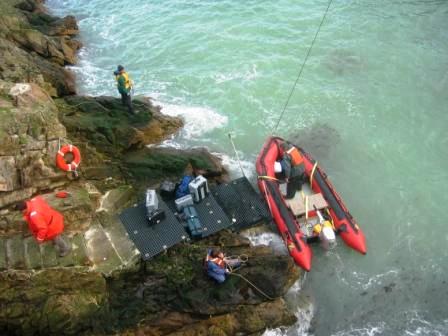
When Superfish tied up on the North Landing buoy this morning with captain Mick Menigoz at the helm, we were poised and waiting with the zodiac to take Cousteau and his crew aboard. Mick is a valuable member of the Farallon Patrol, the volunteer group of skippers who donate their time and vessels to keep the Farallon Science Program fed and resupplied year-around. We always need more help in resupplying the island, so if you are interested in joining the Farallon Patrol, please contact us.

Here are Sandy and Michelle securing the boat while the equipment is unloaded. Landings are always difficult procedures on the Farallones, and due to the rough seas that predominate many landings are cancelled or postponed. Today's landing went well, but the weather is deteriorating for North Landing, and it looks like the film crew might be staying a few days longer than expected.
After the landing was successfully completed all we had to do is hook on the zodiac to the new jib crane and pull it up to the landing platform 15 feet above (this time using human instead of diesel power). The boat then gets stowed away in the boathouse until the next time when weather or the Farallon Factor make North Landing the more suitable landing site.
In the meantime, Cousteau and his film crew are filming our precious and fragile biological resources. Public access to the Farallones is severely restricted, so the Ocean Futures Society film crew are bringing the island to the public through their HDTV programs. Los Farallones blog is also bringing the island to the public, so you all can see and appreciate the magnificence of the Farallon National Wildlife Refuge, and understand the hard work and perseverance necessary from PRBO Conservation Science biologists when we study the island's seabirds and seals in order to understand the ocean's workings. If you like what you see, please support PRBO Conservation Science's Farallon Program.

Sunday, January 15, 2006

The Murres Are Back

The Murres (Uria aalge) have returned to the Farallones. This penguin-like seabird is the most numerous of the twelve species that breed here on the largest seabird colony in the contiguous US. This species was decimated by an egg company that stole the eggs each year during the gold-rush era for sale to California's growing human population. With the end of egg collection, and the protection of the Farallones as a National Wildlife Refuge by president Teddy Roosevelt, the species has recovered somewhat, but is still below pre-egging numbers. Every summer, these beautiful birds raise a single chick on crowded colonies like this one on Shubrick Point. When the chicks are old enough to swim, their fathers take them to sea to teach them how to fish for themselves. The mothers disperse to fatten up in preparation for the next year's breeding effort.
After a few months apart, the adults reconvene on the Farallones on certain days when the winds and weather are just right. Murres form lifelong monogamous breeding pairs and breed each year at the same nest site, so these winter reunions are when they come together after months apart at sea and reacquaint themselves with each other and their nest sites. They also raft up into huge feeding flocks all around the island where they feed by flying underwater after their prey of juvenile rockfish, sardines, and anchovies.

The extremely productive waters of the Gulf of the Farallones provides a bounty that supports a richness, diversity and abundance of marine animals on the Farallon Islands that is unrivalled in the contiguous United States. It is hard to comprehend the riot of life that exists just outside the Golden Gate, in the midst of one of the busiest shipping areas in the country. The wildlife of California's Galapagos is under constant threat from human industry, and Murres are especially hard hit by the oil spills that too often punctuate our datasets. Help protect California's Galapagos, support PRBO Conservation Science today.

Wednesday, January 11, 2006

Elephant Seal Males Battle for Dominance

Today there was a long, exciting battle between Lloyd and Rusty. Elephant seal breeding colonies are organized into harems of cows, each defended by an alpha male. The males battle for dominance, and the right to claim a harem is hard won, with victory generally going to the larger or fiercer opponent. Lloyd and Rusty are subadult males, not quite ready for the heavyweight title and a harem of their own, but these battles establish ranks and train the seals for the big event when they actually fight for the prize. Here is a video from last year of the bull JD chasing Altamont off the Sandflat and away from his harem of cows. This year, JD was deposed from the Sandflat harem by Nero, and Altamont has a harem on Shell Beach.

Sandflat is currently the largest harem on the Farallones, with around 65 cows at the peak of breeding in mid-January. After the islands were re-colonized in 1971, the largest harems became established on West End at Shell Beach. However, the Shell Beach colony began a steep decline after the intense El Nino event of 1982-83 scoured the access beaches away and left an 8-foot vertical wall in the path of cows trying to breed there. This severe El Nino, along with the 1991-92 and 1997-98 were the three most intense El Nino events in the past 150 years. Over the past 40 years, PRBO scientists have documented numerous impacts on breeding, survival, and diet of marine predators from these and other ocean-climate events thanks in large part to the detailed data we collect at the Farallones. Conservation requires science, and PRBO provides some of the best science in the world.

Tuesday, January 03, 2006

After the storm there was the flood


The big storm that caused so much destruction on the mainland did not leave the Farallones untouched. Because of the heavy rain, the meager soil layer on the island was finally so saturated with water that a lake suddenly formed around the PRBO house. The elevated cartpath had blocked all the runoff, and this was the sight that greeted us when we opened our front door in the morning to go out to the beach.


It wasn't just our house that was threatened with the fate of Atlantis; water all over the island was looking for the shortest route to the sea. Another obstacle in its path, the Pipe Shop near East Landing. The back wall of the shop has sprouted a fountain and the water now runs freely in the Pipe Shop through the back wall and out the front door in a steady stream.

Meanwhile back at the house the water was still rising, the flood alarms for our wastewater system were set off and were screaming over the island. The water also found it's way in the crawlspace under the house. The situation started to get desperate, something had to be done!


So Derek blew up the levee to save the town! Raised in the delta, he was familiar with this crude but effective tactic, the Lodi solution worked like a charm.

With the old drain pipe re-excavated the way for future floodwaters is now free again. The 120-year-old Lightkeepers House survived once more by the ingenuity of the island personel.

PRBO's partnership with the US Fish and Wildlife Service is to monitor the biological resources, and to maintain a presence on the island to care for all its structures and systems. Most of the year, PRBO biologists are the only people on the island and are responsible for keeping the electricity, drinking water, and wastewater all flowing properly. Every structure is over 50 years old, some much older, and all require constant maintenance. Machinery does not enjoy the marine environment, and as such, equipment is constantly breaking down. We are completely off the grid, self-sufficient for our power, water, sewage, and communications. There are no plumbers or electricians to make a house call, we have to fix everything ourselves. Or if we can't fix it, patch it up until the next boat can bring a replacement part, or Jesse, the Refuge's Mr. Fix-it, sometimes three or more weeks down the road. Life on the Farallones is every day a magnificient wild nature spectacle, but the Farallon Factor looms large over our island systems, and it's never too long before we're up to our elbows in grease or up to our ankles in wastewater.

Monday, January 02, 2006

New Year's Storm Pummels The Farallones

Huge swells pounded the island and rain dumped out of the sky, flooding the pipe shop and forming a lake around the house. The new year roared in with a major tempest that blasted the landing with monster waves, and whipped the island with winds so fierce they threatened to blow away everything not bolted down. These extreme conditions are seen nearly every winter on the Farallones, making our field work difficult but also providing us with our water supply. We harvest rainwater each winter to supply all our water needs throughout the year. California's climate is a wet winter and dry summer, so whatever rainwater we can collect from December to March has to last eight months until it rains again. Our rainwater collection system was built for the lighthouse keepers and navy station that used to be out here, and is around 100 years old, but still functions great. When the giant swells slam into the island and I feel the rock tremble under my feet, I can believe the stories those old-timers told that the island is hollow, filled with an enormous 'Lost World' cavern.

Wednesday, December 21, 2005

First Cow adopts Schnitzel's abandoned pup

First Cow (-20) is an old and experienced mother. Schnitzel is not. Schnitzel abandoned her pup one day after it was born, the same as she did last year, but last year she had a large wound that gave her some rationale in our eyes for the abandonment. Last year, her pup perished, as it is impossible for a pup to exist without a mother to defend and feed it. This year, First Cow adopted the abandoned pup and began nursing it as well as her own. One of the interesting features of elephant seal society is the pup adoption phenomenon. Pups are often separated from their mothers, abandoned, or crushed in the confusion of the crowded colony, but cows that have lost their pups are very eager to adopt newly motherless pups. We have found that younger cows are more likely to lose their pup, due to their inexperience and low social rank. However, cows that have lost their pups are very eager to adopt a new pup, sometimes even trying to steal pups from their rightful mom. It is a rare event that a cow with her own pup will accept another and suckle it as her own, but that is what First Cow is doing. Normally, the energetic demands of raising one pup is enough to tax a cow's fat stores. It appears that this is a very good year in terms of cow energy supplies. The pups that have been born this year are 10% heavier than pups born last year, indicating that the cows had plenty of rich food to eat while they were at sea putting on blubber and gestating these pups. Apparently, First Cow felt fat enough this year to raise two pups instead of the ususal one, indicating that the past year was great in terms of e-seal food supplies.

PRBO has had the priveledge of working on the Farallones since 1965. We have observed the many species of seabird and marine mammal that breed here for 40 years. These datasets are some of the longest runs of biological data in the world, and they allow us to see how the ocean has changed over that time period through changes in the animals. The scientific research we conduct informs the managers at the US Fish and Wildlife Service, National Oceanic and Atmospheric Administration, and other agencies around the country, and the world so the rich biological treasures of the Farallones and elsewhere can be preserved for future generations. We increase our understanding of how the ecosystems of this planet function through science, and long-term data such as we collect at the Farallones offer rare insight into how ecosystems change through time.

Sunday, December 18, 2005

JD, Beachmaster of Sandflat, Deposed by Nero


JD, previously undefeated beachmaster of Sandflat harem for the last two years and sire of perhaps 180 pups, was soundly defeated and deposed today by a young bull named Nero from the Point Reyes colony. Nero held a small harem of eight cows last year on the Marine Terrace, but has definitely moved up in the world with the outcome of today's bout. Cow elephant seals can only mother a single pup each year during a breeding lifespan of 10-15 years, but in two years JD probably fathered ten times more progeny than any cow possibly could. But that fecundity has a price, a short brutal life of ceaseless battling for dominance. This sort of breeding system is what produces such secondary sexual characteristic oddities as the Elephant Seal nose, Elk antlers, and male Fur Seals that are 5 times larger than females, the biggest difference between the sexes of any mammal.

Thursday, December 08, 2005

Earliest elephant seal pup ever recorded on Farallones


Today saw the birth of the first elephant seal pup of the year. Born to the female named Giovanna, her pup is the earliest recorded birth in the 35 years of this colony's existence. Here is a video of the newborn crying to her mother, while JD, the alpha bull and probable father looks on. Giovanna will now nurse her pup for about 28 days on the richest milk of any mammal, swelling the pup from 60 pounds at birth, to over 300 pounds at weaning. During that time the mother will shrink, as she mobilizes her blubber to give to her pup.

Back at the end of the 1800s, Elephant seals were hunted for their blubber to the point where they were believed extinct. Only 50-100 animals remained on the planet, hidden on Isle de Guadalupe in Mexico. The Mexican Government protected the seal from further hunting, and their numbers grew until in 1971, the first pup was born at the newly-recolonized Farallon Islands. The Farallones and Point Reyes are now the northernmost breeding colonies for this species, although the adults range much farther north, even to Alaska, to feed themselves between visits to the Farallones. Similar to Gray Whales, the elephant seal migrates to Alaskan waters to gorge themselves on the rich feeding grounds there, then comes south to give birth in Mexico and California (Gray Whales used to calve in San Diego's Mission Bay). However, the whales migrate up and down once a year, while the elephant seal makes this migration twice a year! This makes them the mammal with the longest migratory distance travelled each year, over 13,000 miles for some males!
Conserving these amazing long-distance migrants requires the cooperation of 3 national governments, 8 state/provincial governments, and the many agencies and NGOs that look after our ocean and coastal resources along that route. PRBO Conservation Science, the US Fish and Wildlife Service, and Gulf of the Farallones National Marine Sanctuary are the local partners who have an interest in the Farallones and their magnificent elephant seals.

Wednesday, December 07, 2005

Elephant Seal Biology 101

Elephant seals are the biggest seals on the planet. The northern hemisphere species breeds from Mexico to northern California, but their feeding range reaches far offshore and north to Alaska. Males are significantly larger than females and also have a large, dangling proboscis (nose) that gives them their name. Adult males can weigh up to 2 tons at a lenth of 12-15 feet, and females can range between 800 to 1500 pounds at a length of about 9 feet. Elephant seals spend most of their lives in the water and are the deepest diving seals.
Here's a picture where you can see the size differences between a cow and her pup and a bull.
During the breeding season these animals haul out on land and fast the entire time. So all the energy they need to sustain themselves and give milk to their pups, plus all neccessary water for a month is provided entirely by their body fat. Cows give birth to a single pup a few days after hauling out on a rookery and nurse it an average of 28 days. In that time they manage to increase the weight of the pup from 80 pounds at birth to 200 pounds at weaning.

Mother and newborn pup

Then the cows return to sea, leaving their now weaned pups behind. Male elephant seals will stay on land not just a month, but the entire breeding season of about 100 days, fasting all this time. It is no wonder that this physiological stress, combined with their ferocious fighting for mating privileges, restricts a male life span to only 10 - 12 years. Females on the other hand, can live to over 20 years of age, generally producing a single pup each year, starting to breed between age 3-6. Elephant seals are physiological marvels, fasting twice a year during the breeding and molting haulouts, migrating vast distances twice each year between these haul outs, and diving to depths where steel is crushed.


A healthy weanling

The weanlings left behind molt their long black lanugo fur to a short silver coat soon after their mothers depart. They remain for a month or so, learning to swim in tidepools and shallow coves at night. When their hunger finally triggers their departure, they swim along the bottom. These behaviors are thought to be adaptations to shark predation pressure. White sharks are daytime ambush predators that strike prey near the surface suddenly from below. The weanlings will return to the Farallones in the fall to molt again, and that is when you will learn about the sharks and their seal prey in realtime.

Posted by: Danny

What's it like...

...out there on the Farallones? Well, not many of the former buildings remain. Except for two former lighthouse-keeper's residences, a powerhouse and a carpenter shop, the rest were knocked down to allow the tens of thousands of sea birds more space for breeding.

This is a map of the Southeast Farallon Island and West End, the adjacent island that is separated from SEFI by a 15-foot gap called the Jordan Channel. All the island's 'hot spots' for elephant seals are highlighted in pink. The main colony is found on Sandflat, Mirounga Beach and the Marine Terrace above Sandflat, a convenient 2 minute walk from our residence. As you can see there are also elephant seals on West End. Because of the fragile nature of West End ecology (many Common Murres and the endangered Steller sea lions can be found there) we keep the visits to this place to a minimum, only going there once every 10 days.


These two houses are the living quarters for PRBO and Fish & Wildlife personel. Although they were built in the 1870's they have since been remodeled and now offer all the comforts of the modern world such as hot showers, indoor plumbing (including our very own sewage system) and internet access.

And then of course on top of Lighthouse Hill (elevation 330 feet) is the Farallon lighthouse, the first lighthouse to be errected in California because the Farallones proved to be such a hazard to shipping traffic.


Here's a view from the lighthouse towards West End showing the residences at the bottom of Lighthouse Hill.

When this picture was taken in early December the rainy season had just started and the vegetation was just starting to recover from the drought of summer and fall. When we post more pictures of the island during the season you will notice the Farallon flora exploding with life.


This is one of my favourite spots on the island, Fisherman's Bay with it's impressive rock arch (incidently called 'Arch Rock') and the so called 'Sugar Loaf' on the right. You can also see one of the more recent island improvements, the newly errected North Landing crane, our back-up plan should the conditions at East Landing not allow a landing there.
Posted by: Danny